
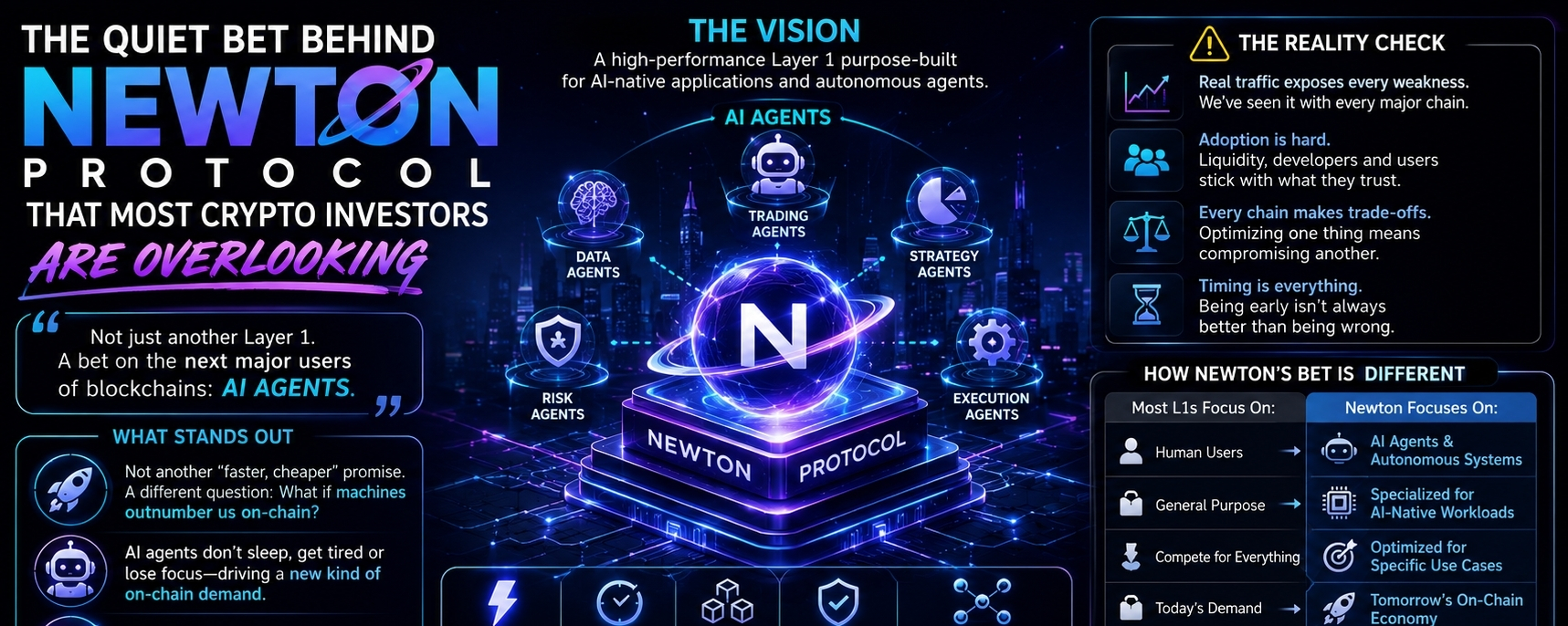
@NewtonProtocol The first time I read about Newton Protocol, I didn't get that usual rush people seem to get every time a new chain appears. If anything, I just paused for a minute and thought, "Alright... let's see what you're actually trying to do." Maybe that's what years in crypto does to you. You stop reacting to announcements and start paying attention to what sits underneath them.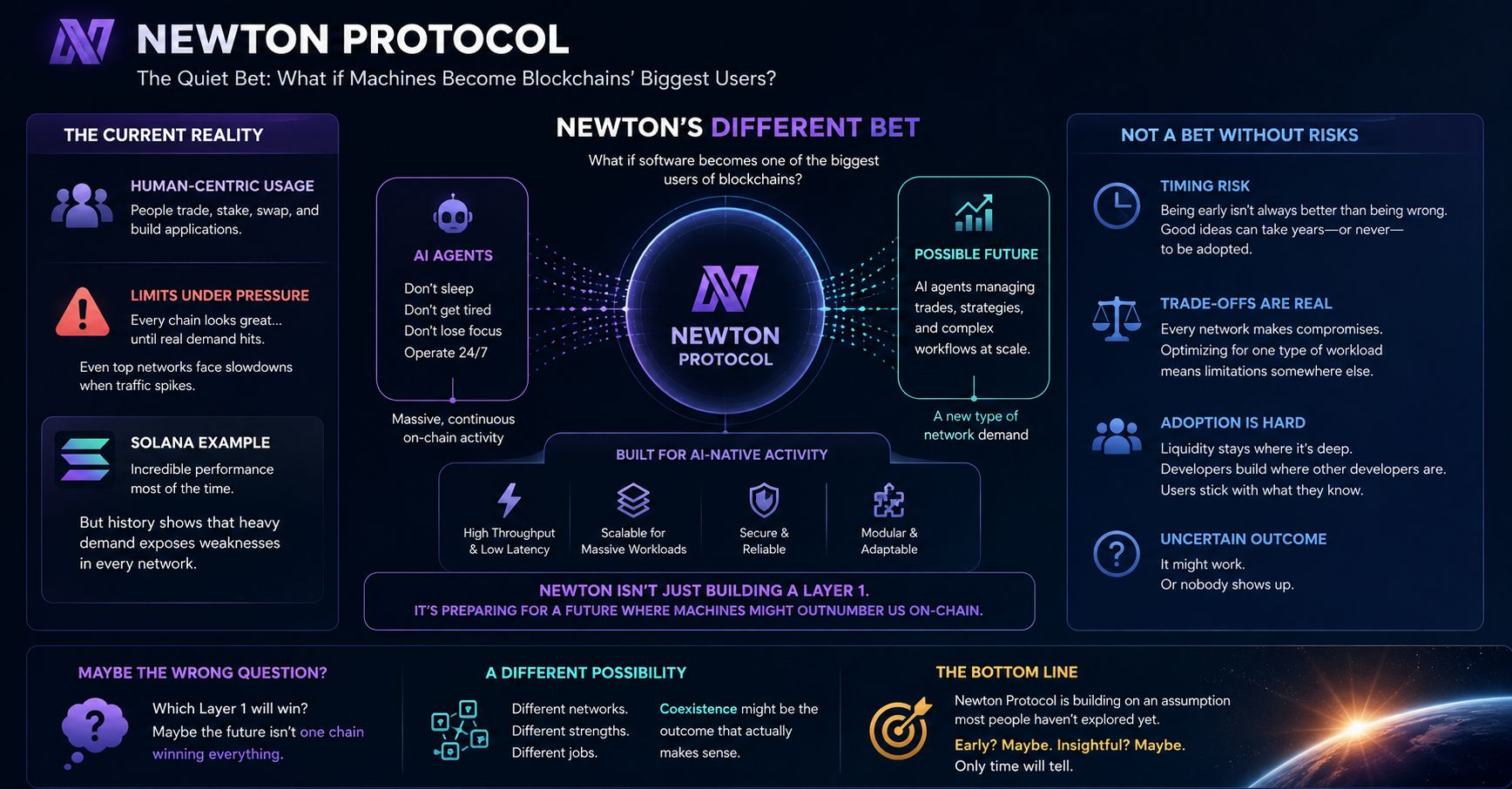
The AI part almost made me scroll past it. Not because AI isn't important, but because lately it feels like every project has discovered those two letters. Sometimes they're there because they genuinely belong. Other times they feel like they're filling empty space. So I tried to ignore the buzzwords and look at the idea itself instead.
What stood out wasn't that Newton wants to build another Layer 1. We've seen that story more times than I can count. Every cycle introduces another chain that's supposed to fix what everyone else couldn't. Faster. @NewtonProtocol Cheaper. More scalable. More secure. Eventually they all start blending together. The names change, the presentations get prettier, but the promises stay strangely familiar.
The funny thing is, blockchains usually don't fail because someone wrote bad code or made terrible design choices. Most of them look perfectly fine until people actually start using them. That's when things get interesting. Real traffic doesn't care about roadmaps. It doesn't care how elegant the architecture looked in a whitepaper. It just shows up all at once and starts exposing every little compromise that seemed harmless during testing.
Solana is probably the easiest example. Most days it feels incredibly smooth to use, and credit where it's due, that experience matters. But we've also seen moments where heavy demand pushed it into uncomfortable territory. I don't say that to criticize Solana. Honestly, every serious blockchain eventually runs into the same reality. It's easy to look fast when nobody is asking much from you. It's much harder when everyone wants the network at the exact same time.
That made me think about what Newton is actually betting on. It isn't just more users. It's the idea that software might become one of the biggest users of blockchains. AI agents don't get tired. They don't sleep. They don't lose focus after staring at charts for six hours. If they're ever trusted to manage trades or strategies at scale, they'll create a kind of network activity that looks very different from what we have today.
Maybe that's the part Newton quietly understands. Most conversations are still centered around people using crypto. Newton seems to be asking what happens if machines eventually outnumber us on-chain. Whether that future arrives in three years or ten is anyone's guess, but it's at least a different question from the ones most Layer 1 projects have been asking.
Of course, that doesn't mean the idea automatically works. Crypto has a habit of getting the direction right while getting the timing completely wrong. Being early isn't always much better than being wrong. Plenty of good ideas have spent years waiting for the world to catch up, and some never did.
I also noticed that Newton doesn't seem obsessed with becoming everything for everyone. I actually respect that. Every network makes trade-offs, whether it admits them or not. Trying to optimize for one type of workload usually means accepting limitations somewhere else. That's just reality. Pretending there are no compromises has always felt more like marketing than engineering.
Then there's adoption, which is honestly where most conversations become a little unrealistic. Technology alone doesn't convince people to move. Liquidity likes familiar places. Developers build where other developers already are. Users don't wake up one morning and decide to abandon the apps they're comfortable with just because a new chain looks technically better. That's probably the hardest part of this entire industry, and no amount of branding changes it.
Sometimes I wonder if we've spent too long arguing about which Layer 1 will win. Maybe that's the wrong question now. Maybe different networks end up doing different jobs because that's simply what makes sense. Or maybe that's another theory we'll eventually laugh at a few years from now. Crypto has a way of making confident opinions age badly.
So when I look at Newton Protocol, I don't see the next chain that's guaranteed to change everything. I've heard that story enough times already. I just see a team building around an assumption that most people haven't really explored yet. Maybe they're early. Maybe they're seeing something others are overlooking. Right now, I honestly can't tell.
It might work. Or nobody shows up.
