
Beyond Automation: Why I Think Newton Protocol Is Really Building an Authorization Layer for Onchain Finance
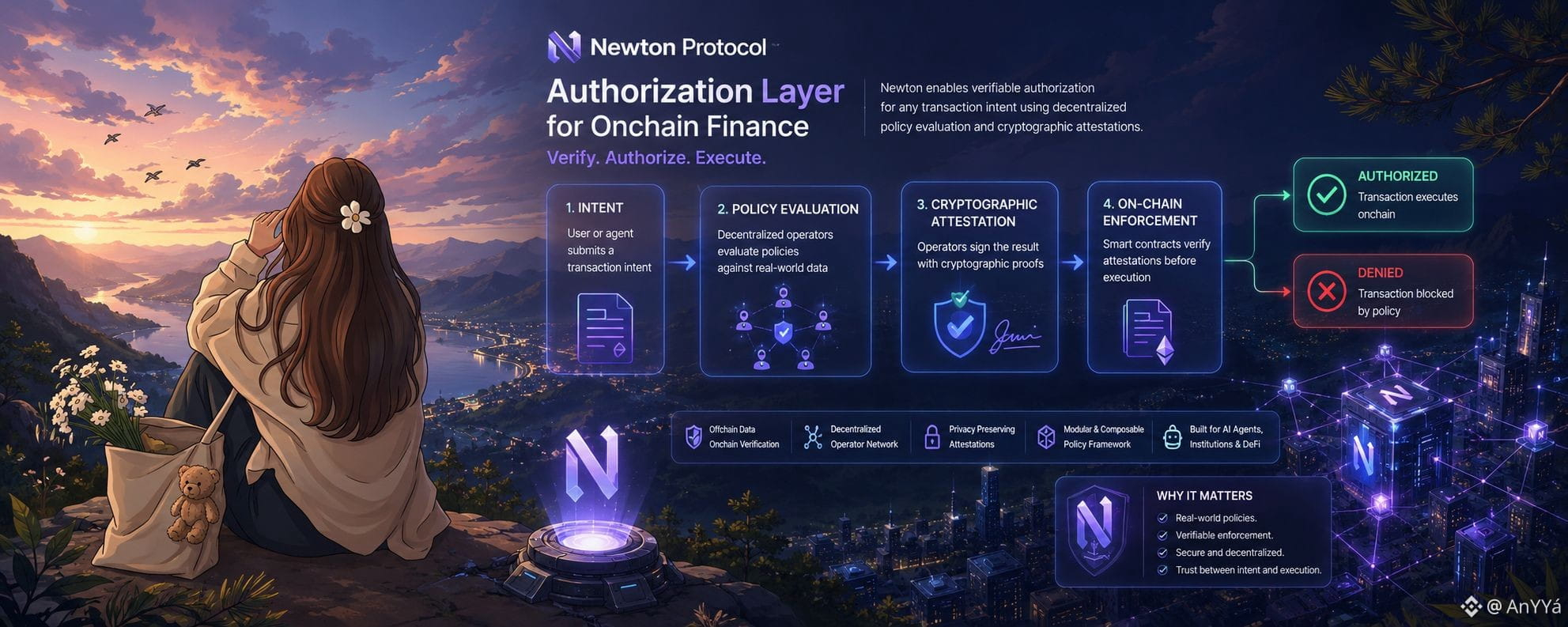
After spending several hours reading Newton Protocol's documentation, developer resources, and technical architecture, I ended up questioning something I had initially assumed. Most conversations frame Newton as an AI automation protocol, but I think that description misses what could become its most valuable contribution. What stood out to me wasn't simply the ability to automate transactions. It was the attempt to create an infrastructure layer that verifies whether an action should be allowed before it is executed onchain.
That distinction may sound minor, but I believe it addresses a problem that blockchains have struggled with for years.
Smart contracts are excellent at deterministic execution. Once predefined conditions are satisfied, they perform exactly as written. The challenge appears when a transaction depends on information that doesn't naturally exist onchain. An institution may want spending limits for automated treasury management. A DAO may require different approval policies depending on transaction size. An AI agent may need permission to execute only within specific boundaries. Compliance rules, identity credentials, and organizational policies all exist outside the blockchain, yet they increasingly influence how digital assets should move.
Traditionally, developers solved this problem by relying on centralized servers or backend services to perform these checks before sending transactions. The blockchain itself never verified how those decisions were made. It simply trusted that someone had already done the necessary validation.
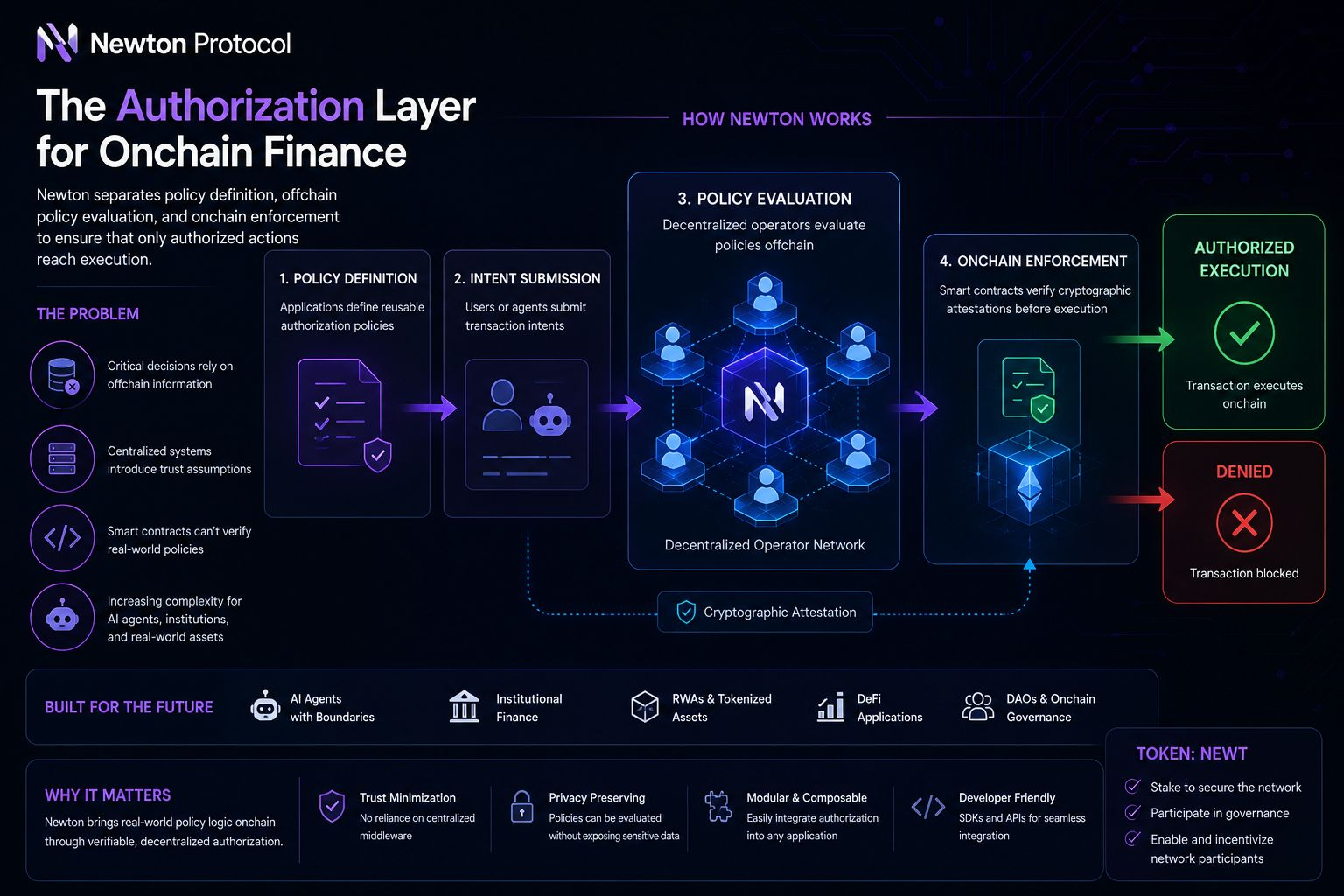
Newton Protocol approaches this differently. Based on its public documentation, policies can be defined independently from application logic, evaluated by a decentralized operator network, and enforced through cryptographic attestations that smart contracts can verify before execution. Instead of embedding every authorization rule inside each application, Newton separates policy definition, policy evaluation, and policy enforcement into independent components. I found this architectural separation more interesting than the automation narrative surrounding the project.
Another observation is that Newton doesn't appear to compete with existing smart contract infrastructure. Rather than replacing execution, it introduces an authorization layer that sits before execution. Applications define reusable policies, users or agents submit transaction intents, operators evaluate whether those intents satisfy the required rules, and only then does the smart contract verify the result before allowing the transaction to proceed.
The rise of AI makes this design particularly relevant. Most discussions about AI infrastructure focus on making agents more capable, faster, or cheaper. I think an equally important question is how much authority those agents should receive. An AI system may become highly effective at managing assets, but unrestricted authority creates obvious risks. Limiting permissions through transparent, verifiable policies feels like a more realistic long-term approach than assuming increasingly intelligent systems will never make mistakes.
Of course, this design introduces trade-offs. Offchain policy evaluation allows Newton to incorporate external information that blockchains cannot easily process, but it also places significant importance on the reliability of its decentralized operator network and the integrity of its cryptographic verification process. Whether this architecture performs effectively under large-scale production usage remains something I will watch carefully rather than assume.
I also found it useful to compare Newton with account abstraction. Technologies such as ERC-4337 and smart accounts primarily improve wallet functionality and transaction execution. Newton seems focused on a different problem entirely. Instead of asking how wallets can execute transactions more intelligently, it asks whether those transactions should be authorized in the first place. These approaches are complementary rather than competitive.
From an economic perspective, I think the long-term value of NEWT depends less on market speculation and more on actual protocol usage. Documentation describes roles for staking, governance, and securing the network, but sustainable token demand will ultimately depend on developers integrating Newton into production applications. If authorization becomes a reusable infrastructure primitive across wallets, AI agents, institutional finance, and decentralized applications, the network could develop meaningful utility. If adoption remains limited, token utility will naturally face constraints.
Because of that, the metrics I plan to monitor are not price charts. I would rather track developer adoption, the number of active authorization policies, operator participation, transaction verification volume, SDK integrations, and ecosystem growth. Those indicators provide a clearer picture of whether the protocol is becoming meaningful infrastructure.
After completing my research, I no longer view Newton Protocol primarily as an automation project. I see it as an attempt to build a trust layer between intent and execution. As blockchain applications become more autonomous and increasingly interact with AI, institutions, and real-world assets, verifying whether an action should happen may become just as important as ensuring it technically can. Whether Newton succeeds remains uncertain, but I believe it is asking one of the more important infrastructure questions emerging in Web3 today.