

The first time I started looking into Newton Protocol, I expected another project trying to make transactions faster or cheaper. After spending time reading through the Mainnet Beta documentation and developer materials, I realized I had been asking the wrong question all along.
For years, I've viewed blockchains as machines that execute instructions exactly as they're written. If a transaction had a valid signature and enough gas, the network's job was done. That assumption felt reasonable because it's how most of us learned to think about decentralized systems.
But the more I thought about institutional finance moving onchain, the more that assumption began to break down.
Imagine a treasury managing hundreds of millions of dollars. Its investment policy may prohibit interacting with sanctioned addresses, require multiple layers of approval, limit exposure to specific protocols, or pause activity when market risk exceeds predefined thresholds. None of those decisions are answered simply because a smart contract executes correctly. A transaction can be technically valid while still violating the organization's own rules.
That's the gap Newton Protocol is trying to solve.
Instead of asking only, "Can this transaction execute?", Newton introduces another question before settlement:
"Should this transaction execute according to the active policy?"
That shift may sound subtle, but it changes how we think about blockchain infrastructure.
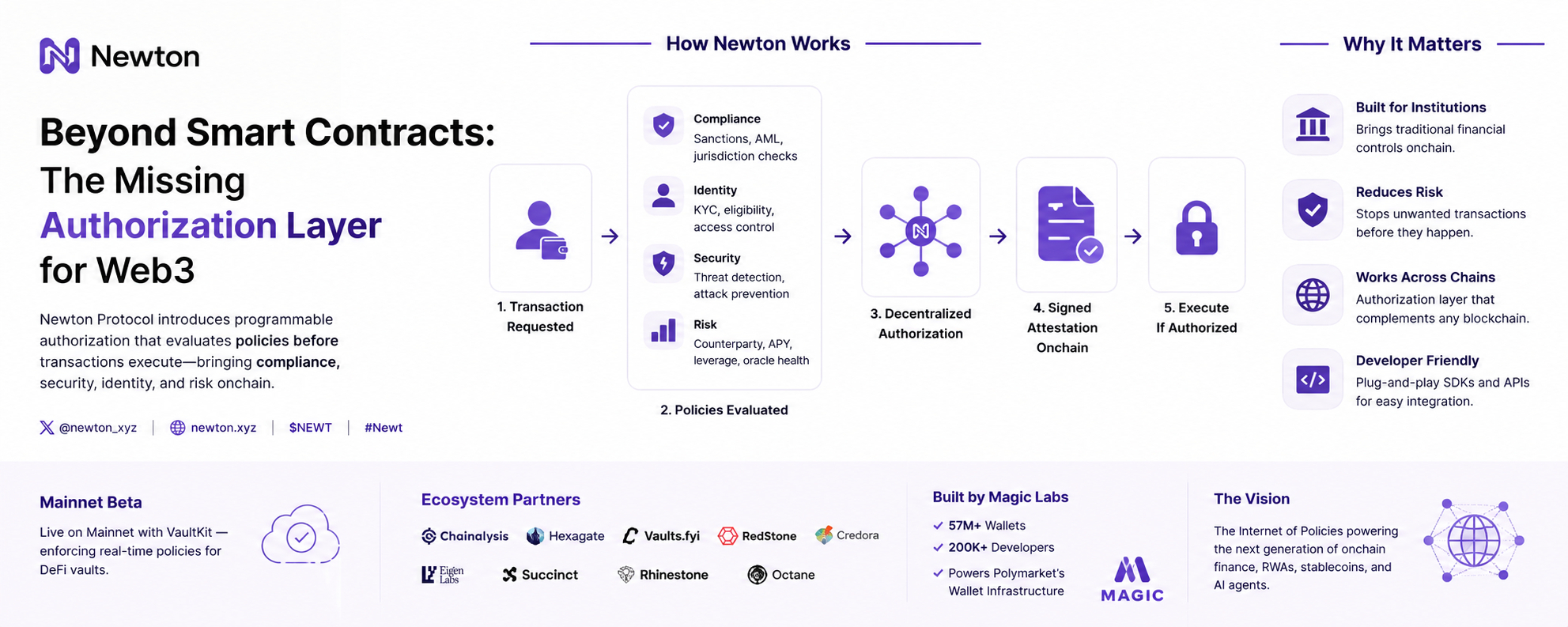
Newton Mainnet Beta introduces an authorization layer that evaluates programmable policies before assets move. Rather than detecting problems after settlement, policies are checked beforehand and the network returns a cryptographically signed authorization decision that can be verified onchain. This moves compliance, identity, security, and risk management from fragmented operational processes into transparent blockchain infrastructure.
What makes this particularly interesting to me is that Newton doesn't attempt to replace existing blockchains or smart contracts. Instead, it complements them. Ethereum and other networks remain responsible for execution, while Newton focuses on authorization. It's a separation of responsibilities that feels surprisingly intuitive once you see it.
The Mainnet Beta demonstrates this approach through VaultKit, where policy enforcement can include four major categories:
Compliance checks such as sanctions screening.
Identity verification and eligibility requirements.
Real-time security protections against suspicious activity.
Risk evaluation covering counterparty exposure, leverage limits, oracle health, and market conditions.
Together, these policies are evaluated before settlement rather than after funds have already moved.
Another aspect that stood out during my research is Newton's broader vision of an "Internet of Policies." Instead of every protocol building isolated compliance engines or custom authorization logic, reusable policies can become shared infrastructure. That reminds me of how cloud computing standardized common services instead of forcing every company to build its own servers from scratch. If authorization becomes modular infrastructure, developers can spend more time building applications instead of rebuilding governance systems repeatedly.
The ecosystem supporting Newton also reflects this infrastructure-first philosophy. Compliance intelligence, security monitoring, market data, and cryptoeconomic security come from specialized partners, allowing policy decisions to incorporate richer information than a blockchain could evaluate on its own. Rather than relying on a single centralized authority, Newton coordinates these inputs into programmable authorization that applications can trust.
Of course, some people may argue that additional authorization introduces unnecessary complexity. One of blockchain's greatest strengths is its simplicity: valid transactions execute, invalid ones don't. Adding another decision layer could be viewed as friction.
I understand that concern. However, as decentralized finance expands toward institutional treasuries, tokenized real-world assets, regulated stablecoins, and autonomous AI agents, execution alone may no longer be sufficient. The question is no longer whether a blockchain can move value efficiently; it's whether it can enforce sophisticated financial rules without sacrificing transparency or decentralization.
The biggest takeaway I came away with isn't that Newton makes blockchains more restrictive. It's that it attempts to make them more context-aware. Smart contracts already know how to execute code. Newton is exploring how decentralized infrastructure can also understand when execution should actually happen.
That distinction could become one of the defining architectural shifts of the next generation of Web3.
As blockchain adoption moves beyond individual users toward institutions, governments, enterprises, and AI-driven systems, perhaps the most valuable infrastructure won't be another faster chain—but a trusted authorization layer that sits quietly before every important transaction.
