


For years, crypto has been obsessed with one question: How do we move value on-chain?
Now, a bigger question is emerging:
How do we move trillions of dollars on-chain while following real-world rules?
This is exactly the problem Newton is trying to solve.
⸻
Smart Contracts Were Never Enough
Smart contracts can automate transactions.
But they can’t naturally answer questions like:
Is this wallet KYC verified?
Can this investor legally own this asset?
Does this transfer violate regional regulations?
Has the transaction passed compliance checks?
Today, these checks are mostly handled off-chain by centralized companies.
That creates friction, trust issues, and operational risk.
Newton introduces something different:
An authorization layer that verifies policy before transactions settle.
Instead of asking “Can the transaction execute?”
Newton asks:
“Should this transaction be allowed?”
⸻
Policies Before Transactions
Newton’s biggest innovation isn’t another blockchain.
It’s programmable policy.
Every vault, token, or asset can have rules attached to it.
Before a transaction completes, Newton evaluates those rules.
If everything satisfies the requirements:
✅ Transaction approved.
If not:
❌ Transaction rejected.
Then the system creates a cryptographically signed attestation proving the decision happened according to predefined policies.
This creates something institutions desperately need:
Verifiable trust.
⸻
Why Institutions Care
Institutions aren’t worried about sending tokens.
They’re worried about:
Compliance
Auditing
Risk management
Regulatory reporting
Investor protection
Without these controls, large capital simply cannot move freely into DeFi.
Newton is positioning itself as the infrastructure that bridges that gap.
Imagine tokenized:
Treasury bills
Real estate
Private credit
Stablecoins
Investment funds
All moving on-chain with programmable compliance built directly into every transaction.
That’s a completely different level of financial infrastructure.
⸻
More Than Just DeFi
Newton isn’t building only for crypto natives.
Its vision extends to:
• RWAs (Real World Assets)
• Stablecoins
• Institutional DeFi vaults
• Asset managers
• Tokenized securities
• Cross-border financial products
Instead of forcing institutions to adapt to crypto,
Newton allows crypto to adapt to institutional requirements.
That shift could become one of the biggest catalysts for mainstream adoption.
⸻
A Strong Ecosystem Is Already Forming
One encouraging sign is the ecosystem developing around Newton.
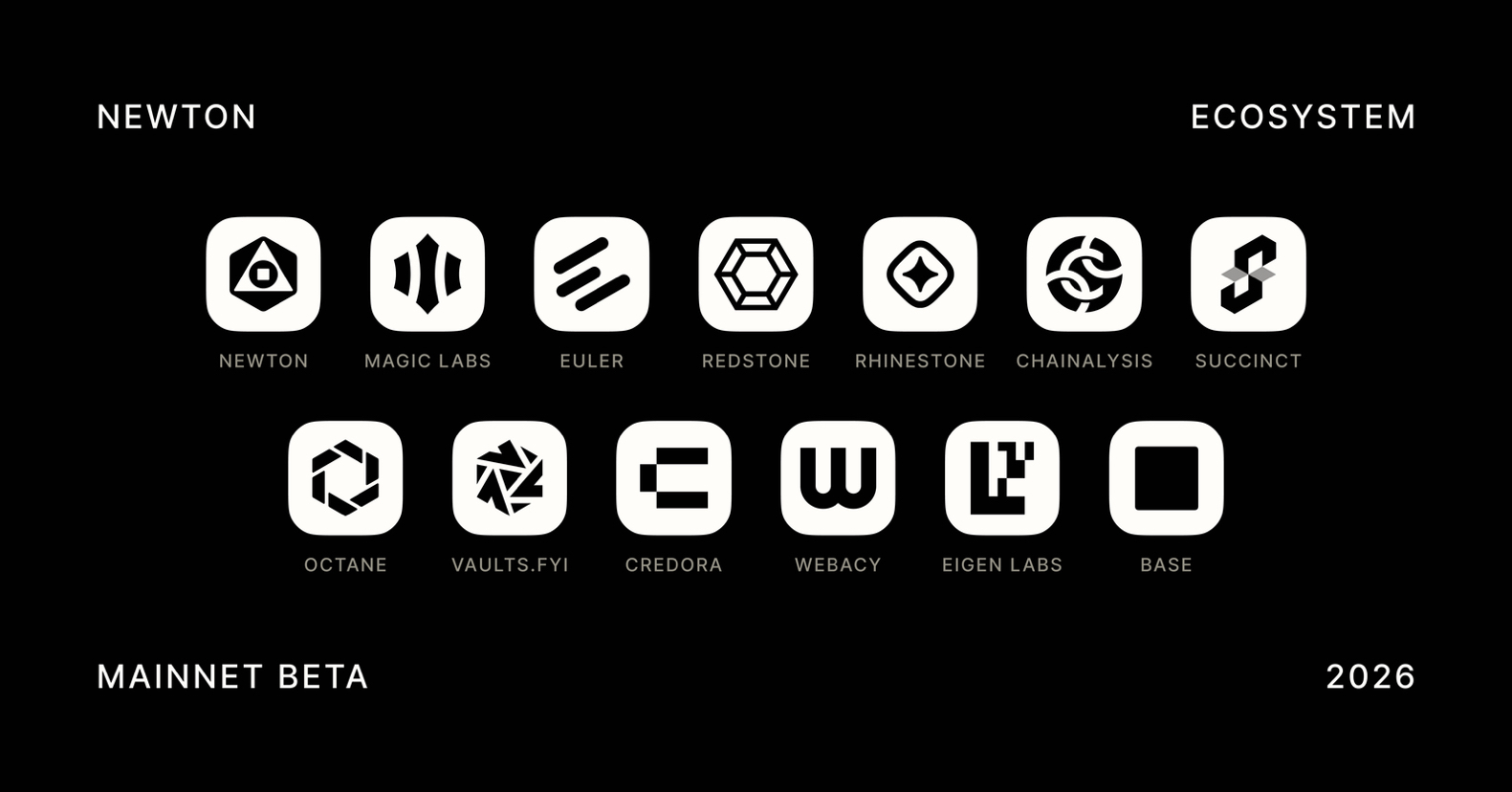
Partners and integrations include projects such as:
Magic Labs
Euler
RedStone
Rhinestone
Chainalysis
Succinct
EigenLayer ecosystem
Base
Octane
Credora
Webacy
This shows Newton isn’t building in isolation.
It’s positioning itself inside an ecosystem focused on security, compliance, identity, risk management, and institutional-grade infrastructure.
⸻
Why This Narrative Matters
The last cycle was driven by:
NFTs.
Then AI.
Then Meme Coins.
The next major cycle could be powered by:
Institutional Capital.
If trillions of dollars eventually enter blockchain markets, they won’t arrive without compliance, authorization, and verifiable policies.
That’s exactly the infrastructure Newton is attempting to provide.
It may not generate the loudest headlines today.
But history has shown that infrastructure projects often become the biggest winners once adoption accelerates.
⸻
Final Thoughts
Most investors focus on the applications everyone can see.
Far fewer pay attention to the infrastructure quietly being built underneath.
Newton isn’t trying to become another Layer 1.
It’s building something arguably more important:
The authorization layer for the on-chain economy.
If tokenized assets, institutional DeFi, and regulated stablecoins become the next trillion-dollar narrative, programmable policy may become just as essential as smart contracts themselves.#Newt $NEWT
Sometimes, the biggest opportunities are created long before the market fully understands why they matter.
Keep Newton on your radar. @NewtonProtocol
⸻
This article is for educational purposes only and should not be considered financial advice. Always do your own research before investing.