Most people think that technology changes the world because it gets faster.
I think technology changes the world when people stop being afraid to use technology.
That sounds like a difference. History keeps proving it.
The internet did not become a part of our lives because websites loaded quickly.
It became indispensable because people slowly learned to trust the internet to shop, work, communicate and store parts of their lives online.
Every major technological leap follows the pattern.
People adopting technology rarely depends on how innovative the technology's
It depends on whether ordinary people feel safe enough to participate in technology.
I keep coming to that thought whenever I read about blockchain technology.
For years the blockchain industry has measured success through metrics like transaction speed total value locked or network activity.
Those numbers are useful they can distract us from a question.
Why do many people still hesitate to use blockchain applications after years of blockchain development?
Maybe the answer has less to do with blockchain technology and more to do with behavior.
Most people are not afraid of blockchain technology itself.
They are afraid of making mistakes like one wallet approval or one phishing website that looks almost identical to the one.
One copied address with a character can be a problem.
In finance mistakes often have a recovery process.
In blockchain systems a single click can permanently change the outcome.
That creates a relationship between innovation and responsibility.
As blockchain technology becomes more powerful users are expected to become more knowledgeable about blockchain technology.
We celebrate self-custody, self-custody also means self-responsibility.
The freedom that makes decentralization attractive is often the freedom that makes newcomers uncomfortable.
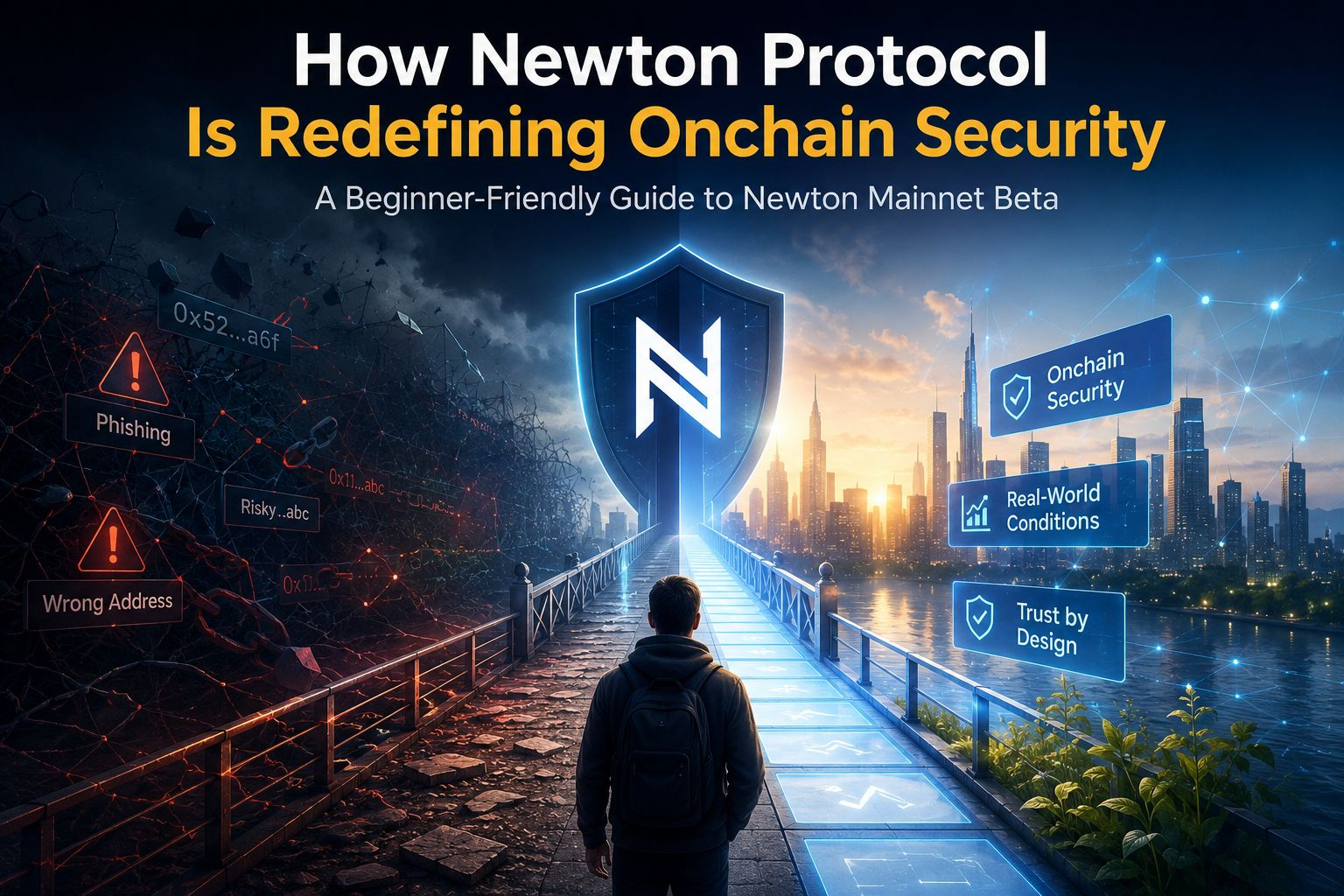
This is where I think Newton Protocol becomes interesting not because it claims to solve everything but because it seems to ask a question.
Of assuming users will eventually become security experts what if blockchain infrastructure itself could shoulder more of that burden?
That question feels more important than any feature.
When I first saw the phrase Mainnet Beta I wondered why a blockchain network would launch publicly while still describing itself as a beta.
At first it sounded contradictory.
The more I thought about it the more it reminded me of how modern engineering works.
Imagine constructing a bridge engineers can simulate weight, weather and stress for years before opening it.
Once thousands of vehicles begin crossing every day new patterns emerge.
Tiny vibrations appear traffic behaves differently than expected.
Maintenance teams discover details that no laboratory could perfectly predict.
The bridge was never unfinished it simply entered the phase where reality becomes the teacher.
That is how I interpret Newton Protocols Mainnet Beta.
It is not about declaring perfection it is about allowing a security-focused blockchain network to mature under conditions while remaining transparent about the learning process.
Ironically that honesty gives me more confidence than pretending every unknown has already been solved.
Blockchain security has never been a destination it is a negotiation between blockchain builders, users and attackers.
Every time blockchain developers strengthen a protocol attackers search for weaknesses.
Every time blockchain interfaces become easier to use forms of deception emerge.
The balance never stands still.
That is why blockchain infrastructure matters much.
Blockchain applications often receive attention because they are visible.
Blockchain infrastructure quietly determines whether those blockchain applications deserve trust in the place.
We rarely think about electricity when opening a laptop we rarely think about internet routing while sending a message.
The best blockchain infrastructure almost disappears because reliability becomes ordinary.
I wonder if blockchain technology is approaching that stage.
Perhaps the next chapter will not belong to blockchain projects competing over who processes the number of transactions per second.
Maybe it will belong to the blockchain networks that make users feel comfortable enough to stop worrying about every signature they approve.
If that happens blockchain adoption may begin looking very different.
Blockchain developers could spend time building blockchain applications of recreating the same security protections.
Businesses might evaluate blockchain systems less as experiments and more, as digital blockchain infrastructure.
New users may join without spending weeks learning habits that feel natural only to experienced blockchain users.
Course none of this removes uncertainty.
Every blockchain security model introduces trade-offs.
Stronger verification can reduce convenience greater automation may create dependencies.
Blockchain privacy protections can complicate transparency blockchain decentralization itself often slows decision-making because no single authority controls the outcome.
Those tensions are not problems to eliminate they are realities to manage.
Perhaps that is the purpose of Newton Protocols Mainnet Beta.
Not to convince everyone that blockchain security has finally been solved to explore whether blockchain security can gradually become part of the foundation of remaining entirely the responsibility of the individual blockchain user.
Maybe I am wrong history has a habit of proving anyone who believes they understand where technology is heading wrong.
One idea keeps staying with me the future of blockchain technology may not be defined by the blockchain protocols that make the promises.
It may be defined by the ones that quietly make trust feel ordinary.
If that day comes most people probably will not notice the blockchain technology all.
They will simply notice that using blockchain technology no longer feels risky.account @NewtonProtocol $NEWT #Newt $SYN