
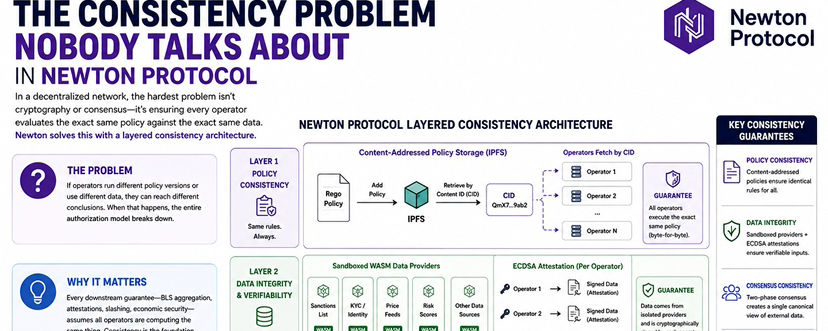
There is an engineering problem sitting at the center of every decentralized authorization system that rarely receives the attention it deserves. It is not cryptography. It is not consensus. It is something even more fundamental: how can a network of independent operators evaluate the exact same authorization policy against the exact same inputs, every time, without relying on a central authority to enforce consistency?
This question matters because decentralized authorization is ultimately a deterministic computing problem. If two operators evaluating the same request reach different conclusions because they loaded different policy versions, queried different external data, or observed the world at slightly different moments, the network can no longer produce a single verifiable authorization result. Once that happens, everything built on top of it, BLS signature aggregation, attestations, economic security, and slashing, begins to lose its foundation.
Newton Protocol approaches this challenge with a layered architecture in which every layer solves a different consistency problem. Rather than depending on a single mechanism, it separates policy integrity, data integrity, and distributed agreement into distinct components that reinforce one another.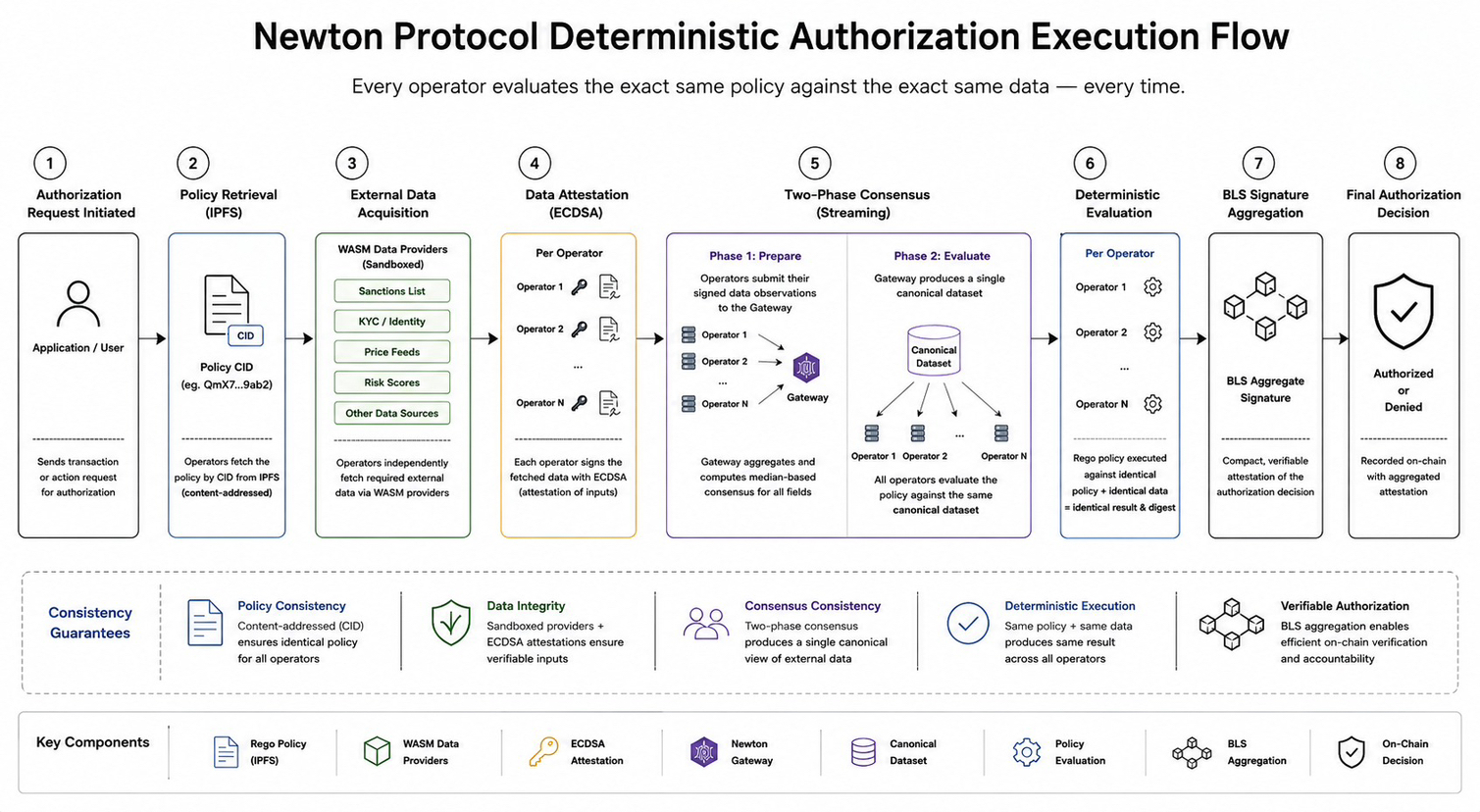
The first layer addresses policy consistency.
Every Newton operator evaluating an authorization request must execute the exact same Rego policy, not a similar version or a locally modified configuration, but the identical rule set. Newton accomplishes this through content addressed storage on IPFS. Policies are referenced by Content Identifier (CID), a cryptographic fingerprint derived from the policy itself. Even a one character modification generates a completely different CID, making silent version drift impossible. Operators requesting the same CID either retrieve the identical policy or fail to retrieve it altogether.
This design provides more than deterministic execution. It also creates an immutable audit trail. Applications can publish the CID of the policy governing their authorization logic, allowing regulators, auditors, developers, or users to independently verify the precise rules being enforced. Runtime ambiguity disappears because the published identifier and the executed policy are cryptographically linked.
Policy consistency, however, solves only half of the problem.
Authorization decisions often depend on external information that changes continuously: sanctions databases, oracle prices, identity records, fraud signals, or risk scores. Unlike policy files, these datasets cannot simply be content addressed because they evolve over time.
Newton addresses this challenge through sandboxed WebAssembly (WASM) data providers.
Each external data provider operates inside an isolated execution environment with strict resource limits and controlled network access. This isolation protects operators from compromised plugins, prevents server side request forgary (SSRF) attacks, and creates a clear boundary between data acquisition and policy evaluation. Data providers can supply information, but they cannot influence how policies are executed beyond the inputs they expose.
After retrieving external data, operators generate an ECDSA attestation over the fetched values. This cryptographic signature binds both the retrieved data and the identity of the operator that observed it. As a result, authorization decisions become traceable to specific signed inputs rather than unverifiable claims. If an operator attempts to represent one dataset while evaluating another, the inconsistency becomes cryptographically detectable.
Even with signed data, another challenge remains.
Independent operators querying mutable external systems will not always observe identical values. A price feed may update milliseconds apart. A sanctions list may change during an evaluation window. These timing differences are unavoidable whenever distributed systems interact with live external state.
Newton resolves this through its streaming two-phase consensus protocol.
During the Prepare phase, operatorsy independently retrieve external data and submit their observations. Newton's Gateway aggregates these responses and computes a canonical dataset using median-based consensus across relevant numeric fields. Instead of allowing each operator to continue with its own observations, the network establishes a single shared dataset for the authorization process.
During the Evaluate phase, every operator executes the Rego policy against this canonical dataset. Because both the policy and the inputs are now identical, every operator produces the same deterministic result and digest, enabling efficient downstream BLS signature aggregation.
The strength of this architecture lies in how these layers complement one another.
Content-addressed storage guarantees policy integrity. WASM sandboxing and ECDSA attestations provide verifiable data acquisition at the operator level. Two-phase consensus reconciles timing differences across independently observed external data. None of these mechanisms alone is sufficient, but together they create a deterministic authorization pipeline that remains decentralized without sacrificing consistency.
There is, however, an important limitation worth acknowledging.
Median consensus is a practical engineering solution rather than a perfect representation of objective truth. It performs well when honest observations cluster around accurate values and malicious inputs remain a minority. Like many distributed systems, its effectiveness depends on assumptions about the quality and independence of participating data sources. Coordinated manipulation across enough providers could still distort the resulting dataset.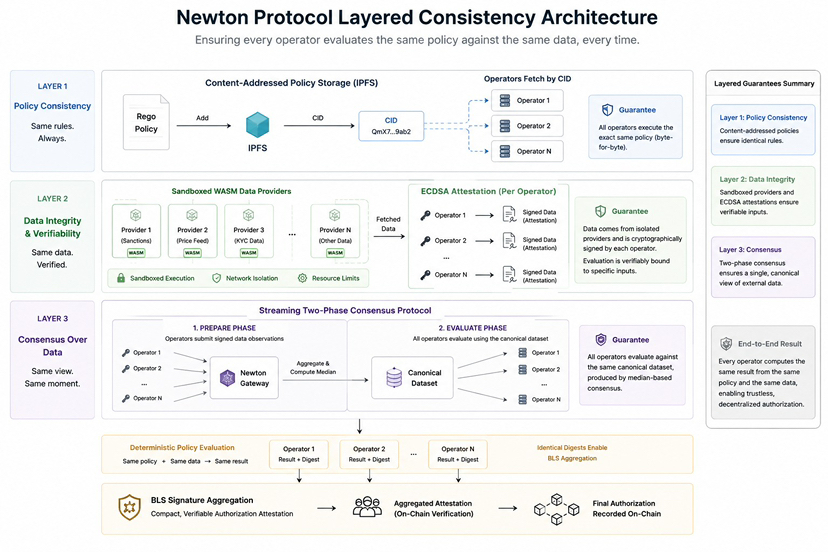
Newton reduces this risk through multiple defensive layers, including sandboxed execution environments and integrations with institutional-grade data providers such as Chainalysis, RedStone, and Hexagate. These measures strengthen the integrity of the data pipeline, but they do not eliminate the broader challenge of establishing trustworthy external state. Understanding that distinction is essential to evaluating the architecture realistically.
What makes Newton's Mainnet Beta particularly interesting is that its promise of programmable, infinitely composable authorization is supported by infrastructure rather than marketing language. Rego allows developers to combine sanctions screening, KYC verification, spending limits, oracle health checks, and custom business logic into a single authorization policy. Yet composability only has value if every operator evaluates that policy against the same verified inputs.
In the end, cryptography can prove that a computation occurred, and consensus can prove that operators agreed on its outcome. Neither matters if the network was never evaluating the same reality in the first place.
Newton's layered consistency architecture is designed to solve that problem. Everything else BLS attestations, programmable authorization, economic security, and decentralized trust, depends on that foundation.
@NewtonProtocol $NEWT #Newt #newt