The more I read into Newton's own whitepaper, the more I noticed something: the entire "why now" argument rests on regulation actually landing the way the paper assumes it will. That's worth sitting with before getting excited about the tech.
The case Newton is making
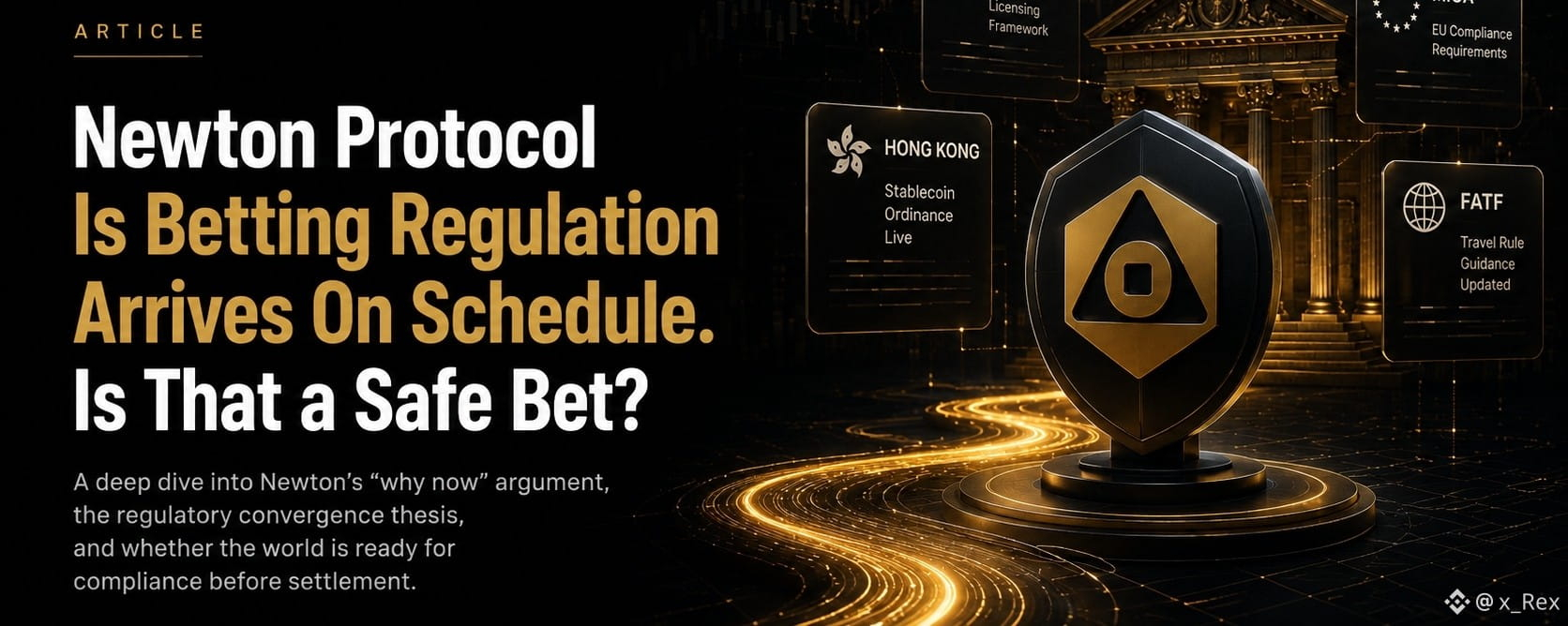
Newton's pitch is that three things are converging at once: regulatory frameworks are crystallizing, institutional capital is already here, and AI agents are starting to transact on their own. The paper points to real anchors — the GENIUS Act establishing a federal stablecoin licensing regime in the US, Hong Kong's Stablecoin Ordinance going live, MiCA's compliance requirements in the EU, updated FATF Travel Rule guidance. Stablecoins have crossed $298 billion in circulating supply. Tokenized real-world assets are past $21 billion. Those numbers are real and checkable, not projections.
The logic is clean: if institutions have to comply with concrete rules, they need infrastructure that proves compliance happened before a transaction settles, not a dashboard that tells them after the fact. Newton positions itself as that missing piece.
Where I Have my Doubts:
Here's my actual hesitation. "Regulatory frameworks are crystallizing" is doing a lot of work in that sentence, and crystallizing isn't the same as settled. Rules that exist on paper still take years to actually get enforced consistently, tested in court, and adopted uniformly across jurisdictions. A stablecoin issuer in 2026 knows more than they did in 2023, sure — but "know the rules" and "have built the infrastructure to prove compliance at the transaction level" are two very different points on the adoption curve.
And Newton isn't the only piece of that puzzle. Even if every institution agreed tomorrow that they need pre-transaction policy enforcement, they'd still need to actually integrate it — rewrite policy logic in Rego, wire it into existing compliance stacks, get their own legal teams comfortable with cryptographic attestations replacing manual review. That's not a switch you flip. That's a multi-year migration for firms that measure change management in quarters, not sprints.
The AI agent piece cuts both ways
The whitepaper also leans on AI agents needing machine-speed authorization as a second tailwind. I think this is actually the stronger argument of the two — an agent moving funds autonomously genuinely can't wait on a human approval queue, so programmatic guardrails aren't optional the way they might be for a human-initiated transfer. But it's also the more speculative one. How much real transaction volume today is actually AI agents executing unsupervised trades versus humans clicking buttons? Not a rhetorical jab — I genuinely don't know the number, and I don't think anyone has a clean one yet.
What would change my mind
If Newton signs even a handful of the institutions it's implicitly targeting — actual stablecoin issuers or RWA platforms putting real volume through the policy engine, not just partnership announcements — that's the signal that the regulatory-convergence thesis is actually translating into usage. Announcements and integrations with data providers like Chainalysis or Credora tell you Newton is building the right connective tissue. They don't yet tell you institutions are using it at scale.
My Analysis Says
The architecture is genuinely well-reasoned for the world the whitepaper describes. The open question isn't whether Newton built the right thing for that world — it's whether that world arrives on the timeline the paper assumes, or whether "crystallizing" regulation stays crystallizing for another few years while adoption waits on the sidelines. Being early to real infrastructure and being early to a market that isn't ready yet can look identical for a long time.
My own analysis based on Newton Protocol's whitepaper (v1.0, Feb 2026) and public regulatory sources. Not financial advice.