
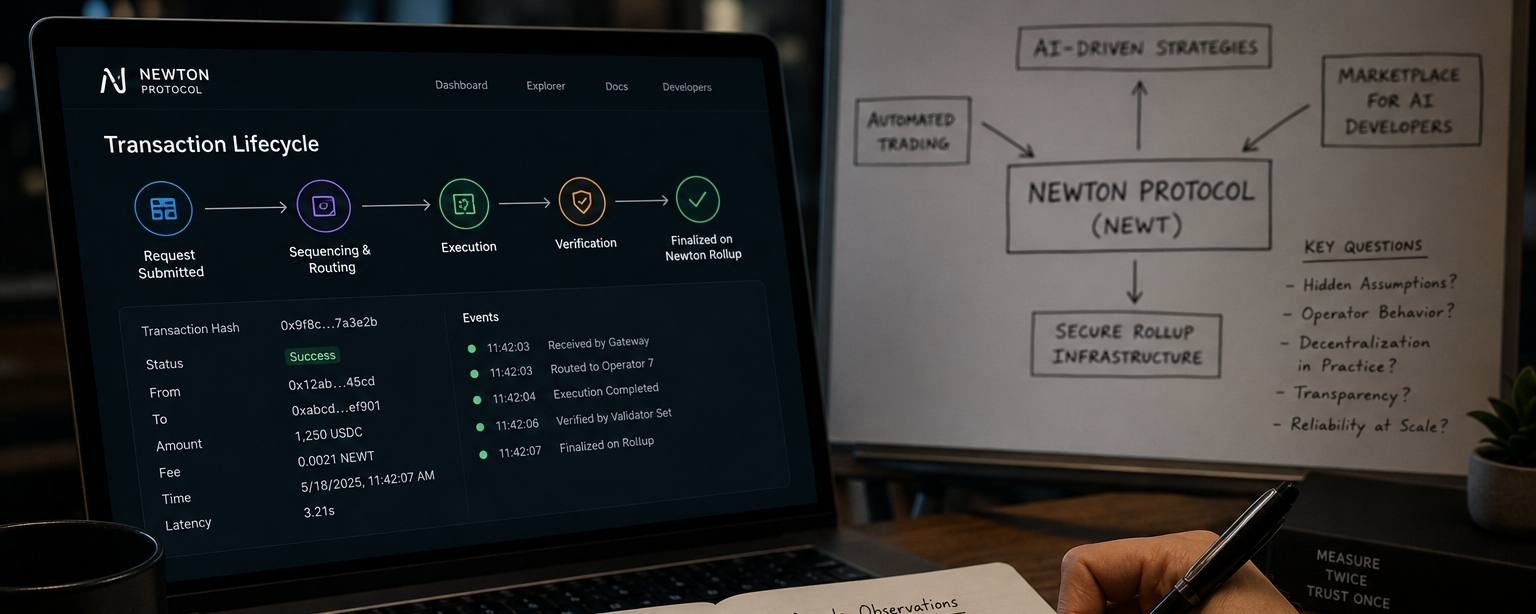
I spent part of the weekend running a series of small test transactions through Newton Protocol, and the first thing I wrote down wasn't an error message or a failed confirmation. It was something much less obvious. One transaction completed exactly as expected, the final state matched what I intended, and every visible check looked normal. Still, the overall interaction felt just a little different from the previous runs. The delay wasn't dramatic, but it was inconsistent enough that I found myself wondering whether I was observing random network conditions or something deeper in the protocol's decision-making process.
That feeling sent me back through the transaction lifecycle instead of simply checking whether the result was technically correct. I wanted to understand each stage independently rather than assuming that a successful outcome meant every intermediate step behaved predictably.
The request itself seemed straightforward. It entered the system without noticeable issues, and nothing suggested malformed inputs or rejection. From there, though, I started thinking about what assumptions the protocol has to make before anything meaningful happens. If Newton Protocol is designed around AI-driven strategies and automated execution, there must be layers deciding not only whether a transaction is valid, but also how it should move through the system efficiently. Those choices may be perfectly reasonable, but they're also mostly invisible from the outside.
The routing stage became particularly interesting to me. I don't know exactly how the protocol selected its execution path during my tests, and I don't want to pretend that a handful of observations reveal hidden mechanics. Still, I noticed that similar requests occasionally produced slightly different timing profiles. That's not evidence of incorrect execution. Distributed systems naturally fluctuate. But it raises questions about whether routing decisions optimize for throughput, operator load, or some policy that isn't immediately visible to participants.
Latency is another area where success can hide complexity. The transaction eventually settled, so from one perspective everything worked. Yet operationally, consistency often matters as much as raw completion. If an AI agent depends on predictable execution windows for automated trading or strategy coordination, small timing variations could matter more than they would for an ordinary transfer. The protocol may technically satisfy every requirement while still introducing uncertainty that becomes important at higher levels of automation.
Verification looked solid from what I could observe. State transitions appeared internally consistent, and I couldn't identify anything suggesting invalid execution. That said, verification answers only one category of questions. It tells me whether the recorded outcome follows protocol rules. It doesn't necessarily explain why the system reached that outcome through one sequence of operational decisions instead of another. Those are different questions, and I think they're easy to blur together when everything appears healthy.
I also kept thinking about operator incentives. Whenever a protocol depends on distributed participants to process workloads, incentives quietly shape behavior even when everyone follows the rules. If operators have flexibility in scheduling, prioritization, or resource allocation, their rational decisions could create patterns that remain technically compliant while producing noticeably different user experiences. I'm not saying that's happening here. I simply don't think it's something that should be ignored when evaluating real-world reliability.
The decentralization story feels similar. A protocol can distribute authority successfully while still concentrating practical influence in subtle ways. Maybe certain operators consistently provide lower latency. Maybe some execution environments become preferred because they're more efficient. None of that automatically weakens decentralization, but it changes how decentralization functions operationally rather than theoretically.
Transparency is probably where my notes become the most speculative. I found enough observable information to verify outcomes, but less information about intermediate decisions. That gap doesn't imply anything improper. Many systems intentionally abstract internal complexity. Even so, when unexpected behavior appears, those abstractions make it harder to distinguish between normal adaptive behavior and hidden assumptions that only surface under particular conditions.
By the end of my testing session, I wasn't worried that Newton Protocol had produced an incorrect result. If anything, the protocol seemed technically sound throughout the transactions I observed. What I couldn't quite answer was whether technical correctness automatically translates into operational reliability once AI agents begin making thousands of decisions under changing network conditions. Those are related ideas, but they aren't identical.
Maybe what I noticed was nothing more than ordinary network variance. Maybe I happened to catch a temporary scheduling difference that disappears over larger sample sizes. Or maybe these small inconsistencies are exactly where the most interesting engineering questions begin. If others have spent more time testing Newton Protocol under sustained automated workloads, did your observations line up with mine, or did you notice entirely different patterns once you looked beyond the final transaction status?
