
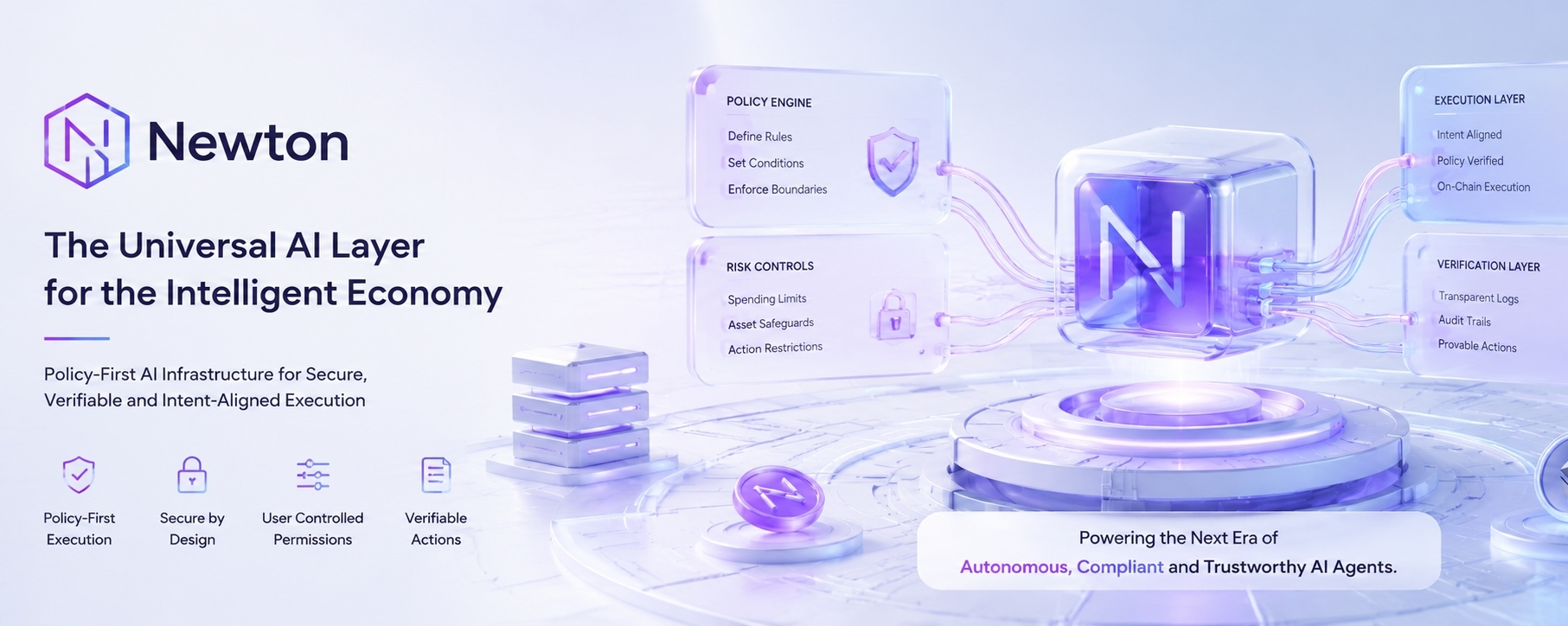

@NewtonProtocol Over the past year, I've noticed that almost every conversation about AI follows the same direction.
People want agents that can do more.
More tasks. More decisions. More autonomy.
The assumption is easy to understand. If an AI can operate with less human involvement, it becomes more useful. At least that's how the story is usually told.
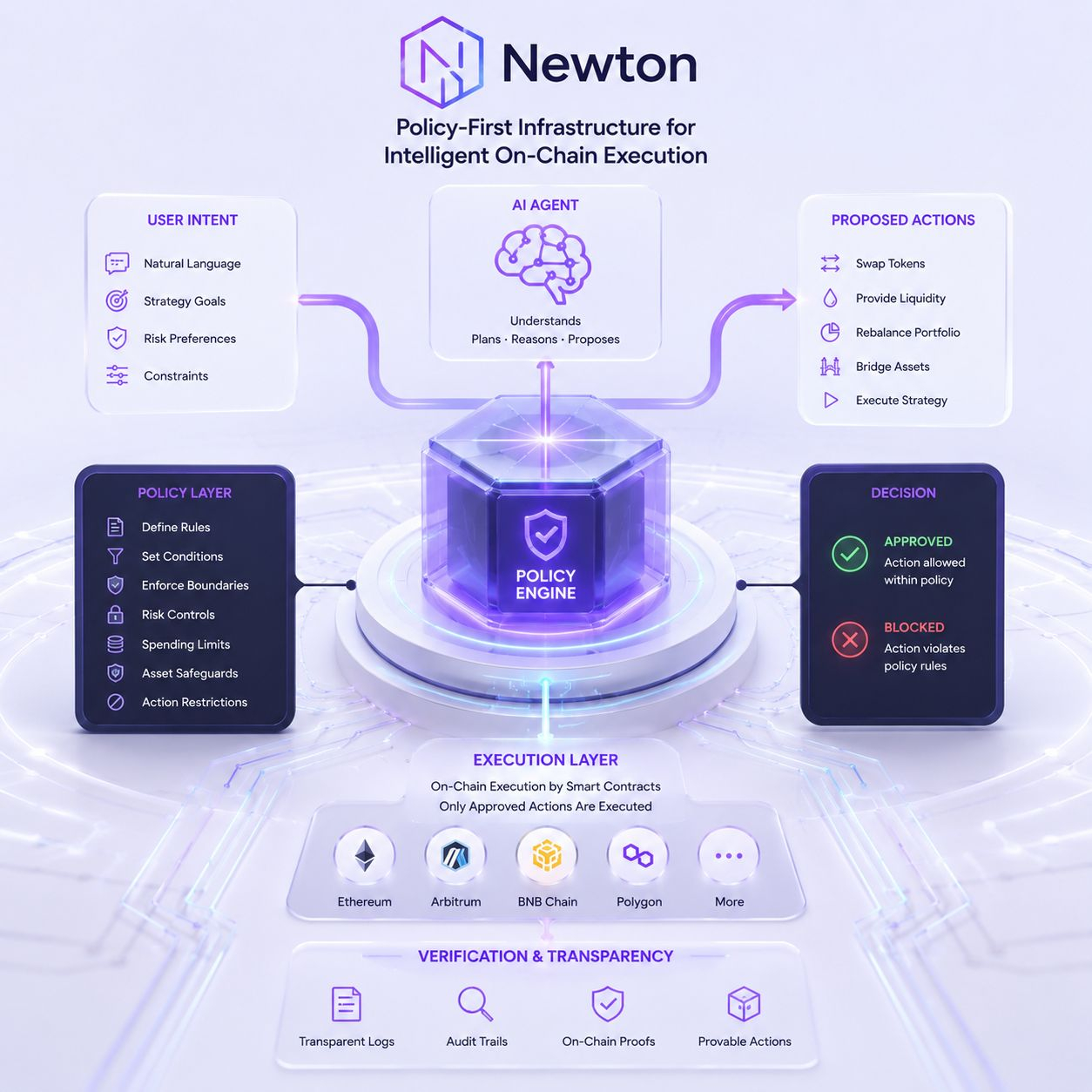
But after spending time reading through Newton Protocol's architecture, I found myself thinking about something that rarely gets the same level of attention.
What if autonomy isn't the destination?
What if the real challenge begins after autonomy is achieved?
The more I think about it, the more I believe the AI industry may be measuring progress through an incomplete lens. We celebrate every new capability because capability is visible. It's easy to demonstrate. It's easy to benchmark.
Limits are different.
Nobody gets excited about restrictions.
Nobody headlines a conference around boundaries.
Yet boundaries are often what determine whether a technology becomes trusted enough to move beyond early adopters.
That's what stood out to me about Newton Protocol.
The project seems built around a simple observation: an AI agent being able to perform an action is not the same thing as an AI agent being allowed to perform that action.
At first, that distinction sounds almost obvious.
But when I look across the industry, I don't think we've fully absorbed what it means.
Imagine a future where AI agents manage portfolios, execute trades, coordinate treasury operations, interact with applications, and move digital assets without constant human supervision.
Technically, that future feels increasingly realistic.
The harder question is what happens when those agents encounter situations that weren't anticipated.
Who defines the boundaries?
Who enforces them?
Who verifies that they were followed?
Those questions become more important as autonomy increases, not less.
That's why I keep coming back to the idea that limits may eventually become more valuable than capabilities.
Not because intelligence stops mattering.
But because intelligence without constraints creates uncertainty.
And uncertainty has always been one of the biggest barriers to adoption.
I've seen this pattern play out repeatedly in technology.
The internet didn't become a foundation for commerce simply because information could move faster. Online payments didn't scale because transferring money became possible. Cloud computing didn't transform businesses because servers became more powerful.
In each case, adoption accelerated when users felt confident that safeguards existed.
Confidence came from structure.
Not freedom alone.
That is why Newton's focus on policy-driven execution feels interesting to me. It suggests a future where the most important layer isn't necessarily the intelligence layer. It may be the layer that determines how intelligence interacts with the real world.
The more I think about it, the more that feels like an overlooked opportunity.
Most discussions focus on building agents that can act.
Far fewer focus on building systems that determine how those actions should be governed.
Yet governance becomes increasingly important as responsibility increases.
A chatbot generating an inaccurate answer is annoying.
An autonomous system making an unauthorized financial decision is something entirely different.
Of course, there are reasons this perspective could be wrong.
Users often prioritize convenience over control. Developers may see policy frameworks as friction. Competing approaches could emerge that rely more on reputation than enforceable rules.
Those possibilities are real.
But I'm starting to suspect that the next stage of AI adoption won't be determined solely by who builds the smartest agents.
It may be determined by who builds the most trustworthy environment around them.
Because eventually, many agents may become capable.
The harder thing to replicate is confidence.
After reading Newton Protocol, I came away with a question I wasn't expecting to ask.
What if the future of AI isn't defined by how much autonomy we can create?
What if it's defined by how well we can control it once it exists?
That feels like a much less popular question today.
Which is exactly why I think it might be worth paying attention to.
@NewtonProtocol #Newt #newt $NEWT
