
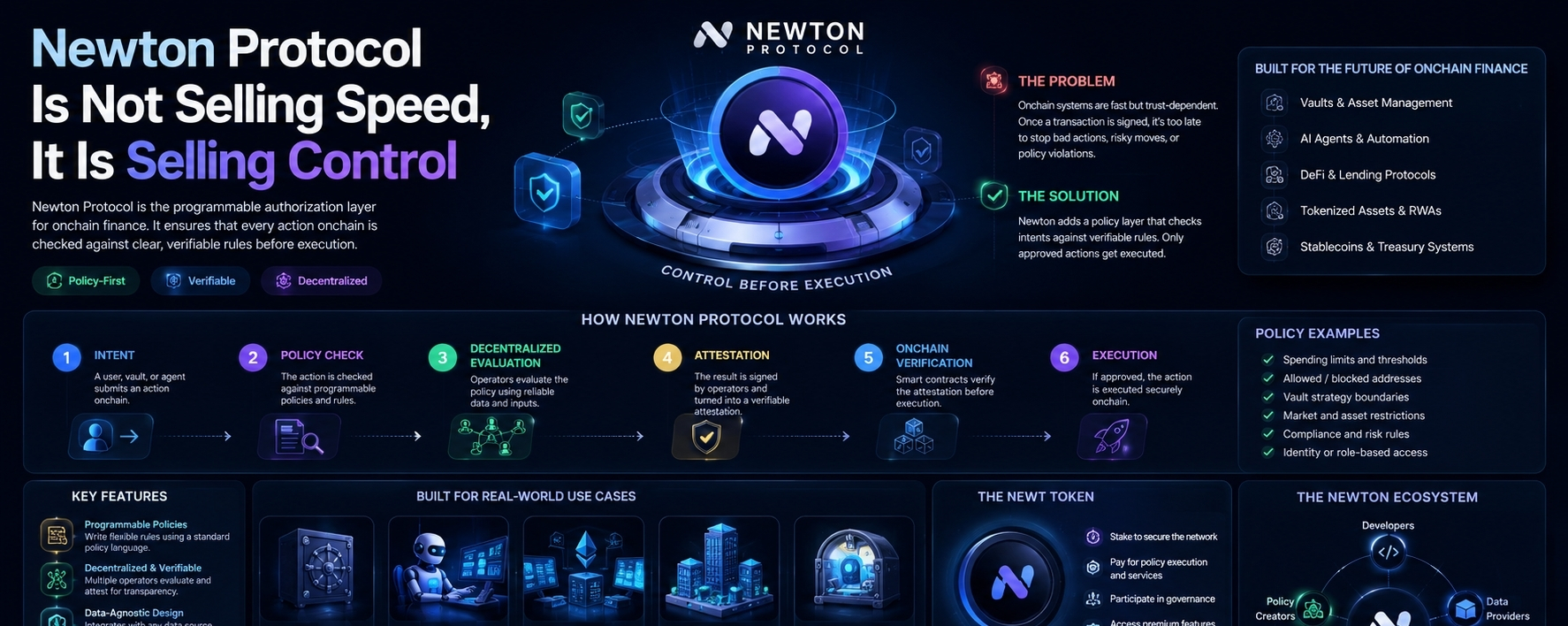

Newton Protocol is the kind of project I don’t want to dismiss too quickly, mostly because I’ve seen this market ignore boring infrastructure right before it becomes necessary.
That does not mean I’m excited. Excitement is cheap in crypto. Every cycle produces another stack of projects promising cleaner rails, smarter execution, safer capital, better automation, and some grand future where everything finally works the way the deck said it would. Most of it gets recycled. Same language. Same pitch. Different logo.
Newton is working in a more uncomfortable corner.
It is not really trying to make crypto faster or louder. It is trying to answer a question the market usually avoids until something breaks: should this action be allowed before it becomes final?
That is the whole thing.
And honestly, that question matters more than people want to admit.
Crypto has spent years worshipping execution. Sign the transaction. Push it through. Let the chain settle it. If the action was stupid, risky, compromised, outside the strategy, or completely misaligned with what users thought they agreed to, well, too late. The transaction happened. The chain did its job. The mess belongs to everyone else.
Newton Protocol is trying to put friction before that moment.
Not friction for the sake of slowing things down. Crypto already has enough friction. Wallet popups, bridge risk, contract approvals, vague dashboards, broken interfaces, half-readable documentation, governance theater. The usual grind.
Newton’s friction is different. It is rule-based. A transaction, vault action, or agent instruction gets checked against a policy before it can move forward. If the action fits the rule, it passes. If it does not, it gets blocked.
Simple idea. Difficult execution.
That is usually where the truth sits.
A lot of people will look at Newton and immediately throw it into the AI-agent basket. I get why. The market has trained everyone to chase the freshest label. Agents are the current shiny thing. Let a bot manage assets. Let it trade. Let it route liquidity. Let it do the work while everyone pretends automation automatically means progress.
But here’s the thing: agents are dangerous without boundaries.
I don’t care how elegant the interface looks. If an agent can act on behalf of a wallet, move capital, approve contracts, rebalance positions, or interact with protocols, then the real question is not whether it can act. The question is whether it can be stopped.
Newton is more interesting when viewed from that angle. It is not “AI plus crypto” in the lazy marketing sense. It is more like a restraint system. A way to say: yes, this agent can do something, but only inside these limits. Only with this amount. Only under these conditions. Only if the rule says it is acceptable.
That is less exciting than a trading bot demo.
It is also more useful.
The same applies to vaults. Maybe even more so.
Vaults are one of those areas where crypto still asks for more trust than it likes to admit. Users deposit funds because a strategy looks reasonable, a manager sounds competent, or the interface suggests there are limits. But too often the real control sits somewhere softer than people think. A description. A promise. A governance post. A dashboard label. A nice-looking risk page that does not actually stop anything.
Newton wants those limits to become enforceable.
If a vault manager tries to move funds outside an approved range, change exposure too aggressively, enable a risky market, adjust parameters beyond the policy, or take some action that users never really signed up for, Newton’s model is supposed to check it before execution. Not after. Before.
That difference sounds small until you have watched enough “post-mortems” pretending to be accountability.
I’ve read too many of them. Everyone has, by now. The exploit happened because a parameter was misconfigured. The loss happened because a manager had too much flexibility. The system behaved as designed, except the design assumed people would behave. The controls were informal. The warning signs were there. The team is reviewing processes.
Always the same smoke.
Newton is trying to move some of that process into the transaction path itself. A policy says what is allowed. The action gets measured against it. The result is proven. The smart contract can use that proof before letting the action happen.
That is the clean version.
The messy version is where I start paying closer attention.
Who writes the policy? Who updates it? Who checks the data feeding it? What happens when the rule is technically correct but economically dumb? What happens when the system blocks something urgent because the policy is too rigid? What happens when an action should be allowed, but one dependency fails and everything closes shut?
These are not minor details. They are where infrastructure either becomes trusted or becomes another layer people route around.
Newton can enforce rules, but it cannot magically make the rules good. That part still belongs to humans. And humans are usually where the system starts to rot.
A badly written policy can create a false sense of safety. A loose policy lets dangerous actions through. A strict policy can freeze useful actions at the worst possible time. A policy designed for one market condition can become nonsense in another. This is the part that will not show up in the cleanest project explainer.
The tool can be strong and still be used badly.
That said, I understand why Newton exists.
As more financial activity moves onchain, pure permissionless execution starts to feel incomplete. Not wrong. Incomplete. There is a difference.
A small user moving funds from one wallet to another does not need a heavy authorization layer. A vault holding millions does. An automated agent with spending power does. A tokenized asset platform probably does. A stablecoin system with real exposure definitely does. Any serious product that wants larger capital eventually runs into the same problem: settlement is not enough.
You need to prove that the action followed the rules before the money moved.
This is the part of crypto that still annoys people because it sounds too much like the old world. Rules. Permissions. Controls. Approval logic. Risk limits. Nobody wants to hear it during a bull market. During a bull market, everything is freedom and velocity. During a crash, everyone suddenly remembers risk management.
The cycle never learns. It just changes vocabulary.
Newton is not bringing back a traditional middleman, at least not directly. It is trying to replace some of that middleman function with programmable policy and cryptographic proof. That is a meaningful distinction. Instead of a person in an office saying yes or no, the system checks predefined conditions and creates a verifiable result.
I like that idea.
I don’t fully trust it yet.
The reason is not that Newton looks unserious. It does not. The design has real thought behind it. The project is dealing with a problem that will only get bigger if onchain finance keeps becoming more automated. Its focus on vaults gives it a practical use case instead of some vague promise about the future. Its policy-based model also gives developers room to adapt rules without rebuilding everything from scratch.
That is the compliment.
Now the harder part.
This kind of infrastructure has to work quietly, repeatedly, and under stress. Nobody cares about an authorization layer when everything is calm. They care when markets are moving, data is messy, managers are rushing, agents are making decisions, and users are already nervous. That is when the system has to decide correctly.
Not beautifully. Correctly.
And if it fails, it will not fail in a dramatic way at first. It may fail through delays. Through confusing integrations. Through policies nobody understands. Through teams adding it for optics but not relying on it deeply. Through developers deciding the extra step is not worth the operational burden. Through users assuming “policy checked” means “safe,” which is never true.
That last one bothers me.
Crypto loves security theater. Badges. Audits. Risk labels. Monitoring pages. Big words around small protections. Newton has to avoid becoming another sticker on the interface. If it is going to matter, it needs to actually sit where the action happens. It needs to block things. It needs to make developers uncomfortable enough to design around real constraints.
Otherwise, it becomes noise.
The NEWT token adds another layer of uncertainty. That is normal, but still worth saying plainly. Infrastructure tokens often sound reasonable when described in their own documents. Staking, fees, governance, participation, network security. The list usually checks out on paper.
Paper is generous.
The real question is whether the protocol creates enough actual demand for the token to matter beyond trading. If Newton becomes a serious authorization layer used by vaults, agents, and onchain financial systems, then the token has a clearer reason to exist. If usage stays thin, the token becomes another market object floating around a good idea.
I’ve seen that movie too many times.
Supply also matters. Unlocks matter. Circulating supply matters. Who holds what matters. When tokens enter the market matters. People love to separate “technology” from “token,” usually when the token structure is inconvenient. But in crypto, the token is part of the system whether people like it or not. If incentives are weak, messy, or misaligned, the cleanest architecture can still struggle.
Newton’s long-term test is not whether people can explain it well. It can be explained well. The test is whether real applications choose to depend on it when money is on the line.
That is a much uglier test.
A vault can say it wants enforceable controls. Will it accept blocked actions when the policy says no? An agent platform can say it wants safety. Will it limit its own flexibility? A protocol can say it wants risk checks. Will it give Newton a real role in execution, or just mention it in documentation?
This is where adoption becomes real or fake.
I’m also watching the cultural tension. Newton sits right on the fault line between crypto’s permissionless ideals and the practical needs of larger capital. Some users will hate the idea of more checks before execution. They will see it as another permission layer, another step away from open finance. They are not completely wrong.
Other users will see the same thing and say: finally, some adult supervision at the transaction level.
They are not completely wrong either.
That is what makes Newton interesting. Not clean. Interesting.
It is trying to make crypto more governable without simply handing control back to centralized institutions. Whether it can actually hold that balance is the open question. A policy layer can protect users. It can also restrict them. It can reduce risk. It can also create new chokepoints. It can make systems safer. It can also make them more dependent on whoever defines the rules and supplies the inputs.
There is no free version of this.
The market usually pretends there is.
Newton Protocol deserves attention because it is working on a problem that will not disappear. As onchain systems become more automated, the cost of bad actions rises. Faster execution makes mistakes faster too. Smarter agents can make dumber losses at scale. Bigger vaults create bigger blast zones. More complex strategies create more places for hidden assumptions to break.
That is the environment Newton is walking into.
Not a clean one. A tired one. A market full of recycled promises, half-finished infrastructure, and users who have learned to distrust anything that sounds too smooth.
Maybe that helps Newton, oddly enough. Its core idea is not smooth. It is heavy. It adds checks. It adds rules. It adds friction. It admits that crypto systems need more than speed and optimism.
I’m still looking for proof in the only place that counts: live usage under pressure.
Until then, Newton sits in that uncomfortable middle space. Serious enough not to ignore. Early enough not to trust blindly. Useful in theory. Hard in practice.
And maybe that is the honest place to leave it.