
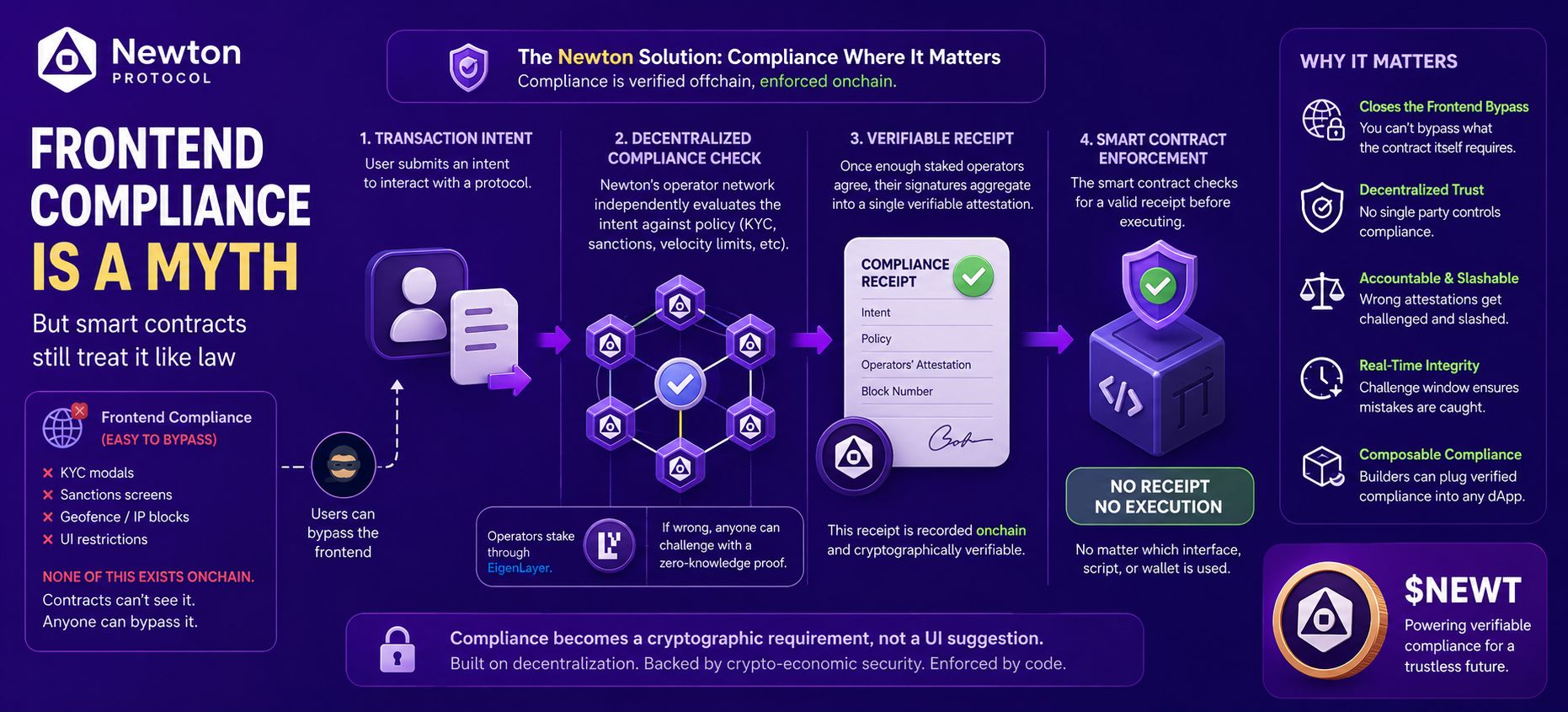
i've been thinking about how much of "onchain compliance" today is really just a website doing its best.
most protocols that claim to be compliant have a KYC modal, a sanctions screening popup, maybe a jurisdiction block based on IP. it feels like a real control. it looks like enforcement.
at first, i assumed that was good enough — a reasonable first line of defense while the industry figures out something better.
It isnt.
a smart contract has no idea any of that happened. the frontend is just a website talking to the chain. any user who wants to skip the interface can call the contract directly through etherscan, through a script, through any wallet that isnt the sanctioned one. the sanctions screen, the geofence, the KYC modal none of it exists at the point where the transaction actually executes. the enforcement boundary and the execution boundary were never the same thing to begin with.
What stood out was how Newton Protocol reframes where the check needs to live. not at the interface, where its optional and bypassable but inside the transaction path itself, where a contract can actually refuse to run without it.
heres the mechanism: when a transaction intent is submitted, Newton's operator network evaluates it against a defined policy sanctions, KYC, velocity limits, whatever the application requires — and independently signs the result. once enough staked operators agree, their signatures aggregate into a single verifiable attestation. that attestation, along with the transaction intent, the policy that was applied, and the block number, becomes a compliance receipt recorded onchain. the smart contract is built to check for that receipt before it will execute the transaction at all.
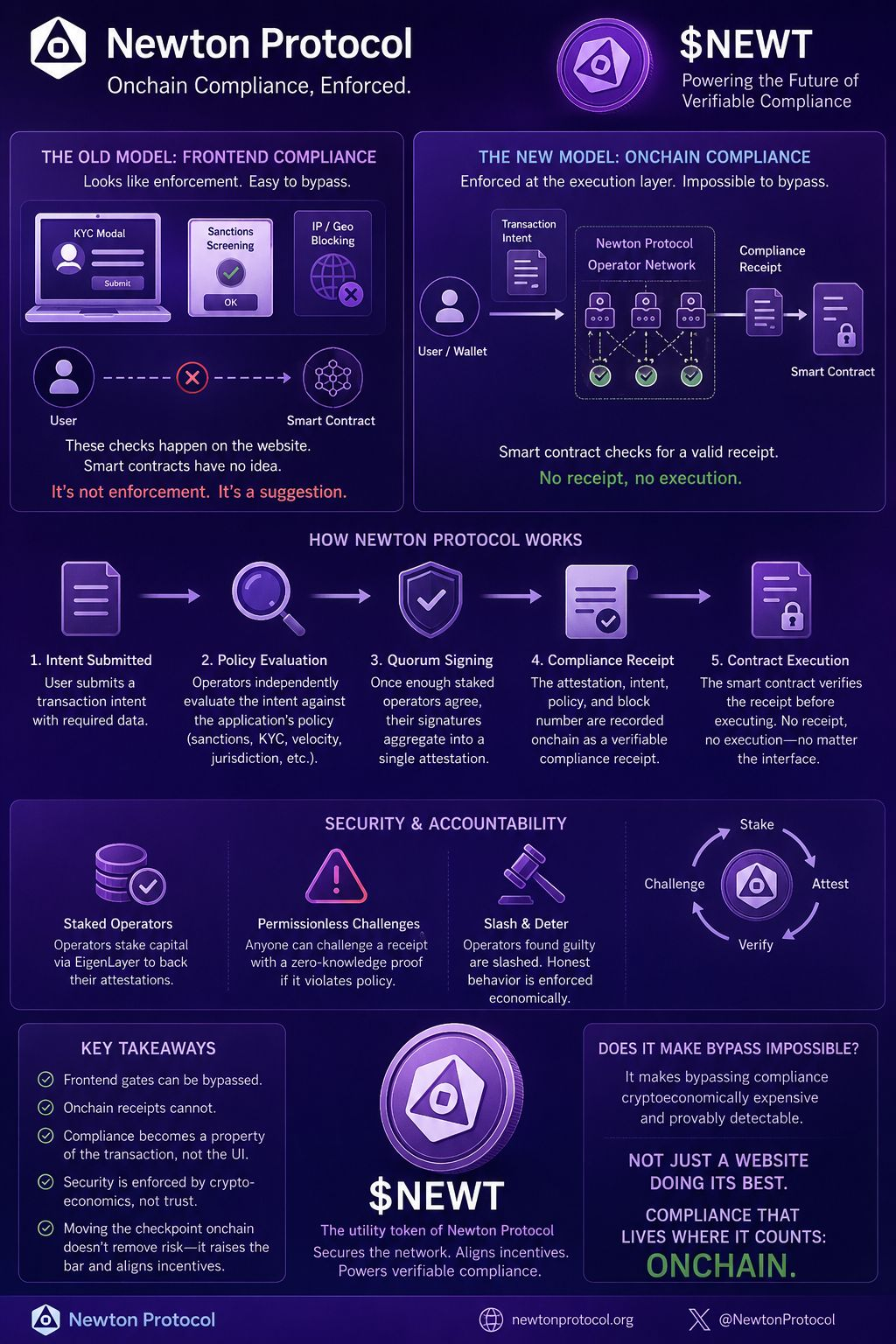
Thats the strength of the design. compliance stops being a UI feature a user can just avoid, and becomes a condition the code itself enforces. no receipt, no execution regardless of which interface, script, or wallet the transaction came from.
But something kept nagging at me here.
if smart contracts now hard-require this receipt to function, that receipt becomes the single most load-bearing piece of the entire transaction flow. every transfer, every mint, every trade routes through it. that sounds like it just relocates the old problem — a UI a user could bypass becomes a receipt system the whole protocol now depends on.
Newton's structural response is that the receipt isnt issued by one party. its produced by a decentralized set of operators, each independently evaluating the policy and staking capital through EigenLayer to back their attestation. if a receipt turns out to be wrong, anyone not just a registered operator can challenge it with a zero-knowledge proof, and the operators responsible get slashed.
Thats the part i havent fully settled.
moving the checkpoint into the contract layer does close the frontend-bypass problem completely. but it also means the entire system now leans on the operator quorum showing up honestly and the challenge window actually catching mistakes in real time, not just in theory. the vulnerability doesnt vanish. it just moves from "a user skipping a webpage" to "a quorum failing to do its job correctly."
so does replacing frontend gates with cryptographic receipts actually make bypassing compliance impossible, or does it just raise the cost and sophistication required to attempt it??
does it make bypass impossible, or does it just make it more expensive??
#newt #Newt @NewtonProtocol $NEWT