
I m watching AI agents become increasingly capable of managing digital tasks, and one question keeps coming back: should they also be trusted to manage crypto assets?
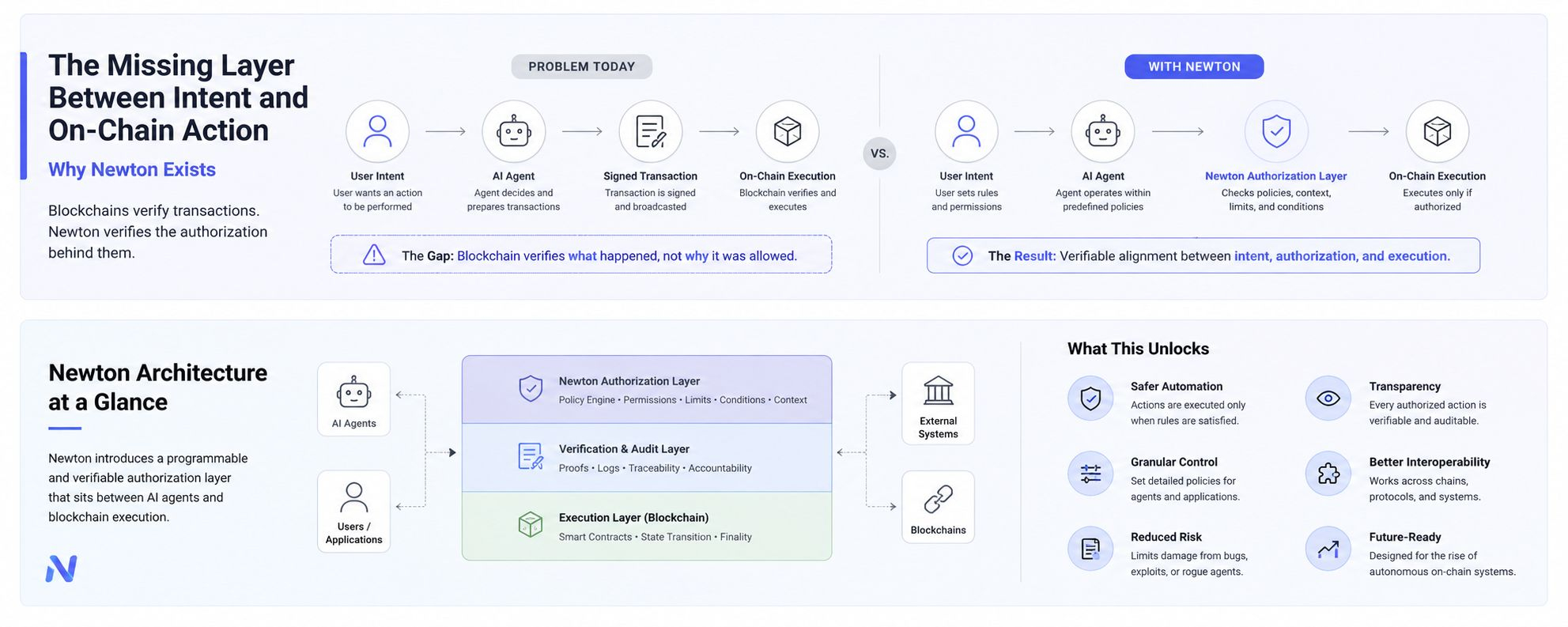
That question is more important than it first appears. Blockchains already do an excellent job of verifying what happened. They confirm signatures execute smart contracts and record transactions permanently. But they do not necessarily verify whether an automated action truly matched the user's intent.
This is the problem that helps explain why Newton (NEWT) exists. MN
The project's core idea is not simply making AI interact with blockchains. It is exploring whether authorization itself can become programmable verifiable and easier to audit before autonomous software is allowed to perform sensitive actions.
That distinction matters.
Today's wallets typically treat permission as a binary choice. A user signs a transaction or grants an approval and software receives the authority to act within those limits. As AI agents become more autonomous however those permissions may no longer reflect the user's real intentions in every situation.
Imagine an AI assistant managing a treasury rebalancing assets or interacting with multiple DeFi protocols. Even if every transaction is technically valid users may still want additional conditions. Perhaps spending should remain below a certain limit only approved protocols should be accessible, or transfers should occur only during specific circumstances.
Traditional blockchain infrastructure does not always evaluate those kinds of contextual rules.
Newton explores whether those rules themselves can become part of the authorization process. Instead of verifying only that a transaction was signed the system aims to verify that the transaction satisfied predefined permission policies before execution.
If successful this changes where security is applied. Rather than protecting only private keys, the protocol also attempts to protect decision making.
That approach offers several potential advantages.
Programmable authorization could reduce the damage caused by compromised AI agents or software bugs by limiting what automated systems are allowed to do. It may also improve transparency because permissions become explicit rather than remaining hidden inside application logic.
At the same time this approach introduces new challenges.
Authorization systems are naturally more complex than simple signature verification. Every additional rule creates more logic to design audit and maintain. Poorly designed policies could introduce unexpected vulnerabilities even if the underlying cryptography remains secure.
Developer experience is another important factor. Security frameworks are only valuable if developers can implement them without creating excessive friction. A technically elegant system that proves difficult to integrate may struggle to gain meaningful adoption.
Interoperability also deserves attention. AI agents rarely operate within a single application or blockchain. Their usefulness increasingly depends on interacting across wallets protocols and off chain services. Authorization systems become far more valuable if they can maintain consistent permission models across those different environments.
Perhaps the biggest lesson is that no protocol completely removes trust. It changes where trust is placed.
With Newton users still rely on the correctness of authorization policies software implementations and governance decisions. Evaluating those assumptions is just as important as evaluating the underlying blockchain.
For me Newton is most interesting not because it promises smarter AI but because it asks a practical infrastructure question: How can autonomous systems prove they acted within the boundaries users actually intended?
As AI agents continue expanding their role in decentralized finance answering that question may become just as important as verifying the transactions themselves.
