
Newton Protocol: The Real AI Revolution Won't Be About Smarter Agents—It Will Be About Smarter Rules
Imagine giving an AI complete control over your crypto portfolio.
It can trade 24 hours a day, bridge assets across multiple blockchains, stake tokens, rebalance positions, provide liquidity, and react to market conditions in seconds. It never sleeps, never gets tired, and never misses an opportunity.
Now imagine that same AI making one incorrect decision.
One faulty permission.
One malicious interaction.
One unexpected smart contract.
Within moments, years of accumulated capital could disappear—not because the AI wasn't intelligent enough, but because nothing stopped it from making the wrong move.
That thought changed the way I evaluate AI projects in crypto.
Most investors are fascinated by what autonomous agents can do. I find myself far more interested in what prevents them from doing something they shouldn't.
That simple shift in perspective is exactly why Newton Protocol earned a place on my research list.
The AI Narrative Is Missing Its Most Important Question
Artificial intelligence has become one of the strongest narratives in the blockchain industry. Every week introduces another protocol promising autonomous trading, intelligent DeFi strategies, automated treasury management, or AI-powered financial assistants.
The innovation is exciting.
But I believe the industry is asking the wrong question.
Everyone wants AI that is faster.
Everyone wants AI that is smarter.
Very few people are asking whether AI is accountable.
As autonomous agents begin managing larger amounts of capital, interacting with dozens of protocols, and making increasingly complex financial decisions, accountability becomes just as important as intelligence.
Without clear boundaries, even the smartest system can become a source of unnecessary risk.
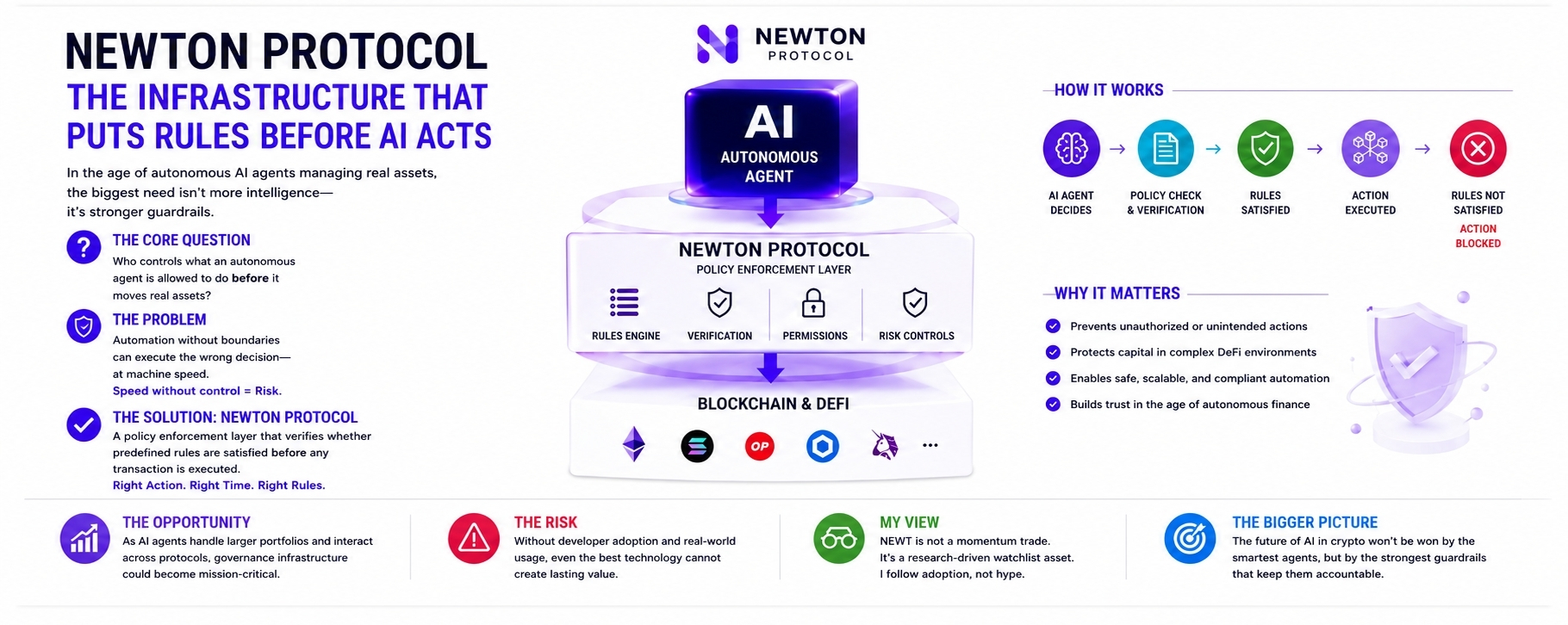
Newton Protocol Isn't Trying to Build a Better AI
This is what makes Newton Protocol different.
Instead of competing to create another intelligent agent, the project focuses on the invisible layer that determines how those agents behave.
Think of it as building the rulebook before the game begins.
Rather than allowing software to execute every possible action, Newton aims to ensure that predefined policies are verified before execution ever takes place.
That may sound like a subtle distinction.
I don't think it is.
It's the difference between reacting to mistakes after they happen and preventing them from happening in the first place.
In traditional finance, every significant institution operates within compliance frameworks, approval systems, and operational policies.
As decentralized finance matures, autonomous software will likely require similar guardrails.
Someone has to build that infrastructure.
Newton Protocol wants to become part of that foundation.
Speed Isn't the Biggest Problem in Crypto
Crypto has spent years optimizing performance.
We have faster blockchains.
Cheaper transactions.
Improved scalability.
Lower latency.
Greater automation.
Yet many of the industry's largest failures didn't happen because technology was too slow.
They happened because automated systems executed actions exactly as instructed—even when those instructions led to catastrophic outcomes.
Automation without governance simply accelerates mistakes.
That's why I believe policy enforcement may become one of the most underrated sectors in Web3.
The future isn't just about moving assets faster.
It's about ensuring they're moved responsibly.
Why This Opportunity Could Matter
If autonomous AI becomes a normal part of decentralized finance, entirely new infrastructure will be required.
Developers won't only need machine learning models.
They'll need permission systems.
Execution policies.
Verification frameworks.
Identity controls.
Risk parameters.
Governance layers.
All of these components become increasingly valuable as financial automation expands.
Should Newton establish itself as reliable infrastructure for this growing ecosystem, it could occupy an important niche that relatively few blockchain projects are addressing today.
Infrastructure rarely attracts the loudest headlines.
It often creates the strongest long-term value.
But Great Technology Isn't Enough
A compelling vision alone doesn't justify an investment.
Crypto history offers countless examples of technically brilliant projects that failed because almost nobody built on top of them.
Infrastructure only becomes valuable when developers choose to integrate it.
That means Newton's future depends less on technical documentation and more on ecosystem growth.
Are developers building?
Are applications launching?
Are autonomous agents actually using policy-based execution?
Are real users interacting with the protocol?
Those questions matter far more than temporary price rallies.
Why I'm Watching NEWT Closely
For now, I don't view NEWT as a speculative momentum trade.
I view it as a long-term research position.
Every update tells a bigger story than the daily chart.
Instead of chasing short-term volatility, I'm paying attention to adoption metrics:
• Growth in developer activity.
• Expansion of ecosystem partnerships.
• Increasing on-chain usage.
• Real applications deploying the protocol.
• Organic demand rather than narrative-driven speculation.
Those signals reveal whether the protocol is becoming useful—or simply becoming popular.
There is a significant difference.
The Biggest Opportunity May Be Trust
Everyone assumes the winners of the AI era will be the projects creating the smartest autonomous agents.
I'm not convinced.
History suggests that every technological revolution eventually depends on trust.
The internet required encryption.
Cloud computing required security.
Digital payments required fraud protection.
Artificial intelligence in finance will likely require governance.
That could become one of the most valuable infrastructure layers of the next blockchain cycle.
If autonomous software is going to manage billions of dollars in digital assets, users won't simply ask whether an AI can execute a transaction.
They'll ask whether it should.
The protocols capable of answering that question may become some of the most important infrastructure projects in Web3.
Final Thoughts
Newton Protocol hasn't proven that it will dominate this emerging category.
It still faces the same challenge confronting every early-stage blockchain project: attracting developers, building a thriving ecosystem, and delivering real-world adoption.
But I believe it's asking one of the most important questions in decentralized AI.
Instead of chasing intelligence alone, it's exploring how intelligence can operate safely, transparently, and within clearly defined limits.
As AI becomes more autonomous, governance may become just as valuable as computation.
The next generation of blockchain innovation may not be remembered for creating the smartest machines.
It may be remembered for creating the systems that made those machines trustworthy.
What are your thoughts?
As AI continues transforming decentralized finance, where do you believe the greatest long-term value will emerge—from building increasingly powerful autonomous agents, or from building the infrastructure that keeps those agents accountable?