Most mainnet launches blur together after a while.
Big promises, bold marketing, and the same familiar claims about speed and scalability.
That’s why Dusk’s recent step felt different. Not because it tried to be louder than the rest, but because it addressed a problem many users quietly experience and rarely talk about.
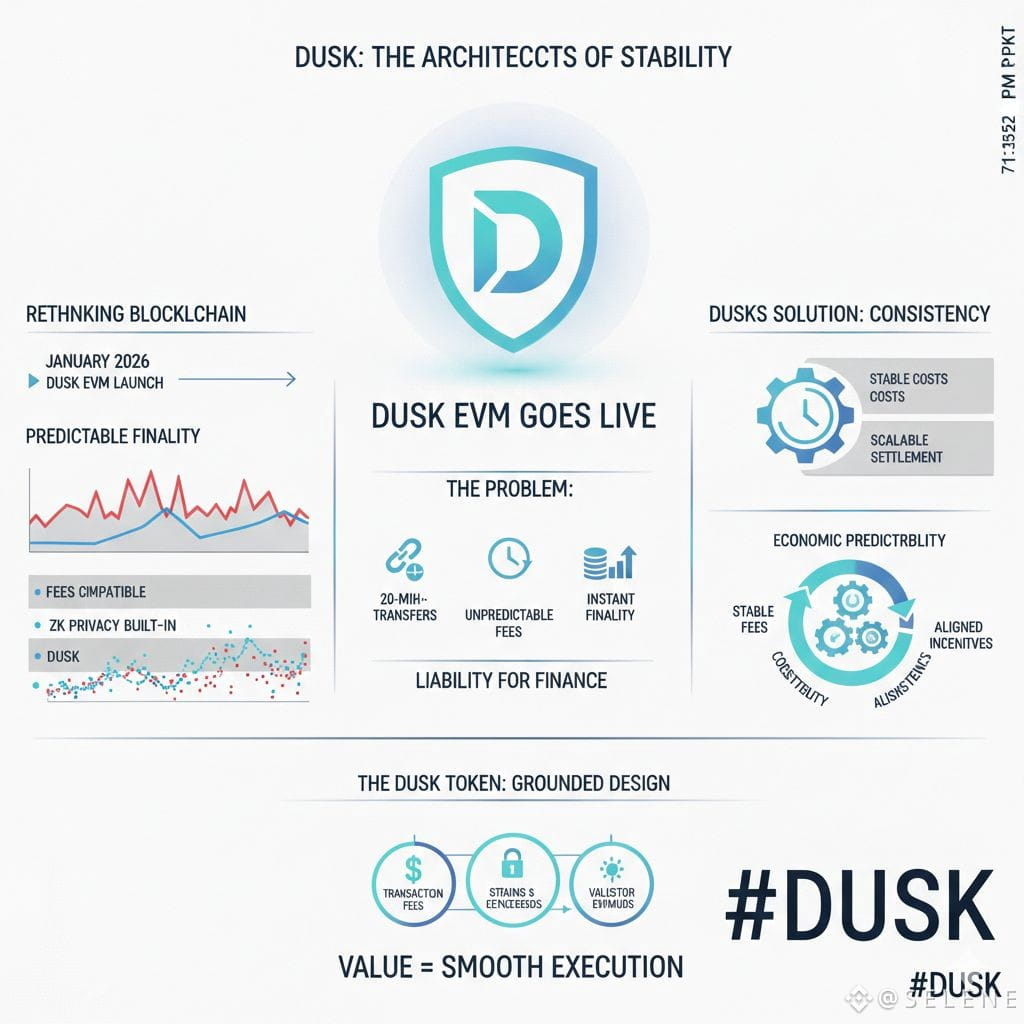
In January 2026, DuskEVM went live.
On the surface, it reads like a technical upgrade Solidity compatibility combined with built-in zero-knowledge privacy, designed to operate within MiCA-compliant frameworks. Useful
yes, but not exactly something that usually grabs attention.
What made it stand out was timing.
Just days earlier, a simple cross-chain transfer on another network took nearly twenty minutes to settle.
Fees spiked unexpectedly, blocks became congested, and the entire experience felt fragile.
It was a reminder of how many blockchains still behave unpredictably under real demand.
For systems that aim to support payments, tokenized assets, or regulated finance, that unpredictability is more than an inconvenience.
It’s a liability.
Dusk takes a different path. Instead of chasing peak throughput or marketing-friendly metrics
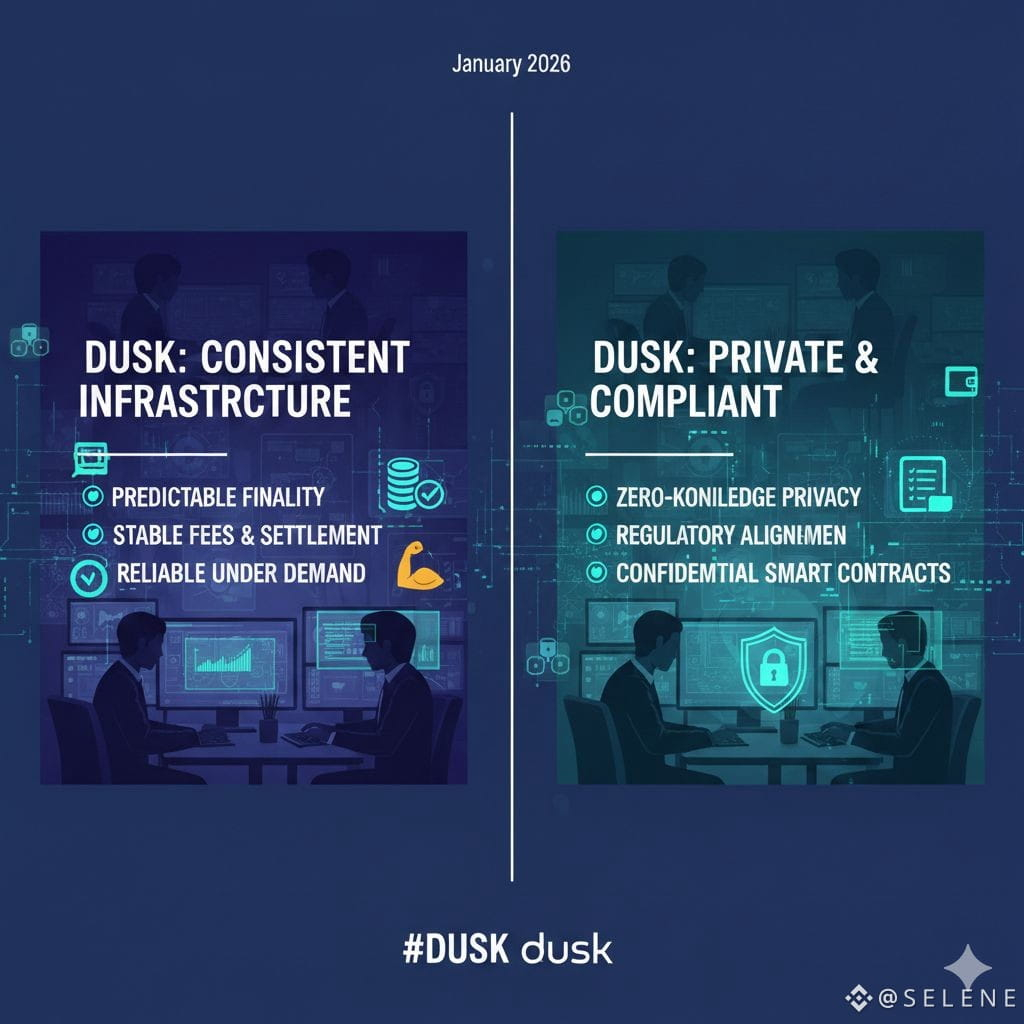
it focuses on consistency. Its design prioritizes predictable finality and clean settlement even as network activity grows.
Blocks don’t suddenly slow down or behave differently when demand increases.
That stability matters when financial operations need to reconcile accurately and on time.
This philosophy shows up clearly in how Dusk positions itself.
It doesn’t present as a consumer product or a speculative playground.
It feels more like infrastructure. The kind you don’t notice when everything works, but immediately miss when it doesn’t. Similar to reliable internet or payment rails
its value is measured in smooth execution rather than excitement.
Privacy is another area where Dusk’s approach stands out.
Zero-knowledge technology is built directly into the execution layer, allowing transactions and smart contracts to remain confidential without breaking regulatory alignment.
This balance is rare.
Many networks treat privacy and compliance as opposing forces, forcing projects to choose one or the other.
Dusk instead treats them as requirements that must coexist, especially if real-world assets and institutions are involved.
The role of the DUSK token reinforces this grounded design.
There’s no unnecessary complexity.
DUSK is used to pay transaction fees stake for consensus participation and reward validators who secure the network.
Incentives are clear and aligned with long-term reliability rather than short-term speculation.
Validators are compensated for honesty and uptime not for chasing volatility.
Low fees and near-instant finality make the network practical for everyday financial activity, but the real strength lies in predictability.
When costs remain stable and settlement times are reliable, developers and institutions can plan with confidence.
That’s essential for tokenized assets, compliance-heavy applications and cross-chain workflows that require trust in timing and execution.
As real assets begin to enter blockchain environments and cross-chain flows become more common, infrastructure quality becomes more important than novelty.
Dusk doesn’t feel like an experiment trying to prove a concept.
It feels like a system being quietly put in place for long-term use.
There’s no hype-driven excitement here.
No promises of revolution overnight. Instead, there’s reassurance. The kind that comes from systems designed to work consistently, even when conditions are less than ideal.
In a space often driven by noise, Dusk’s mainnet milestone is a reminder that sometimes the most meaningful progress is the kind that simply.