
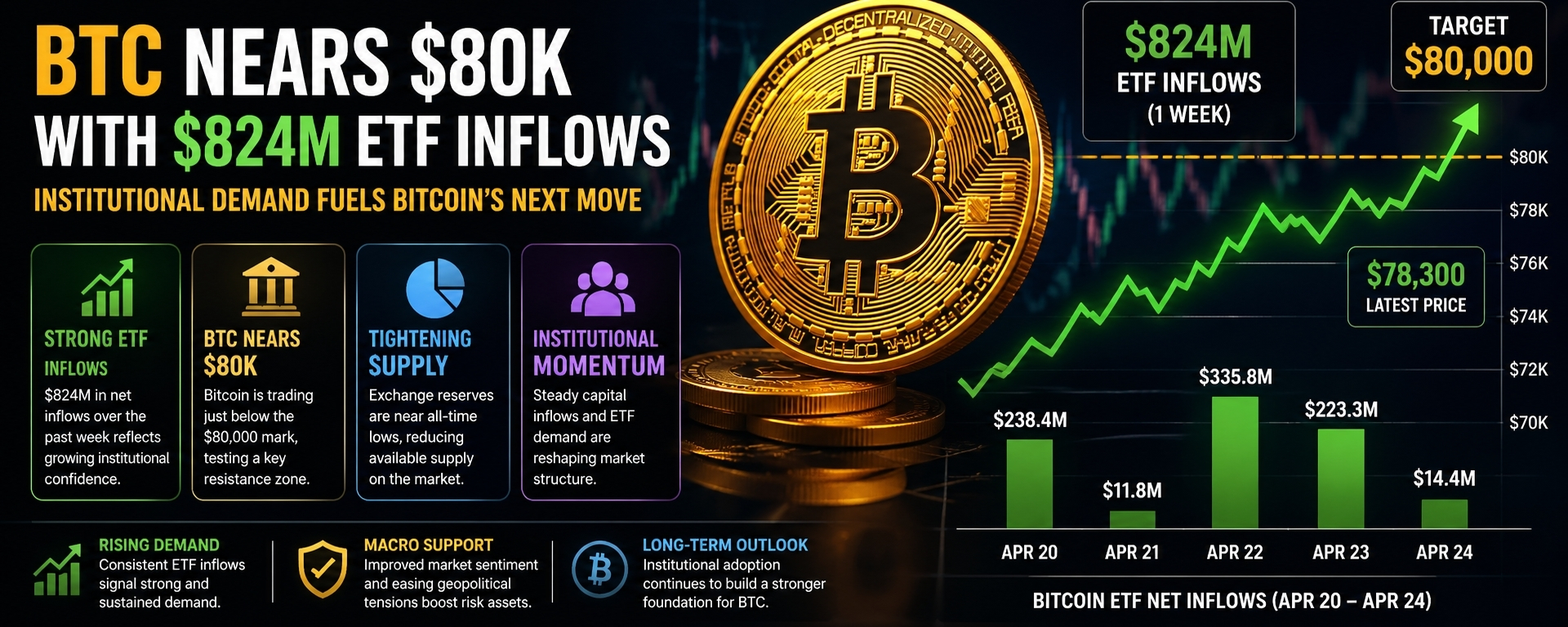

Bitcoin is once again drifting toward the $80,000 mark, and at first glance, it feels like a familiar moment. Price climbs, excitement builds, and the same question starts circulating: is this the breakout everyone has been waiting for?
But if you sit with the chart a little longer, something feels different this time. The move isn’t loud. It isn’t chaotic. It feels… steady.
And that’s where the real story begins.
A Slow Climb Toward a Loud Number
There’s something about round numbers in markets. They carry weight, even if nothing fundamentally changes at that exact level.
Right now, Bitcoin is hovering just below $80K, and you can almost feel the tension building. Some traders are getting ready for a breakout. Others are waiting to sell into strength. It’s that classic push-and-pull that happens whenever price approaches a psychological barrier.
But what stands out isn’t just where Bitcoin is—it’s how it got here.
This hasn’t been a straight vertical move. It’s been a gradual climb, with pauses, small pullbacks, and a sense that buyers aren’t rushing—they’re just… showing up.
The Quiet Force Behind the Move
Underneath the price action, there’s a quieter driver at work: ETF inflows.
Over a recent week, about $824 million flowed into Bitcoin ETFs. That number doesn’t scream hype. It doesn’t go viral. But it matters more than most headlines.
Because this isn’t fast money chasing candles. This is structured capital entering through channels designed for longer-term exposure.
It changes the mood of the market.
Instead of sharp spikes driven by emotion, you get something more controlled. More patient. It’s less about excitement and more about positioning.
Not a Rush—More Like a Drift Upward
What’s interesting is how these inflows showed up.
There were a couple of strong days midweek where money came in aggressively. Then things slowed down. Not reversed—just slowed.
That detail matters.
If this were purely hype-driven, you’d expect either constant acceleration or a sudden drop-off. But this looks different. It looks like demand that doesn’t need to chase.
Buyers stepped in when they wanted exposure, and then they let the market breathe.
That’s not something you see in every rally.
Supply Isn’t Fighting Back
At the same time, there’s another subtle shift happening.
There aren’t as many sellers.
Long-term holders don’t seem eager to exit at these levels. Coins aren’t flooding back onto the market. And when supply stays quiet while demand keeps coming in—even gradually—it creates pressure.
Not explosive pressure. More like a tightening.
And in markets, tightening often leads to movement—it just doesn’t always happen immediately.
A Market That Feels More Balanced
One of the easiest mistakes to make right now is assuming this is a typical Bitcoin surge.
It’s not.
There’s still volatility. There’s still speculation. But the structure feels more balanced. It’s not being driven entirely by short-term traders jumping in and out.
There’s a layer of capital underneath that seems more patient.
That doesn’t mean the market is safer. It just means it behaves a little differently.
The $80K Question Everyone’s Asking
Naturally, the big question is whether Bitcoin will break above $80,000.
But that’s only half the story.
Breaking a level is one thing. Staying above it is something else entirely.
If Bitcoin pushes past $80K but demand fades, the move could stall quickly. But if it breaks through and those ETF inflows keep coming, the market could start building momentum on top of a stronger foundation.
Right now, it’s sitting right at that decision point.
What’s Supporting This Move Right Now
There isn’t just one reason Bitcoin is holding up here—it’s a mix of small things working together.
Steady ETF inflows are creating consistent demand.
Selling pressure is relatively low, which keeps the market from getting overwhelmed.
And overall sentiment across markets feels stable enough that risk-taking hasn’t disappeared.
None of these factors are dramatic on their own. But together, they’re enough to support a slow climb.
What Could Change the Direction
Even with this steady structure, nothing is guaranteed.
If ETF inflows slow down significantly, the market could lose one of its key supports.
If broader financial conditions shift, Bitcoin could feel the impact quickly.
And if too many traders start expecting an easy breakout, the market might do what it often does—move the other way.
That’s the nature of it.
A Subtle Shift in Who’s Driving the Market
There’s also a deeper change happening beneath all of this.
Bitcoin used to move mostly on retail energy—fast decisions, emotional trades, sudden momentum.
That energy is still there. But now, it’s sharing space with something else.
More investors are entering through ETFs. They’re not reacting to every price move. They’re thinking in terms of allocation, exposure, and time.
That shift doesn’t remove volatility. But it does change the rhythm.
Final Thought
Bitcoin getting close to $80K isn’t just about price.
It’s about the way the market is moving—more measured, more structured, and a little less frantic than before.
That doesn’t mean a breakout is guaranteed. And it doesn’t mean a pullback is off the table.
It just means this moment feels different.
Not louder.
Just… steadier.