

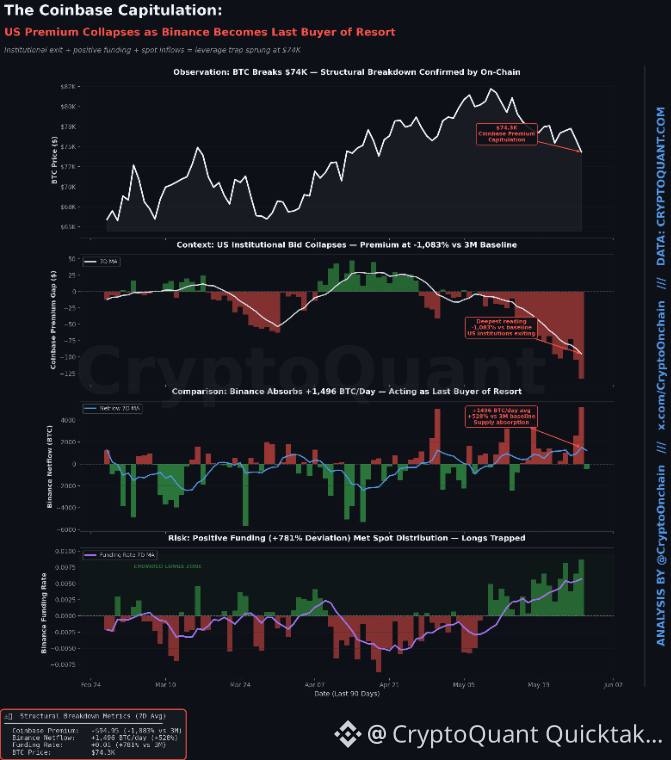
The structural weakness highlighted in recent analyses has now fully materialized. Bitcoin’s drop to $73K was not a random selloff, but the result of a growing divergence between weakening spot demand and overheated derivatives positioning — a warning on-chain data had been signaling for weeks.
The clearest sign of stress came from the Coinbase Premium Index, which plunged to a -1,083% deviation from its 3-month average. Historically, readings at this level appear during major distribution phases, not ordinary pullbacks. The raw premium gap reached -94.95, showing that US-based investors were selling aggressively below offshore market prices. When the largest regulated crypto market trades at a persistent discount, it typically signals institutional exit rather than simple profit-taking.
At the same time, Binance absorbed much of that selling pressure. Binance BTC Netflow shifted to an average inflow of +1,496 BTC over the past seven days — a +528% deviation above its 3-month average. This suggests that supply leaving US-regulated venues, including Coinbase and ETFs, is moving toward Binance, where global retail traders and market makers are attempting to absorb the excess supply.
The derivatives market further intensified the decline. Binance Funding Rates were running +781% above their 3-month average shortly before the crash, indicating that leveraged traders were still heavily positioned long while spot markets weakened. The move toward $73K likely triggered a wave of long liquidations, accelerating downside momentum.
Three weeks ago, the data pointed to a warning. Today, it confirms active distribution. The key question now is whether Bitcoin can stabilize around $73K or if remaining leveraged positions will push the market toward the stronger on-chain support zone between $70K and $72K.
Written by CryptoOnchain