
On April 7, 2026, the cryptocurrency market is at a critical turning point. Bitcoin has pulled back to around $68,500 after breaking through $70,000, while Ethereum is fluctuating around $2,100. The core contradiction in the market is reflected in the fierce game between continuous inflows of institutional capital and geopolitical risks — the net inflow of the U.S. spot Bitcoin ETF exceeded $470 million in a single week, completing a new round of "chip exchange" between retail and institutional investors, while Trump's April 7 deadline set for Iran puts pressure on risk assets. Looking ahead, the promotion of the (CLARITY Act) and the Fed's policy window provide support for the market, but the situation in the Strait of Hormuz and the upcoming release of over $540 million in tokens in April pose dual challenges. Investors are advised to adopt a "core position + flexible hedging" strategy to conduct swing trading in the $65,000-$75,000 range.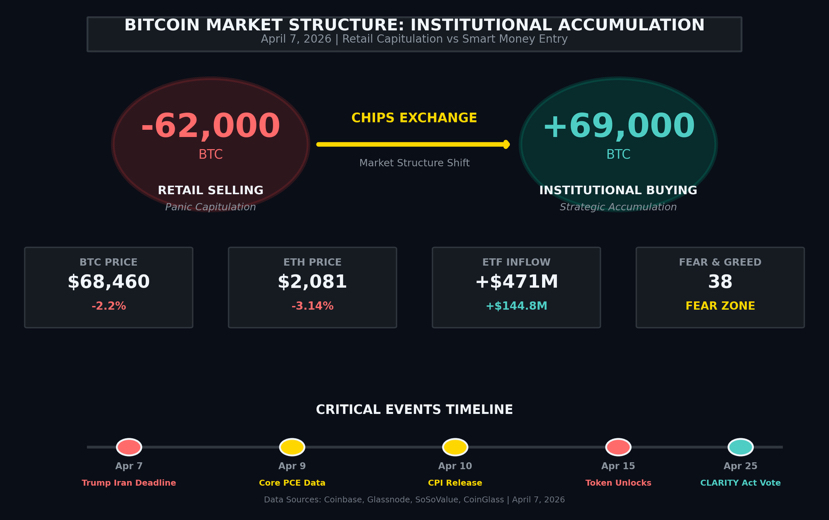
In-depth market analysis
1. Market review: The tug-of-war at the $70,000 threshold
As of the morning of April 7 London time, Bitcoin was trading at approximately $68,460, down 2.2% on the day, erasing the gains from the previous trading day that broke $70,000. This price level marks Bitcoin's first return to the $70,000 threshold since March, but bulls failed to hold their ground. Ethereum's performance has been relatively weak, currently at $2,081, down 3.14% on the day, but still recording a 4.9% gain for the week, indicating strong support at the $2,000 level.
The overall market capitalization remains at $2.38 trillion, with the fear and greed index reading 38. Although still in the fear zone, it has risen 10 points from last week, indicating that market sentiment is slowly recovering. Notably, Bitcoin's market share remains stable between 58.4%-58.7%, suggesting that capital is more inclined to flow into mainstream assets rather than high-risk altcoins.
2. Macroeconomic environment and geopolitical factors: repricing of safe-haven and risk assets
The greatest uncertainty currently facing the market stems from the situation in the Middle East. President Trump set an April 7 deadline for Iran to reopen the Strait of Hormuz or face threats to strike Iranian civilian infrastructure. Meanwhile, Iran has rejected ceasefire proposals, and the risk of escalation in U.S.-Iran conflicts is putting pressure on global stock markets, with S&P 500 futures down 0.4%.
On the macro data front, the U.S. added 178,000 non-farm jobs in March, far exceeding the expected 60,000, and the unemployment rate fell to 4.3%, while the ISM Manufacturing PMI recorded 52.7. Strong employment data has reduced expectations for the Federal Reserve to cut rates in the short term, with the market generally expecting interest rates to remain unchanged for the remainder of 2026. This "high rates lasting longer" environment is usually unfavorable for risk assets, but Bitcoin has recently shown safe-haven properties similar to gold; since the regional conflict broke out at the end of February, gold has dropped over 10%, while Bitcoin has remained relatively resilient.
3. Financial perspective: structural changes in institutional accumulation and retail exit
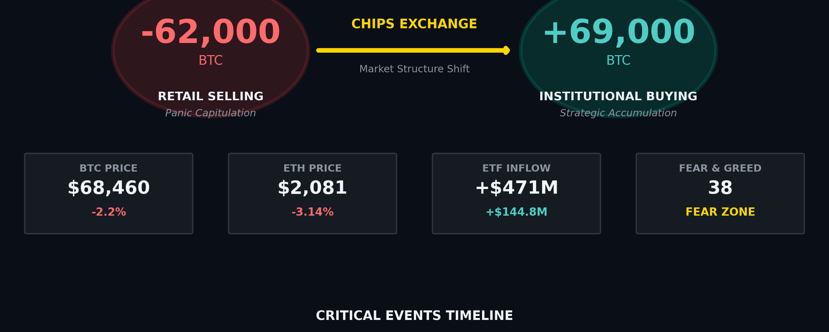
On-chain data reveals the most profound structural changes in the market over the past three months: retail investors have sold a total of 62,000 bitcoins, while institutional and corporate investors have increased their holdings by 69,000 during the same period. This "blood exchange" phenomenon marks a transition from a retail-driven market to one led by institutions.
The inflow of funds into the U.S. spot Bitcoin ETF provides direct evidence. In the week of April 7, net inflows into Bitcoin investment products reached $144.8 million, while Ethereum products saw inflows of $40.1 million. On a single day, Monday, U.S.-listed Bitcoin spot ETFs recorded a net inflow of $471.3 million, continuing the positive momentum from the previous week. Strategy (formerly MicroStrategy) increased its holdings by 4,871 bitcoins in the first quarter of 2026, bringing its total holdings to 766,970; Metaplanet purchased 5,075 coins, rising to become the third-largest corporate holder globally.
This institutional trend is also reflected in the Ethereum ecosystem. The Ethereum Foundation staked over 45,000 ETH in April, raising its total staked amount to 69,500, just 500 short of achieving the strategic target of 70,000. The foundation has converted its treasury holdings into interest-generating assets, providing funding for operations while avoiding selling ETH at low market levels, releasing a strong bullish signal.
4. Technical analysis and key price levels
Bitcoin has been oscillating in the $65,000-$75,000 range for over a month. From a technical perspective, $67,500 is a key support level; if it holds, it could lay the foundation for a new round of upward momentum; if it fails, it may test the $66,000-$68,000 support band. Notably, about 45% of Bitcoin's supply is currently in a state of unrealized loss, a metric that historically often signals either a panic sell-off "capitulation" or a late-stage accumulation phase.
Ethereum has formed strong support in the $1,800-$1,900 range, with resistance initially at $2,100, and if broken, the target will shift to $2,300-$2,400. The continuous decline in ETH reserves on exchanges indicates reduced immediate selling pressure, and if demand rebounds, it may create supply constraints.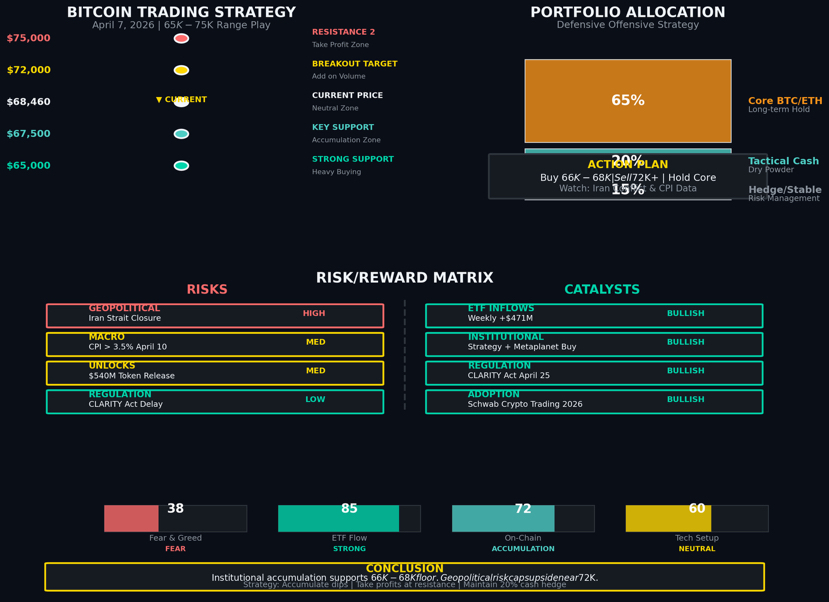
5. Regulatory catalysts: (CLARITY Act) and pension funds entering the market
Progress on the regulatory front provides potential upward catalysts for the market. Coinbase Chief Legal Officer Paul Grewal stated that negotiations on the stablecoin yield provisions in the (CLARITY Act) are "very close" to reaching an agreement, with a vote expected in late April. If passed, it will provide a clear regulatory framework for digital assets, removing the biggest barrier to institutional entry.
Further impacts may come from the U.S. Department of Labor's proposed rule, which provides a "safe harbor" for 401(k) plan managers, allowing them to offer cryptocurrency-linked investments, theoretically opening up an $8 trillion retirement savings market. Charles Schwab announced plans to launch spot Bitcoin and Ethereum trading services in the first half of 2026, marking the traditional brokerage's expansion from ETFs to direct digital asset trading.
Operational strategy recommendations
Based on the above analysis, the current market environment is suitable for adopting a "defensive offensive" strategy:
Core position allocation (60%-70%): Maintain a high proportion allocation to Bitcoin and Ethereum (recommended ratio 7:3 or 6:4). Gradually increase holdings in Bitcoin in the $66,000-$68,000 range, and consider long-term allocation in Ethereum below $1,900. This part of the position serves as "digital gold" and infrastructure assets, ignoring short-term volatility.
Dynamic position management (20%-30%): Engage in swing trading within the $65,000-$75,000 range. If Bitcoin breaks above $72,000 with volume, consider going long, targeting previous highs; if it drops below $65,000 due to geopolitical conflicts, reduce positions and wait for stronger support around $60,000. Closely monitor the U.S. core PCE price index on April 9 and the CPI data on April 10; if inflation exceeds expectations, it could trigger sell-offs in risk assets.
Risk hedging: Given the uncertainties in the Middle East situation, it is recommended to retain 10%-15% in cash or stablecoins as maneuverable funds. If conflicts in the Strait of Hormuz escalate, leading to sustained high oil prices, consider temporarily reducing risk exposure. Also, pay attention to the unlocking pressure of over $540 million in tokens in April, to avoid heavy positions in altcoins with high unlocking risks.
Medium to long-term perspective: The continued inflow of institutional capital and the clarification of regulatory frameworks are reshaping market structure. Even if a short-term pullback occurs due to geopolitical risks, as long as the trend of ETF capital inflows remains unchanged, Bitcoin's support in the $66,000-$68,000 range should hold effectively. Investors should take advantage of the current volatility under fear sentiment to build their core asset positions, waiting for the regulatory dividends to be released after the (CLARITY Act) is passed.#Polymarket将升级交易所架构 #Chaos Labs退出Aave DAO #Strategy增持比特币 #特朗普最后期限施压伊朗 #苹果中国区App Store下架Bitchat $BTC



