


The crypto market is going through one of those moments where patience and strategy make the difference between seizing an opportunity or getting caught in a downturn. Bitcoin has retraced from the peak of almost $126,000 to $89,000, and the general sentiment has cooled quite a bit since the collapse of FTX in 2022.
But here comes the question that many of you ask me: is it time to "buy the dip"? The answer is not as simple as a yes or a no. It depends on your strategy, your risk management, and above all, knowing how to differentiate a temporary pullback from a real trend change.
Let's break down everything you need to know about this strategy so you can make informed decisions.

What does "buying on the dip" actually mean?
Buying on the dip is a strategy that involves entering the market when an asset has dropped in price, hoping it will recover and you can benefit from the rebound. The key is to do it during a general uptrend, where the drops are simply temporary pauses.
The logic is simple: when the market falls due to fear, panic, or profit-taking, but the fundamentals have not really changed, that may be the opportunity. The trick is knowing when it's a healthy correction and when it's the start of something more serious.
Historically, this strategy has worked in times like the COVID crash in March 2020. Those who bought in that drop saw double-digit returns in a few months. Bitcoin has had multiple drops of 30% to 40% within bullish markets, followed by new rises that surpassed previous highs.
But be careful, not all drops are opportunities. Buying without clear signals or risk controls can expose you to significant losses.
What's happening with cryptocurrencies today
To know if it makes sense to apply this strategy now, you first need to understand the current market context.
Bitcoin is moving in the range of 88,000 to 95,000 dollars in November 2025, after having touched highs near 100,000. Ethereum is between 3,100 and 3,300 dollars. The price of cryptocurrencies in general has shown considerable weakness.
Several factors are contributing to this pullback:
Large Asian holders have been selling steadily, making price recovery difficult. Capital inflows into Bitcoin ETFs have slowed down, a sign that institutions are being more cautious. Enthusiasm around new projects has decreased significantly, many small projects are falling apart, and even the stronger ones are receiving less attention.
The excess of new token launches has saturated the market. Altcoins are having a particularly hard time this year due to inflated valuations and few real use cases. And to top it off, the traditional stock market has outperformed crypto, attracting investors who would otherwise have entered here.
The crash on October 10 was a turning point. It caused massive liquidations and reminded everyone how thin liquidity is in many coins. Confidence took a strong hit, and nervous traders withdrew even more.
When it makes sense to buy on the dip
This strategy does not always work nor in any circumstance. There are specific moments when the odds are in your favor.
During an established uptrend
The strategy works best when the overall market is in an uptrend. Pullbacks are seen as pauses before new rises. Buying dips in a bear market is like trying to catch a falling knife.
To confirm the trend, you can use moving averages. If the price stays above the 50 or 200-day moving average, the drop is likely temporary. In the current case of Bitcoin, technically in a short-term downtrend. The 200-day moving average is around 107,000 dollars, which means Bitcoin is trading well below this key resistance.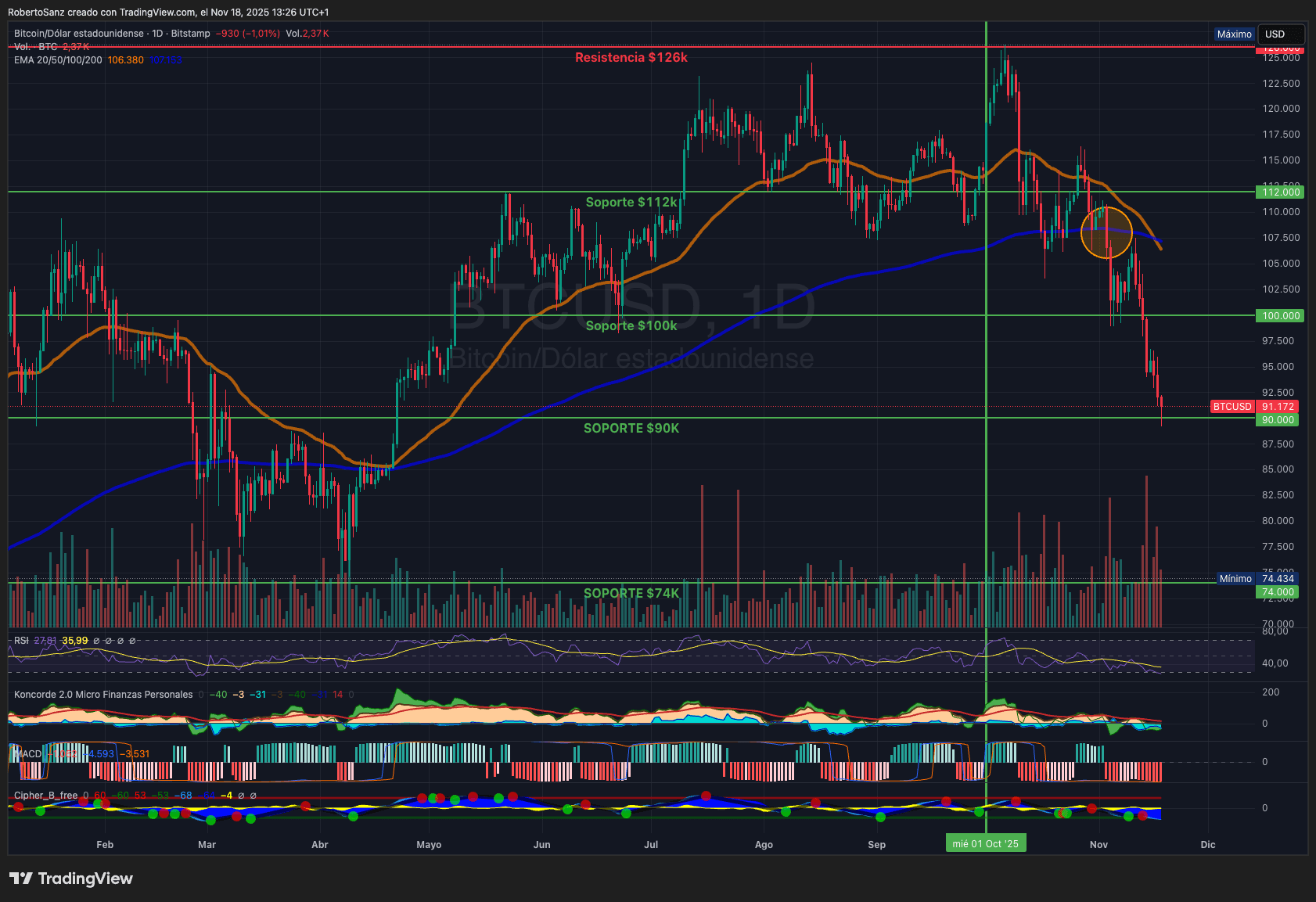
Buy your cryptocurrencies on Binance
With oversold technical indicators
Look for confirmation before entering. An RSI below 30 may indicate oversold conditions. Bullish MACD crossovers near support add conviction. And spikes in buying volume on red days may signal institutional accumulation.
Drops to important technical levels like previous support zones, Fibonacci levels, or ascending trend lines tend to attract buyers. After a strong rally, a pullback to the 38.2 or 50 percent Fibonacci level can be a tactical entry point.
When NOT to use this strategy
Avoid buying dips in sideways markets without a clear direction. Also not during systemic massive sell-offs like financial crises or geopolitical shocks, because those drops can deepen quickly. And certainly, not when there's extreme euphoria and everyone is talking about crypto at all-time high prices.
The typical low liquidity of small altcoins is also a trap. In those cases, a small movement can generate disproportionate losses.
Current technical levels you should watch
To properly apply the strategy, you need to know the relevant levels in the current cryptocurrency prices.
Bitcoin is between 88,000 to 95,000 dollars. Its key supports are at 85,000 dollars and 78,000 dollars. The resistances to overcome are 95,000 and the psychological level of 100,000 dollars.
Ethereum moves between 2,800 and 3,100 dollars. Significant supports are at 2,500 dollars as a psychological level and 2,000 as a strong technical support. Resistances are between 3,500 and 4,000 dollars.
For those trading in euros, the current price of cryptocurrencies in euros is approximately 82,000 to 86,000 euros for Bitcoin and 2,900 to 3,100 euros for Ethereum, considering the current exchange rate.
The value of cryptocurrencies should be evaluated not only in nominal terms but in relation to their utility, institutional adoption, and position within the broader market.
Mistakes you should avoid at all costs
I've seen these mistakes over and over again, and they are what differentiate those who make money from those who lose it.
Confusing low price with value
Just because something has dropped doesn't mean it's a bargain. Ask yourself not only how much it has fallen but whether it should bounce back. Check if the fundamentals remain solid or if something fundamental has changed.
Entering without confirmation
The most common mistake is buying too soon, during the drop itself, before any signal that the market is stabilizing. This leads to repeated stops or deep losses.
Look for reversal signals like bullish engulfing candles, divergences, or breakouts above previous lows. Entering after seeing stabilization increases your success rate, even if you miss the exact bottom. Believe me, it's better to lose the first 5 percent of the move than to lose 20 percent waiting for a bottom that never comes.
Putting all capital in at once
Many traders make the mistake of entering with their entire position on the first drop. If the market falls further, they have no room to maneuver and losses are amplified.
Use partial entries. If you have 500 euros to invest, consider entering with 150 euros initially and reserving the rest for additional purchases if the price drops further. This is especially useful if you're just starting to invest in cryptocurrencies with little money.
Ignoring time frames
If you are using 1-hour charts but expect recoveries over weeks, your strategy is not aligned. A setup on a 1-hour chart requires tighter stops and quicker exits than a trade based on daily or weekly drops.
Risk management: what really matters
You can have the best strategy in the world, but without proper risk management, you won't get far. This is fundamental.
Always use stop loss
Place stops just below the last swing low of the pullback. If the price breaks that level, the setup is likely invalid and it's better to exit.
Practical example: if you buy Bitcoin at 88,000 dollars, you could place a stop loss at 84,000 dollars, below the key support of 85,000. If it breaks that level, you accept the loss and exit. That is discipline.
Set realistic goals
Use reward-risk ratios like 2 to 1. If you risk 4,000 dollars on a trade, your target should be at least 8,000 dollars of potential profit.
Following the previous example: entry at 88,000 with a stop at 84,000, risk of 4,000 dollars. Your target could be 96,000 dollars, potential profit of 8,000, ratio 2 to 1. This way, even winning only half of your trades, you come out ahead.
Position size according to your capital
Don't risk more than 5 to 10 percent of your capital per trade. If you are starting with little money, protecting your capital is essential. A series of small losses can wipe out your trading account.
How to apply this if you have little capital
One advantage of cryptocurrencies is that you don't need large amounts to start. Investing in cryptocurrencies with little money is perfectly viable, but it requires even more discipline.
Use fractional entries as I mentioned before. Divide your purchases into several transactions instead of putting it all in at once. With limited capital, it is safer to focus on Bitcoin and Ethereum rather than betting on high-risk altcoins. They have greater liquidity and lower relative volatility.
Limit orders are your friends. They allow you to set purchases at specific levels without needing to be glued to the screen all day. You can buy crypto here and start with amounts that are comfortable for you to practice this strategy.
The current context: mixed signals
Despite all the recent negativity, there are arguments both for and against whether this is a good opportunity.
Positive signals include that Bitcoin's long-term trend remains intact. We have not seen the extreme euphoria that marks the top of a bull market. Global financial conditions are improving with interest rates falling. And the stock market remains strong, historically Bitcoin tends to follow its direction.
The caution signals are that sentiment is at a low since FTX. ETF inflows have slowed considerably. There is constant selling from large Asian holders. And altcoins are particularly weak, which is often a sign of general market weakness.
My personal reading is that we are in a consolidation phase within a broader bull market. But that doesn't mean you should just jump in without more. Wait for the technical confirmations we have discussed.
Conclusion: patience over impulse
Buying on the dip can be a very effective strategy if executed correctly. But it is not a magic formula nor does it always work. It requires patience, discipline, and an honest understanding of the market context and your own risk tolerance.
In the current environment, with Bitcoin retreating from highs but maintaining its long-term technical structure, there may be opportunities for disciplined traders. The key is not to rush, wait for confirmations, and above all manage risk properly.
What you take away from this article: don't buy just because the price has dropped. Wait for reversal signals and technical confirmation. Always use stop loss, without exceptions. Don't commit all your capital at once. And adapt the strategy to your time horizon and risk tolerance.
The market will always be there tomorrow. Your capital, once lost, is much harder to recover. Act with a cool head and a clear plan.
Disclaimer: This content is for educational purposes only and does not constitute financial advice. Cryptocurrencies are high-risk assets, and you can lose all your capital. Always do your own research before investing.
Comment what your next purchase will be, I'll read you in the comments!


