#ETH走势分析 #安全入金 #安全出金小常识 Viewing the truth of things from the standpoint of crime.
Analyze the essence of cases from the perspective of human nature.
The People's Bank of China published an article titled (Coordination Mechanism Meeting on Crackdown on Virtual Currency Trading and Speculation) which clearly pointed out: 'We will continue to adhere to the prohibitive policy on virtual currencies and continue to crack down on related illegal financial activities.' This also means that in the short term, the likelihood of 'policy loosening' for virtual currencies in China is almost zero; on the contrary, regulation will become more normalized and institutionalized.
Dayi was not surprised when he saw this news for the first time, but instead had a clear sense that 'the boot has finally dropped'. Many friends in the crypto space often ask me: 'Does Hong Kong's policy mean that the mainland will soon relax its regulations?' 'Is the current bear market silent, so will regulation loosen up too?'
The content of this central bank meeting may be the most direct and calm response to these fantasies.
At this time point, we must abandon the emotional interference of K-line fluctuations, and seriously consider a key question from the underlying logic of law and regulation: under the main tone of 'continuous crackdown', is there still a place for virtual currency in China?

I. The deeper meaning behind 'continuous crackdown'.
Many people only read the headlines of the news, but as legal professionals, we must delve into the text and understand the 'weight' and 'wording' of official discourse.
This meeting is named 'Coordination Mechanism Meeting on Crackdown on Virtual Currency Trading and Speculation', with participating units including the Ministry of Public Security, the Central Cyberspace Affairs Commission, the Central Financial Office, the Supreme Court, the Supreme People's Procuratorate, the National Development and Reform Commission, the Ministry of Industry and Information Technology, the Ministry of Justice, the People's Bank of China, the State Administration for Market Regulation, the Financial Supervision and Administration, the China Securities Regulatory Commission, and the State Administration of Foreign Exchange, a total of thirteen ministries, which is a more formidable lineup compared to the 2021 crypto space's famous '9·24 Notice' (issued by ten ministries), with the addition of the Ministry of Justice, the National Development and Reform Commission, and the Central Financial Office, which shows its high specifications.
This also indicates that the issue of virtual currency speculation has long ceased to be merely a 'violation' at the financial level, but also involves 'illegal crimes' in the fields of administrative law enforcement and even criminal justice.
It is particularly noteworthy that the meeting explicitly stated 'continuous crackdown'. In a legal context, this means not only a short-term 'crackdown' but also entering a stage of institutionalized and long-term governance. Regardless of how the price fluctuates, the regulatory red lines will not dance along with it.
On the surface, the meeting is to respond to the new risks of 'virtual currency speculation and illegal criminal activities', but the deeper logic lies in the fact that virtual currency, especially stablecoins, possesses characteristics such as anonymity and decentralization, making it difficult to achieve regulatory compliance and anti-money laundering reviews, becoming important tools for fraud, illegal fundraising, and cross-border capital outflow. This is the fundamental reason for the 'continuous crackdown'.
II. The 'survival soil' has been completely salinized.
So, is there still space for virtual currency to exist in mainland China?
If the so-called 'survival soil' refers to an open, legal, and protected trading market, then the answer has long been clear: it does not exist at all, and there is no hope of rebuilding.
From 2013 to 2017 and then to 2021, China's classification of virtual currency transactions has gradually tightened. The '9·24 Notice' has clearly defined activities related to virtual currency as illegal financial behavior, and has completely prohibited them.
From now on, any attempts to establish exchanges, promote ICO projects, or operate large-scale OTC businesses within the country will face not administrative penalties, but criminal prosecution, specifically including:
(1) Exchanges and issuing teams: No foothold both domestically and internationally.
Regardless of whether they are registered overseas, as long as they provide virtual currency trading services to Chinese users, it constitutes illegal financial activities. Domestic technical support and marketing personnel involved may also face charges of illegal business operations, and even be recognized as opening a casino in scenarios involving contract trading.
(2) OTC merchants: Representatives of high-risk practitioners.
Many merchants engaged in 'arbitrage' unknowingly violate multiple criminal red lines. The fundamental problem lies in their inability to identify and control the source of funds, making them easily entangled in the following crimes:
Crime of aiding: If the trading counterpart involves fraud or gambling funds, and the transaction behavior is abnormal but still assists in completing the transfer, it can constitute aiding information network crime activities.
Concealment crime: Handling suspicious or knowingly illegal income may violate the crime of concealing or hiding criminal proceeds.
Crime of illegal business operations: Although there is still controversy over whether trading USDT constitutes a crime, under behaviors like 'wash trading', the path of classification is clear.
III. The 'gray area' and 'frozen card risks' for ordinary users.
Since institutions have no place to settle, is there still room for individual behavior?
Currently, for individual C2C virtual currency transactions, regulation adopts the principle of 'not encouraging, not supporting, not guaranteeing'.
(1) Purely holding does not constitute illegal behavior.
Currently, the law does not define purely holding Bitcoin or other virtual currencies as criminal behavior.
(2) Investment behavior is not protected by law.
If losses or fraud occur due to crypto trading, relevant contracts are likely to be deemed invalid, and losses must be borne by oneself. However, if recognized as victims of criminal cases, one can still seek legal recourse.
The greatest risk comes from the **'withdrawal stage'**, especially when account transactions involve suspicious funds.
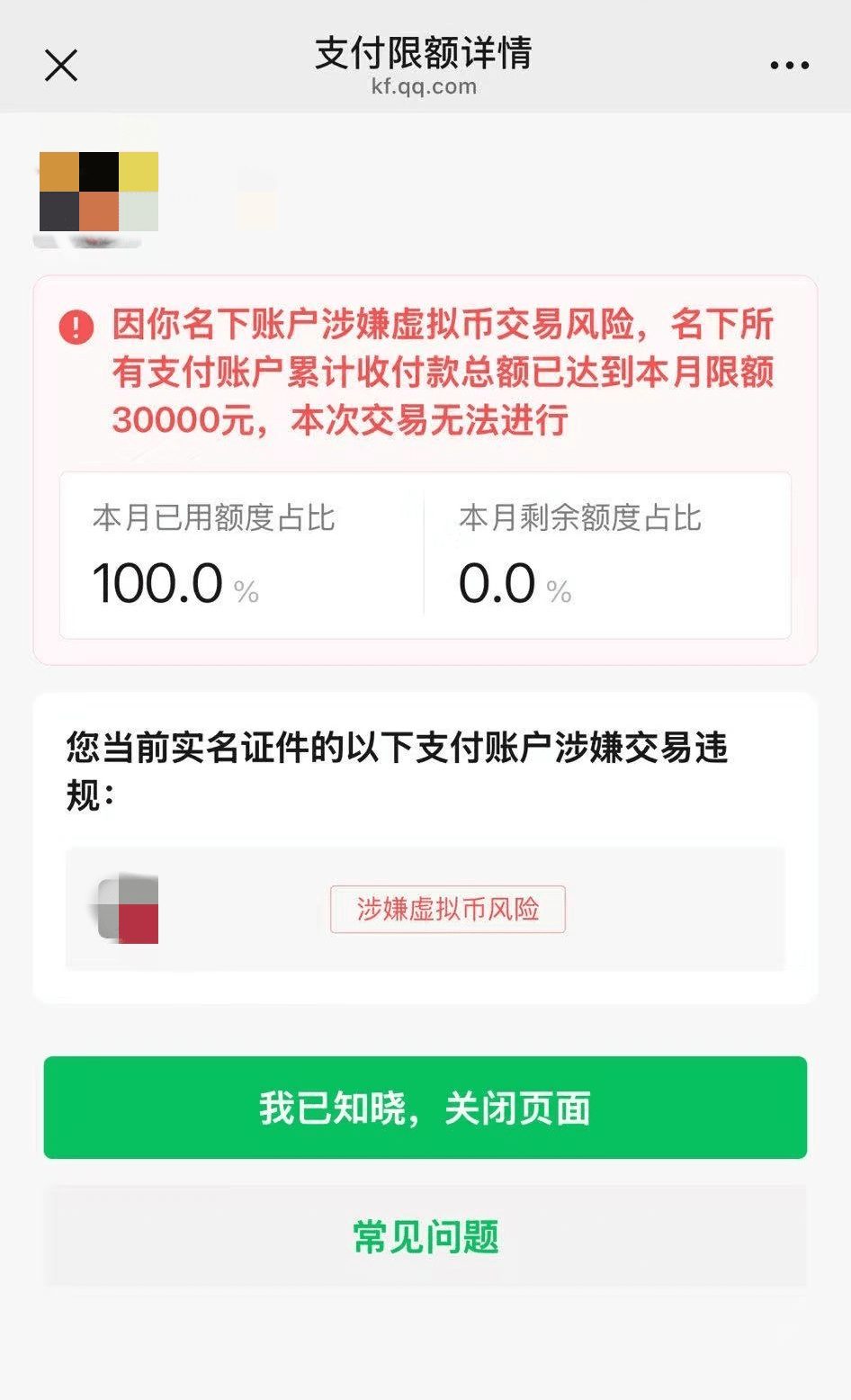
Recently, after the central bank emphasized crackdowns, the actual operational level has manifested as a further strengthening of the 'card-cutting action'. For example, WeChat Pay has intensified its identification and banning of virtual currency transactions. Once the system's risk control is triggered, the consequences can range from limits on transactions to account suspensions.
Dayi has seen too many ordinary users mistakenly harmed due to 'withdrawals'. Once a receiving account receives funds related to a case, it may be frozen, and they may even be summoned or detained by police across provinces, with the unfreezing process being long and difficult. Without a legal trading system, it means it is difficult to escape the contamination of illegal funds.
IV. Final reminder: See reality clearly, respect the law.
Since the regulatory authorities have once again confirmed the attitude of 'continuous crackdown', I would like to give the following advice to friends still active in the crypto or Web3 field:
Do not fantasize about compliance paths.
In mainland China, there is no possibility of compliance for virtual currency-related trading activities. The so-called promotion of 'licensing in certain areas' is mostly a scam or misleading.
Stay away from OTC and score-running operations.
Especially for those engaged in cross-border payments and foreign trade settlements, do not use USDT for convenience, as the police often regard it as part of money laundering.
Be cautious with 'going offshore' strategies.
Many teams may have 'physically gone offshore', but their business still connects with mainland clients, and funds remain circulating domestically, making them even more susceptible to full-chain crackdowns due to obvious cross-border traces.
Individual players, please take care of yourselves.
If you must participate, please use spare money, and be mentally prepared for your account being frozen and assets being reduced to nothing. Do not help others buy or sell tokens or participate in 'crypto masters' pump projects.
In China, virtual currency may still have some private holding space as 'virtual goods', but as 'financial tools' or 'payment media', its survival environment has completely dried up.
This coordination meeting is not the introduction of any new policies, but rather a reaffirmation of existing positions. In the current environment, recognizing trends, respecting the law, and maintaining bottom lines are more important than seizing a 'hundredfold coin' opportunity for wealth.
After all, freedom is your heaviest burden.
About Dayi.
Dayi, the founder of Dayi Blockchain (Chongqing) Legal Consulting Center, has been engaged in social media for nine years, has seven physical stores in Chongqing, has five years of experience working with major exchanges and coin merchants, is a firm believer in Bitcoin, and has helped fans successfully appeal for the unfreezing of cryptocurrency-related bank accounts hundreds of times, successfully appealing for dozens of wrongly included accounts on the punishment list!