Yesterday's non-farm data aligns well with my previous analysis regarding the current strengthening of divisions within the Federal Reserve.
Employment is in a stage of moderate decline.
First, let's take a look at the data released yesterday, and then I will provide a broader perspective; there's no need to limit our view to the monthly non-farm data.
This is a factor that has a relatively small influence on interest rate cut expectations.
Finally, I will provide a link to the interest rate cut expectation indicators used by professional institutions.
Mom no longer needs to worry about me being misled by market voices.
Why has the division within the Federal Reserve strengthened now?
1. Latest non-farm employment data
Yesterday's data was released along with the data for October and November.
However, due to the government shutdown in October, the October data may not be very accurate.
The main points are as follows:
1. The October data was revised, showing a decrease of about 105,000 jobs in October, indicating a significant decline.
2. November saw an increase of 64,000 jobs, exceeding market expectations, but the unemployment rate also rose to 4.6%, a multi-year high, also above market expectations.
3. The new jobs mainly came from the healthcare and construction sectors.
2. Data Interpretation
As I mentioned in my previous post, the U.S. is now in a stagflation phase.
On one hand, inflation is high, and the cost side for businesses remains elevated, requiring interest rate hikes.
On the other hand, employment is weak, but it’s not a situation of massive unemployment or a surge in jobs.
The reason is that we are currently at a transitional point where the economy is shifting from prosperity to decline.
Business owners' costs have gone up, but the overall environment is poor, and income is not guaranteed.
However, at this point, large-scale layoffs are not feasible, and salary cuts would affect work motivation.
What can be done is to not hire new employees, and forget about year-end bonuses and salary increases.
Yesterday's non-farm data aligns well with this reality; most of the new jobs came from healthcare and construction, not the service industry.
The overall unemployment rate has risen to 4.6%, showing signs of a slowdown in the job market.
The market's interpretation is still generally positive.
By the end, you will understand why it is somewhat positive; market expectations are not determined by one person's positive statement, but rather by the entire market, especially the voices of the vast majority of institutions that represent expectations.
We are not listening to just one person's opinion; it's not enough for a certain KOL to say a few words; we need to consider the views of professional large funds.
This is why the non-farm data is favorable for interest rate cut expectations, but BTC is still declining.
If you are only listening to some so-called signal teachers and see the non-farm data as positive and go long without understanding the bigger logic behind it, then you deserve not to make money.
3. Jump out of non-farm
But if we want to use non-farm data to judge the probability of future interest rate cuts,
I think it’s not very meaningful.
In previous posts, I mentioned a point that the real influence on crypto assets is not a single rate cut at an FOMC meeting, but rather the path of interest rate cuts.
However, because interest rate meetings and non-farm data are relatively easy to disseminate and hype, we see more discussions around them.
But I want to say that the actual significance is not large.
The reason is that FOMC meetings are held about every 6-7 weeks, with 8 meetings in a year.
The data referenced by the Federal Reserve should be ordered by weight as follows:
PCE Personal Consumption Expenditures Price Index (the most important data)
CPI Consumer Price Index
Non-Farm Employment (NFP)
Initial Jobless Claims
PMI Purchasing Managers' Index
Quarterly GDP
Except for GDP, all of the above data is released monthly, so a single non-farm data point actually does not have a significant impact on the FOMC.
Moreover, these data often present contradictory results; overly focusing on this data may be detrimental to investment.
4. Evil Cult Practices
A crucial point in human evolution from animals to humans is the ability to use tools.
Now there are so many professional institutions in the market, using professionals to track and analyze this data in real-time.
We don’t need to waste our precious time studying these small data points.
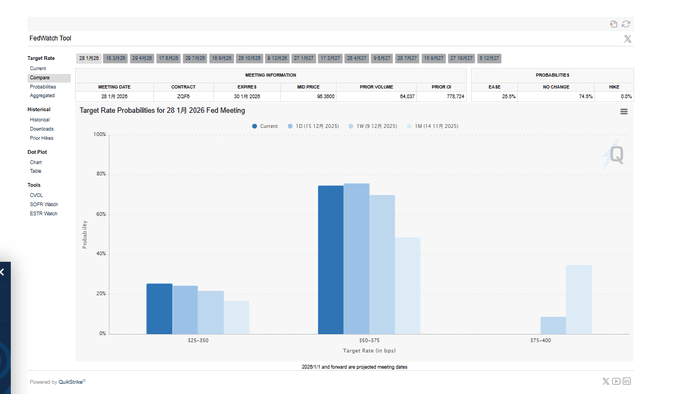
Here’s a link where you can directly see the market's expectations for the next FOMC meeting's interest rate cuts.
FedWatch - CME Group: https://cmegroup.com/markets/interest-rates/cme-fedwatch-tool.html?utm_source=chatgpt.com
In the future, if you want to see the market's expectations for the next interest rate cut, just check this website's data.
You can also see the changes in market expectations over the past few months; it's absolutely first-hand data.