
Introduction
Bitcoin's 'Four-Year Cycle' sounds mysterious, but the core idea is: halving occurs every four years, creating a cycle of rises and falls from bear to bull.
Four-Step Cycle:
Bear Market Bottoming: After a significant drop, large investors begin to quietly buy in.
Halving Preheat: Before the halving, the market speculates on scarcity, and prices gradually rise.
Crazy Bull Market: After the halving, the effect of reduced supply becomes apparent, combined with new entrants, prices soar.
Bubble Burst: After excessive market leverage, a crash occurs, leading into a new bear market.
Why is there this cycle?
In simple terms: Sudden halving of output + everyone expects the price to rise. Halving reduces the output of new coins; if demand remains the same or increases, prices are likely to rise. Additionally, the habit of a four-year cycle creates a 'self-fulfilling prophecy.'
Historical cycle review:
2013: Relying on early geeks and players.
2017: Ethereum and ICO heated up the scene.
2021: Global liquidity injections, institutions began to enter.
2025 (now): Dominated by spot ETFs, resembling an institutional market, retail voices have become smaller.
Will this cycle disappear? It's possible.
Because the market has changed: ETFs have allowed a large amount of institutional funds to enter, and the correlation between Bitcoin and U.S. stocks and macroeconomics (such as Federal Reserve policy) is becoming stronger. These forces may overshadow the simple 'halving' effect, making the four-year boom and bust become milder.
How to determine if the cycle is over?
Look at these points: Will there still be a surge after the halving? Will there be a major liquidation leading to a deep decline? Is Bitcoin's trend more aligned with Federal Reserve policy? Will retail investors frenzy enter again?
Summary
The underlying rules of Bitcoin (halving) remain unchanged, but the players and external environment have all changed. The historical patterns still hold reference value, but future cycles are likely to be more complex and milder, and may not be the familiar 'four-year cycle.'
One: Will BTC's 'four-year script' be played out after halving?
Bitcoin has a repeatedly mentioned rule—the 'four-year cycle.' It is like an agreed-upon rhythm; every four years, the market undergoes a cycle from bear market to bull market.
One, the four stages of the cycle.
This cycle typically consists of four stages, repeating endlessly:
Bottoming period(Accumulation phase)
After the bull market ends, market sentiment is low, and prices hover at the bottom. At this time, the 'big players' who truly believe in Bitcoin begin to buy in batches, but most retail investors are still watching.Pre-heating period(Before halving)
As the next 'halving' approaches, the market begins to speculate on the expectation of supply reduction, and prices slowly rise. Funds gradually flow back, and the media also begins to pay attention.Frenzy period(Post-halving bull market)
After the halving officially occurs, the production of new coins decreases, combined with market sentiment's push, prices often rise rapidly, even experiencing parabolic increases. Retail investors flock in, leverage amplifies volatility, and new highs are eventually reached.Ebbing period(Bear market liquidation)
After the frenzy, the market plummets due to excessive leverage and emotional exhaustion. Investors are liquidated and sell off, with altcoins particularly suffering, and the market returns to calm until the next cycle begins.
Two: The core of the cycle: halving
Why four years? The key lies in Bitcoin's 'halving' mechanism.
Approximately every four years, the reward for mining new Bitcoin is halved. From the initial 50, to 6.25, and then to 3.125 after the halving in 2024... This is like gold becoming scarcer; Bitcoin achieves artificial scarcity through code.
Historically, every time after a halving, due to the sudden slowdown in new coin supply, if demand remains unchanged or increases, prices often rise. This is also the most fundamental supporting logic for the 'four-year cycle' theory.
Three, will the cycle always be effective?
Although the past three cycles seemed to follow this rhythm, the market is undergoing profound changes:
Institutions are entering on a large scale through Bitcoin ETFs, and the market structure is different from before.
The impact of the global macro economy (such as Federal Reserve policy) on Bitcoin prices is growing stronger.
As the market volume grows, volatility may gradually become calmer.
These factors may mean that future cycles will not be as 'regular' as in the past.
To summarize
Bitcoin's 'four-year cycle' is a rhythm formed during specific development stages in past markets. It reflects the scarcity expectations brought by halving and carries the collective memory of market sentiment. However, as Bitcoin matures, future 'cycles' may become more complex and milder.
Is this pattern continuing or gradually fading? Perhaps we are at the best time to observe it.
Two: Review of past cycles
Every bull market in Bitcoin over the years has been marked by a distinct era.
2013: The experimental field for geeks
At that time, Bitcoin was still very niche, mainly circulating in tech circles. The discussions were about whether it could be considered 'digital gold' and the famous story of someone spending 10,000 bitcoins on two pizzas. The largest exchange at that time was Mt. Gox, handling over 70% of transactions. But it suddenly collapsed in 2014, announcing the loss of 850,000 bitcoins. This trust crisis caused Bitcoin's price to plummet by 85%, marking the chaotic end of the first cycle.
2017: The frenzy of retail investors and the ICO boom.
In this round, Bitcoin is truly going mainstream. Driving all this is the smart contracts brought by Ethereum and the subsequent ICO craze. Countless new projects managed to raise substantial funds with just a white paper. Bitcoin's price soared from a few hundred dollars to nearly $20,000, attracting extensive media coverage.
The end of the frenzy also stemmed from ICOs. Project teams sold the Ethereum they raised for cash, creating significant selling pressure. At the same time, the U.S. SEC began large-scale regulation, classifying many ICOs as illegal securities offerings. Market confidence collapsed, and Bitcoin ultimately plummeted by 84%.
2021: The year of institutionalization under liquidity injections.
The global liquidity injection after the COVID-19 pandemic has led to a massive influx of funds into the market. The narrative around Bitcoin has also upgraded to 'macro asset' and 'store of value.' Companies like Tesla and MicroStrategy began openly purchasing and holding Bitcoin, and payment giants like PayPal also supported it. Meanwhile, the popularity of DeFi and NFTs attracted more retail investors.
The end of the cycle began with a series of internal industry collapses: Luna's crash, Three Arrows Capital's bankruptcy, culminating in the exposure of the FTX fraud case. At the same time, the Federal Reserve began aggressive interest rate hikes, withdrawing market liquidity. Under pressure from both inside and outside, Bitcoin retreated from its highs.
2025 (current): The era of institutional dominance initiated by ETFs
The biggest difference this time is that the spot Bitcoin ETF has been officially approved. The entry of traditional financial giants like BlackRock and Fidelity has made Bitcoin a standardized investment product. Institutional funds have become the dominant force, leading to Bitcoin prices reaching historical highs even before the halving in 2024. Currently, retail enthusiasm seems not yet fully ignited, presenting a calmer, more 'institutionalized' look than before.
In simple terms: every cycle of Bitcoin is the result of new funds and new stories acting together—from geek belief to retail frenzy to institutional endorsement. The market is growing, players are changing, and the only constant may be its continuous evolution and remarkable vitality.
Three: Why do cycles occur?
Why does Bitcoin have a bull market every four years? There are actually several key drivers behind it.
Core driving force: scarcity
An important model called 'stock-to-flow ratio' simply divides 'existing total' by 'annual new supply.' The higher this number, the scarcer the asset.
Bitcoin's production is halved every four years, and this ratio will jump once. Currently, this number for Bitcoin is about 110, while gold is only around 60. In terms of model significance, Bitcoin is already scarcer than gold—this predictable scarcity is the underlying foundation for the formation of cycles.
Psychological effect: If everyone believes it, it becomes real.
Bitcoin does not have the 'intrinsic value' of traditional assets; its price largely depends on 'how much everyone believes it is worth.'
When more and more people remember the rhythm of 'every four years' and buy and sell according to this expectation, this pattern will truly become self-fulfilling. The more history repeats itself, the stronger this psychological suggestion becomes, forming a kind of cyclical market consensus.
External fuel: the global 'tap'
Bitcoin's bull market cannot do without the nurturing of global liquidity. Some believe that Bitcoin's larger cycle is actually highly correlated with the 'liquidity injections' of central banks worldwide:
2013: Benefiting from the monetary easing after the 2008 financial crisis.
2017: Related to the liquidity brought by the depreciation of the yen at that time.
2021: Directly driven by global liquidity injections after the COVID-19 pandemic.
The market is currently focusing on the Federal Reserve's policy shift (when to stop tapering, cut interest rates), which may directly impact the rhythm and height of this cycle.
Player transitions: from retail frenzy to institutional dominance
Different participants determine different market characteristics:
Institutional investors (such as ETFs and listed companies) are usually more rational and long-term; they often buy during market panic, helping to build a bottom.
Retail investors, on the other hand, are more easily driven by emotions, often entering the market in large numbers and using leverage due to FOMO (fear of missing out) during the late stages of a bull market, which often exacerbates market volatility and creates bubble tops.
In summary: Bitcoin's four-year cycle is the result of intrinsic scarcity, collective market psychology, global liquidity tides, and changes in player structure. Now, as institutions become the dominant force, whether this old rule will be changed by new plays is the most worth observing aspect of this cycle.
Four: Will BTC's four-year curse truly fail this time?
Why do some say the 'four-year cycle' is outdated?
Mainly because the market has completely 'changed':
1️⃣ Institutions are entering, and the way of play has changed.
Currently, the largest buyers of Bitcoin are ETFs, listed companies, and hedge funds. They are not as emotional as retail investors but invest cautiously and use leverage according to a plan. This influx of 'calm capital' will naturally suppress market volatility, gradually smoothing out the previously dramatic cycles.
2️⃣ The volume has grown, and we pay more attention to macro conditions.
Bitcoin's market value now exceeds one trillion dollars, and its correlation with global liquidity and Federal Reserve policy is becoming stronger. The 'halving' occurs every four years, but economic cycles do not adhere to such a schedule. When macro factors exert more influence than halving, the regularity of cycles may be broken.
3️⃣ The 'power' of halving is weakening.
The initial halving cut the block reward from 50 bitcoins directly to 25, a huge change. The recent halving only reduced it from 6.25 to 3.125. As the base decreases, the supply shock brought by each halving is also diminishing.
How to determine if this cycle pattern has truly failed?
You can observe these key signals:
Will it still surge after the halving?
If there is no explosive rise within 12-18 months after the halving, it may indicate insufficient cycle momentum.
Will there be a 'chain liquidation-style' crash?
The mark of the end of past cycles was often a crash caused by high leverage liquidations (often exceeding 70% decline). If adjustments become milder, the cycle may be 'transforming.'
Is the price completely following macro policies?
If Bitcoin's trend highly overlaps with the Federal Reserve's interest rate hikes/cuts, it indicates that it has become more like a 'macro asset' rather than following its own halving rhythm.
Are retail investors still crazy?
At the peak of past cycles, retail investors flooded in, and altcoins surged crazily. If the market is always dominated by institutions, lacking the 'frenzied relay' from retail investors, the shape of the cycle will also be different.
In summary: the cycle may not disappear, but it will definitely 'transform.'
The underlying mechanism of Bitcoin (halving) remains unchanged, but the forces driving the market have shifted from retail sentiment to institutional funds and macro policies. Future cycles are likely to become longer, milder, and even more deeply tied to global economic cycles.
The script we are familiar with, the 'four-year boom,' may be being rewritten, but this does not mean opportunities disappear—it just means the rules of the game have changed, and those who understand the new rules will be able to find direction in the new cycle.
Five: Review of the big VIP code strategy
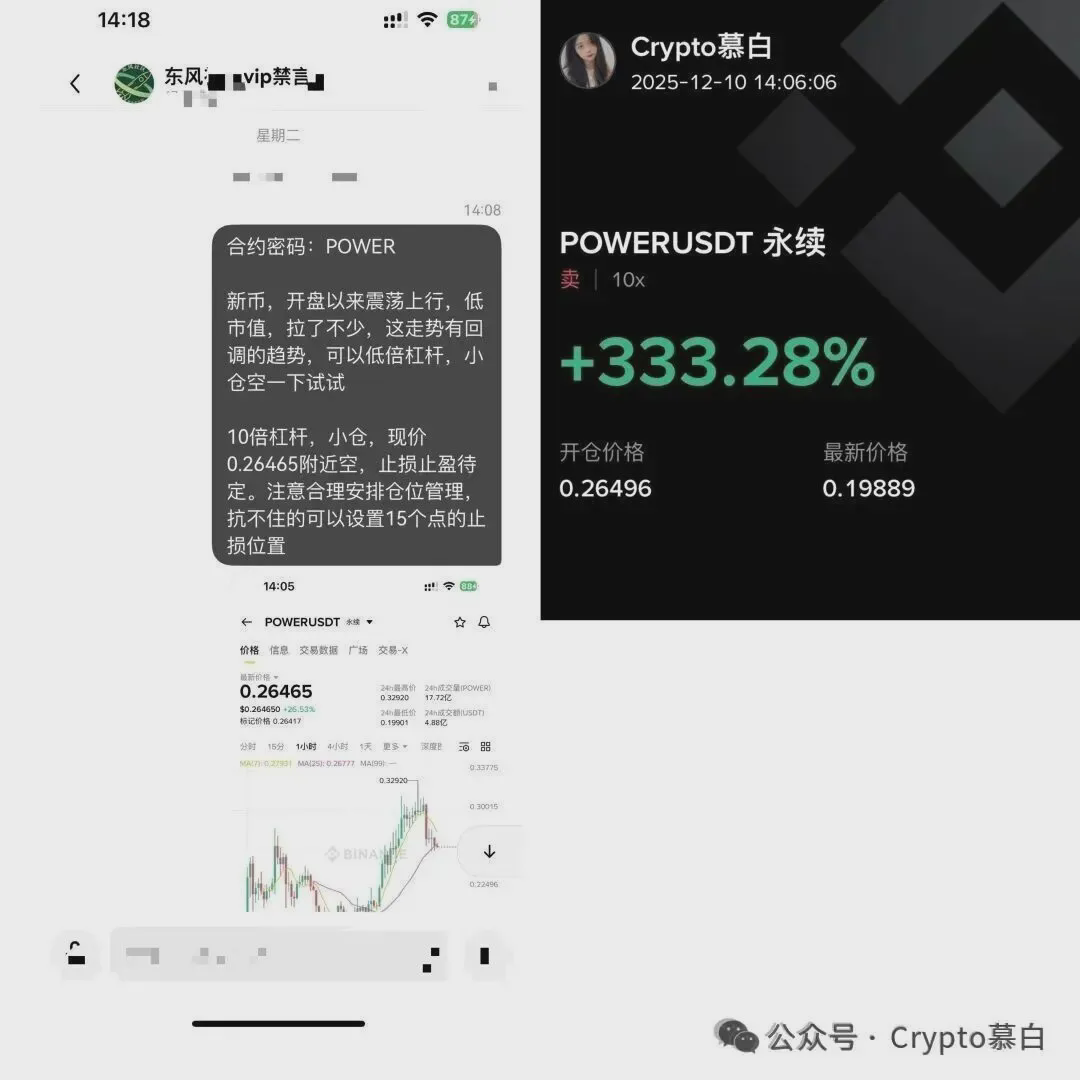
On December 9, Tuesday, the big VIP was shorting POWER around 0.26465.
Using 10x leverage, I gained more than 3 times the profit.
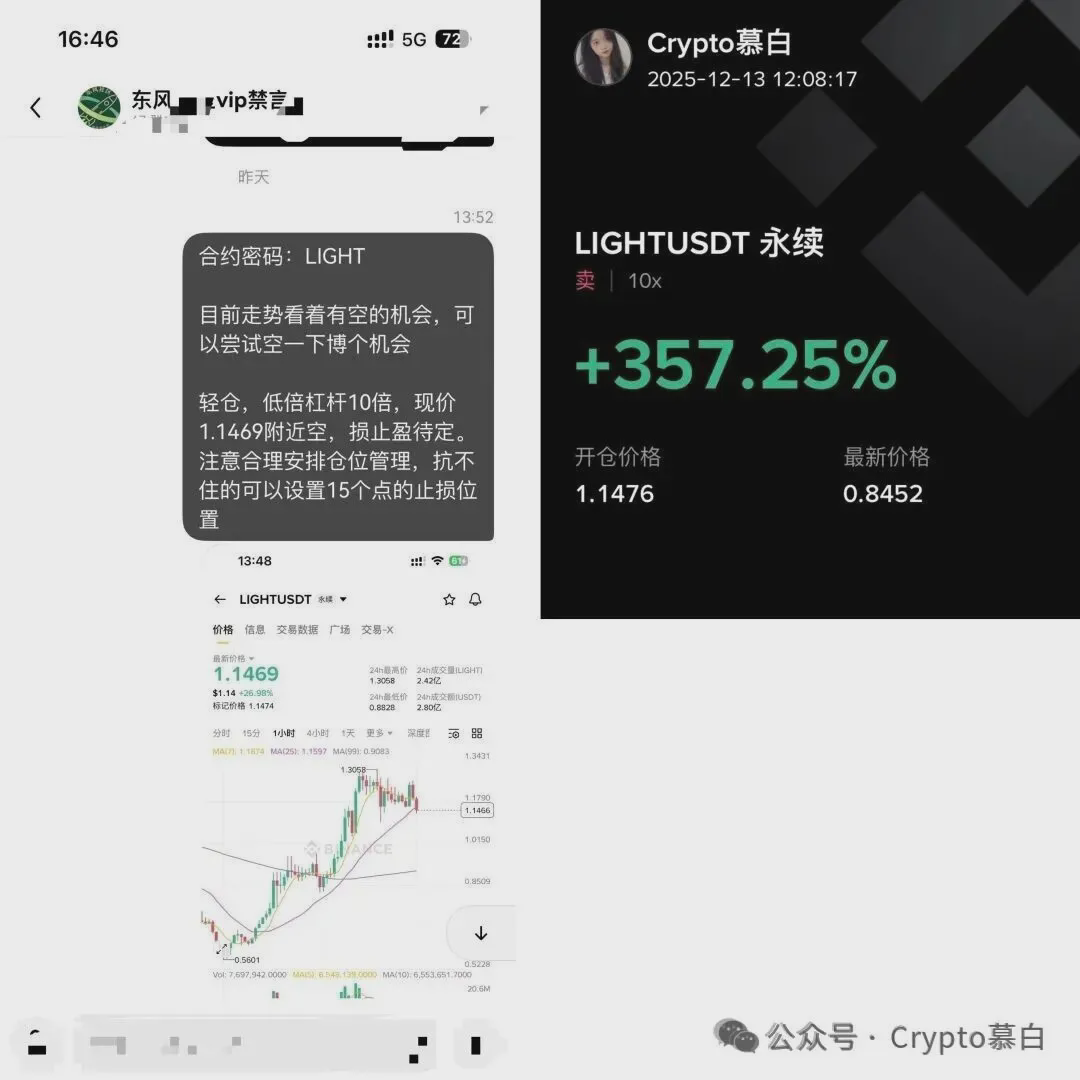
On December 12, Friday, the big VIP was shorting LIGHT around 1.1469.
Using 10x leverage, I gained more than 3 times the profit.
The overall strategic direction of the big VIP is still strong; this is the strength of the big VIP, which is evident and openly stated, refusing to play catch-up!
For those who want to keep up with the big VIP's pace in real-time, come to the big VIP; the big VIP has more wealth codes to share, as per the usual, come to the big VIP to claim!
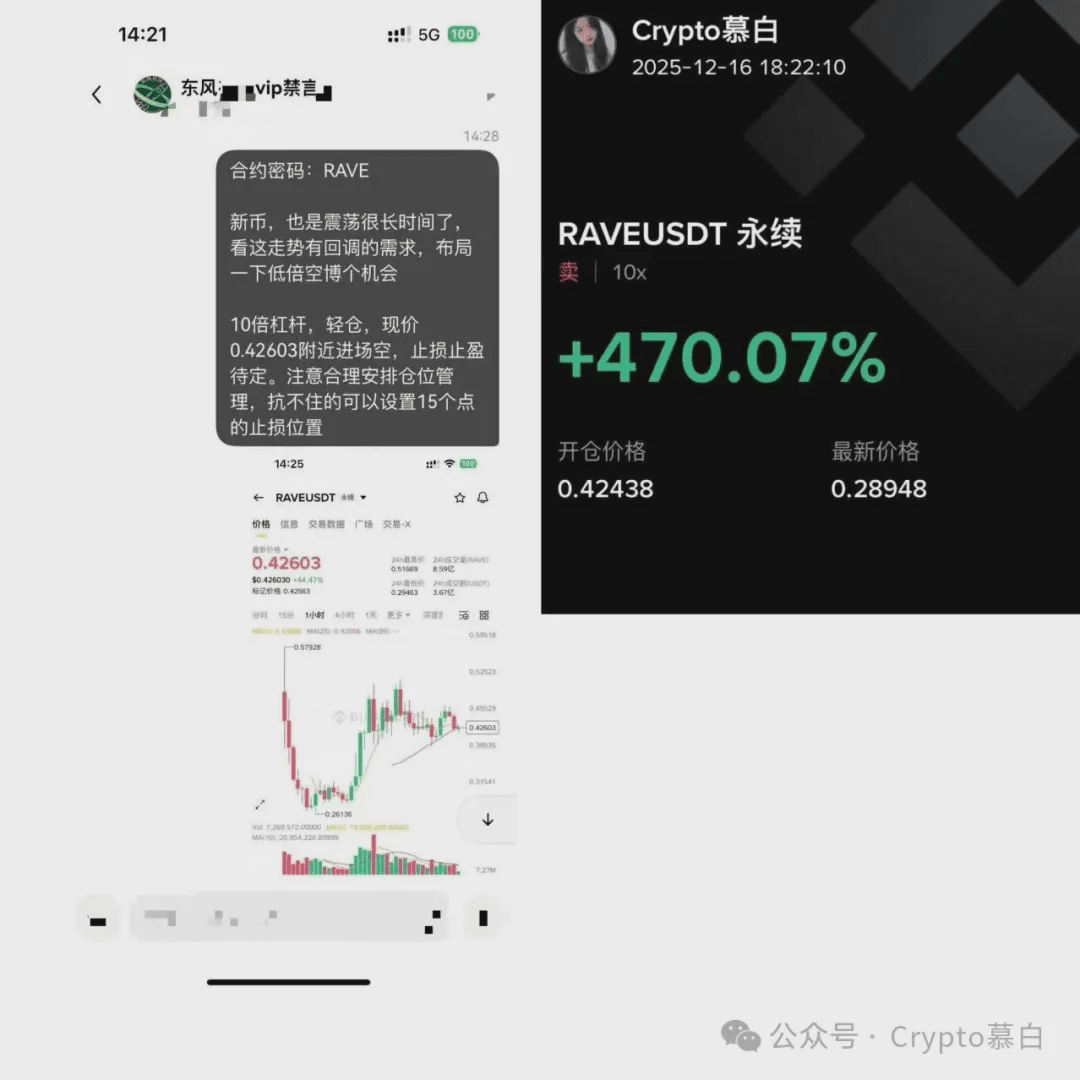
On December 16, Tuesday, the big VIP was shorting POWER around 0.42603.
Using 10x leverage, I gained more than 4 times the profit.
Click on the yellow text below for the Binance official link to join the Binance official group, White Army:
White Army [Binance Official Group]
For inquiries about the big VIP wealth strategy, feel free to add the big VIP's personal Binance official chat ID: mubai369.