

When the world's largest publicly traded Bitcoin holder started hoarding US dollars, the market had far more questions than answers. In early December 2025, Strategy announced the establishment of a $1.44 billion cash reserve and paused its usual coin purchases; this company, once viewed as the 'infinite bullet' of Bitcoin's biggest bull, is redefining its survival strategy.
Its cash reserves are clearly sourced - through a market issuance plan selling Class A common stock, from November 17 to 30, 2025, the company sold approximately 8.214 million shares of common stock, raising net proceeds of about $1.478 billion.
This funding will be specifically used to cover preferred stock dividends and debt interest payments for the next 21 months, achieving a 'decoupling' of shareholder returns from Bitcoin price fluctuations.
 1. Core of the Event: Details of Reserves and Sources of Funds
● Strategy's cash reserve plan clearly illustrates a shift in the company's financial strategy. The company has raised funds through an ATM stock sale plan, specifically selling 8.214 million shares of common stock between November 17 and 30, 2025, raising net proceeds of $1.478 billion.
The vast majority of this funding is being used to establish cash reserves, with the company clearly stating that the reserves will specifically cover dividend payments and debt interest for the next 21 months.
● With the announcement of establishing cash reserves, Strategy's Bitcoin purchasing activity has noticeably slowed. Data shows that during the same period from November 17 to 30, the company purchased only 130 Bitcoins, with a total expenditure of $11.7 million.
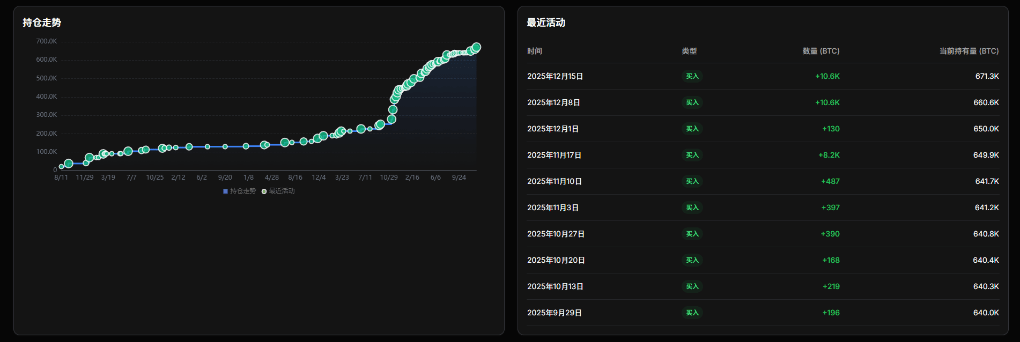
● This stands in stark contrast to the company's past practice of continuously buying Bitcoin in large volumes. As of November 30, 2025, Strategy has accumulated 650,000 Bitcoins, accounting for 3.1% of the global Bitcoin supply.
2. Strategic Intent: From Aggressive Expansion to Defensive Consolidation
● The primary goal of Strategy in establishing cash reserves is to protect the company's credit. The company has issued multiple series of preferred shares, including STRF, STRK, STRD, etc., which promise an annual yield of 8% to 10%. This high yield commitment brings a heavy payment pressure, and failure to pay dividends on time could trigger a vicious cycle of credit rating downgrades and rising financing costs.
● Another important consideration in building cash reserves is to establish a defense line to avoid a 'death spiral.' The market has long been concerned that if Bitcoin prices plummet, the company may be forced to sell Bitcoin in large quantities to maintain operations, thereby exacerbating the market downturn. The $1.44 billion reserve is a direct response to this concern, providing the company with at least a 21-month buffer.
● Additionally, Strategy is attempting to attract a broader range of investors. By reserving 21 months' worth of dividend funds, the company hopes to attract traditional income-oriented investors who value stable cash returns without needing to understand the deeper logic of Bitcoin.
This means that even if the Bitcoin price drops significantly, dividends can still be paid on time, enhancing the company's appeal to conservative investors.
3. Market Response and Stock Performance
● Following the announcement, Strategy's stock price fell more than 10% at one point during intraday trading on December 1, 2025, hitting a low of $156, and finally closing at $172. The market has shown clear concern about the strategy shift of the largest Bitcoin bull.
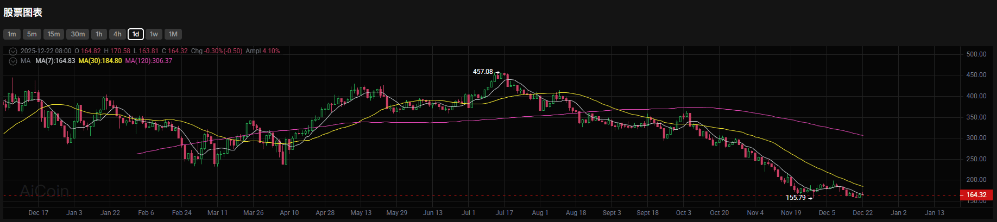
● There are differing views among analysts. According to TipRanks, Wall Street analysts still maintain a 'Strong Buy' rating on Strategy's stock, based on 12 buy and 2 hold recommendations over the past three months. The average target price is $467.75, indicating a potential upside of 182.59% from current levels.
● There is intense debate within the Bitcoin community regarding this. Some investors believe this is a betrayal of the Bitcoin standard strategy, with shareholder rights being diluted in exchange for depreciating fiat currency. The biggest concern in the market is that when the largest buyer announces a slowdown in purchases, it will hit the already fragile market confidence. Strategy has long been one of the most significant 'buying forces' in the Bitcoin market, and a reduction in its purchasing power could exert greater downward pressure on Bitcoin in the short term.
4. Financial Challenges and Regulatory Pressure
● Strategy is facing multiple financial challenges. Due to the decline in Bitcoin prices, the company has significantly lowered its financial expectations for 2025. When the company initially set its performance guidance, it expected the Bitcoin price to reach $150,000 by the end of the year, but it has now been adjusted to between $85,000 and $110,000.
Based on this new price range, the company has updated its key targets: the Bitcoin yield target has been reduced to 22% to 26%, and the target for Bitcoin's appreciation against the dollar has also been lowered accordingly.
● New regulatory challenges are also emerging. MSCI is considering excluding companies that hold over 50% of their total assets in digital assets from its global benchmark index. MSCI believes that such companies are more akin to investment funds rather than operating entities.
● This proposal poses a direct threat to Strategy. TD Cowen analysts estimate that approximately $2.5 billion of Strategy's market capitalization comes from the MSCI index, with another $5.5 billion from other stock indices. If excluded from major indices, the company could face capital outflows of up to $8.8 billion.
5. Industry Impact and Future Outlook
● Strategy's shift in strategy could have far-reaching implications for the entire Bitcoin industry. As a 'whale' holding 3.1% of the total Bitcoin supply globally, its every move has significant market implications. The company's cash reserve plan marks a shift towards greater emphasis on traditional financial stability, which may become a new paradigm for the industry.
● It is worth noting that Strategy's business model is highly dependent on continuous financing capability. The company's financial statements show that there is still $14.375 billion available for subsequent stock issuance. However, this 'ammunition depot' is limited, especially when market risk appetite declines.
● In the future, Strategy may attempt a Bitcoin lending model to increase returns. CEO Phong Le stated, 'When traditional financial institutions enter this space, and we have more counterparties, lending Bitcoin is an option we will consider.'
This shift indicates that the previously aggressive 'buy and hold' model is adjusting under pressure.
● The company's core metric—mNAV—is under close scrutiny. This metric compares the enterprise value to its Bitcoin holding value, and when the ratio falls below 1.0, it indicates that the company's stock trading price is lower than the value of its Bitcoin holdings. This could trigger difficult decisions regarding the sale of Bitcoin.
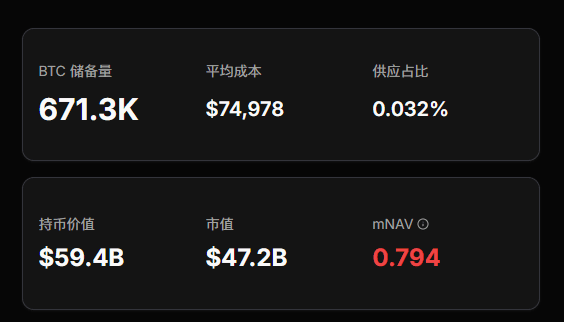
As Bitcoin prices fell about 30% from the October peak, Strategy's stock price has already dropped by 50%. Once relying on preferred shares, convertible bonds, and common stock issuance to raise nearly $10 billion for Bitcoin investments, it has shown signs of fatigue under market pressure.
The company holds 650,000 Bitcoins, and its market value once exceeded the value of its Bitcoin assets by several times; now this premium barrier is thinning. The cash reserves serve as a dam built between Bitcoin faith and financial reality, but the real test lies in whether this line can hold when market winters last longer than the 21-month buffer period.
Join our community to discuss and grow stronger together!
Official Telegram community: https://t.me/aicoincn
AiCoin Chinese Twitter: https://x.com/AiCoinzh
OKX welfare group: https://aicoin.com/link/chat?cid=l61eM4owQ
Binance welfare group: https://aicoin.com/link/chat?cid=ynr7d1P6Z
