
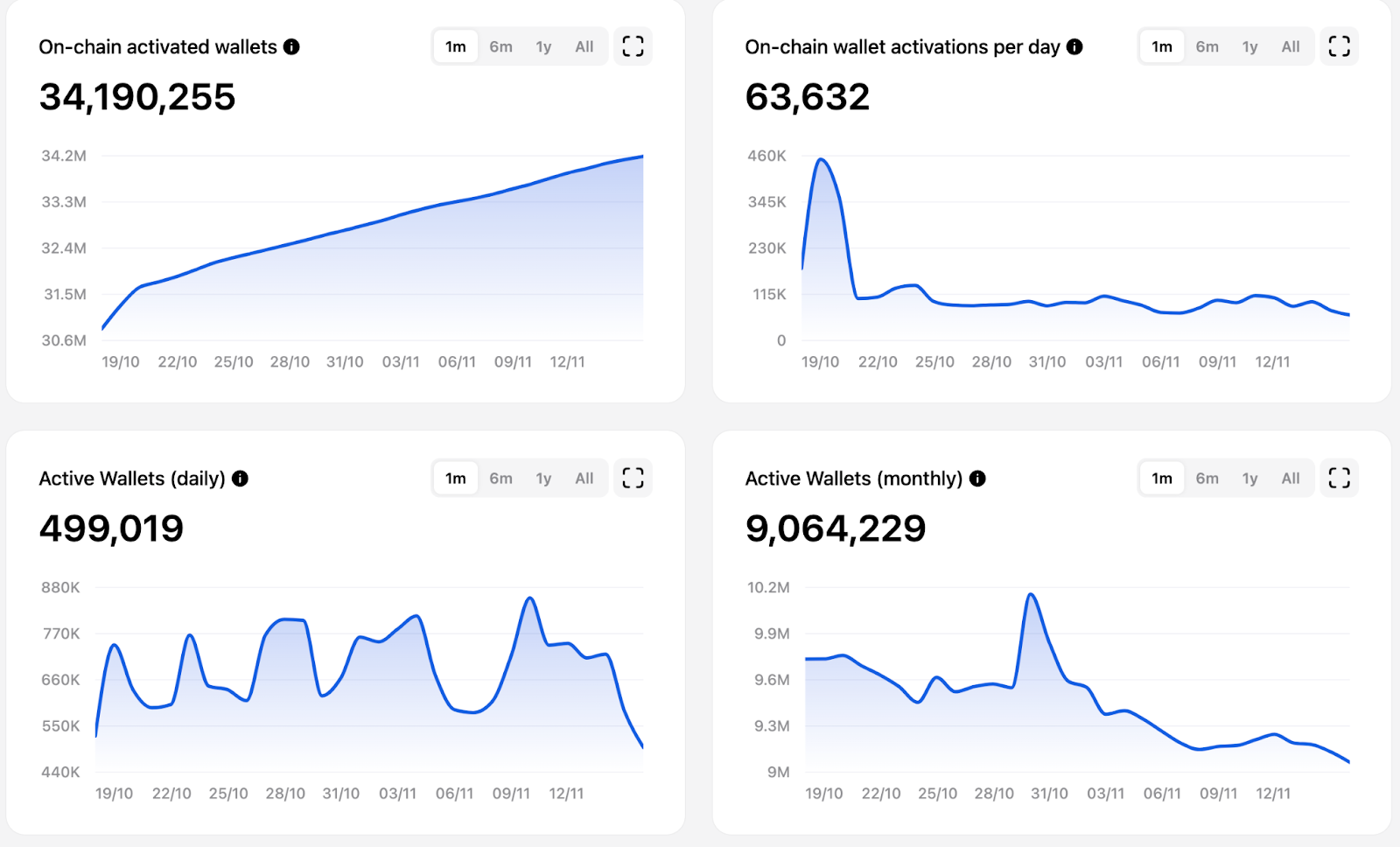
Earlier this year, through the Telegram mini-program as a window, the TON ecosystem experienced explosive growth in active user numbers due to the 'Tap to earn' trend, showing more than 6 months of growth. According to TON Stat data, during the peak period on TON (early October this year), the number of monthly active addresses exceeded 100 million, but from mid-October, the number of active users in the TON ecosystem began to show a significant decline.
Although Tap to earn is an easily accessible way for users, the expectation of airdrops is the only bond that ties such applications to users. After the airdrops of leading applications in this sector, user retention and secondary conversion rates are extremely low. Public data shows that Catizen's retention rate is 14%, while Hamster is only 7%.
It is evident that TON's Tap to earn has brought a brief surge in popularity to the GameFi market, but this is not the final answer. In fact, the majority of Mini-Games on TON do not attract loyal DeFi users or true Web3 gamers. The Mini-Games in the TON ecosystem still face typical GameFi problems, including insufficient game performance and content innovation, deviating from the core of entertainment and gradually evolving into financial products. Additionally, the project's economic model design is unreasonable, leading to an imbalance between players' earnings and investments, resulting in a significant decline in participation motivation for both developers and users over time.
On the other hand, developers face high barriers when developing games based on the Web3 stack. Due to the relatively niche development languages supported by smart contracts, complex game logic is difficult to implement on-chain. Additionally, high on-chain gas and storage costs, technical fragmentation, and imperfect development tools and infrastructure restrict the development and deployment of high-quality games. Furthermore, the migration of traditional games to the blockchain also faces difficulties, making it challenging to achieve breakthroughs in the development of the Web3 gaming ecosystem.
At this stage of transition in the Web3 gaming field, AAA game developer MetaArena has been the first to identify the essence of these problems, launching a series of facilities that significantly lower the development and deployment threshold for developers, providing perfect support for game operation, and establishing a pipeline for all users to participate in the game ecosystem through engaging Web3 game content, improving the current situation of Web3 games and promoting blockchain games to the next development stage.
MetaArena: Building infrastructure to promote the NEXT flywheel in blockchain gaming
MetaArena is a company focused on Web3 entertainment and gaming, dedicated to developing an innovative Realm AI game engine that supports AAA-level games. This engine has successfully launched its first AAA standard game (Final Glory) and achieved multi-chain compatibility, bringing players an immersive top-tier gaming experience. At the same time, MetaArena actively explores the application of cutting-edge technologies such as ray tracing and AI interaction, continuously driving game effects and technological innovation.
On the developer side, the MetaArena game engine not only provides an integrated development tool and engine trained with AI, offers SDKs and middleware, significantly lowering the development threshold for developers, improving efficiency, accelerating and shortening cycles, but also establishes deep partnerships with the world's fastest Layer1 public chain <SEI, jointly building a new generation of Web3 gaming format that is high-performance, decentralized, and highly interoperable. Both Web2 and Web3 developers can easily get started, eliminating technical barriers and smoothly entering the Web3 field.
On the user side, as a user-centric Web3 gaming ecosystem based on blockchain technology, the MetaArena engine provides a decentralized, player-led fair economic system, creating a sustainable autonomous world metaverse centered around interconnected games. This allows players to not only enjoy exciting gaming experiences but also dynamically allocate rewards based on player contributions (game time, UGC creation, community governance, etc.), transforming players from 'consumers' to 'beneficiaries.'
Focusing on the MetaArena game engine, its infrastructure stack includes three parts: MetaOS, CollabSphere, and GameFun Marketplace.
MetaOS
MetaOS is a key component of the MetaArena engine, serving as the underlying engine that supports game operations. MetaOS provides developers with a highly extensible and compatible operating system. It encapsulates a series of development tools and plug-and-play game modules, providing modular interfaces that are compatible with mainstream Layer1/2, helping developers seamlessly implement cross-chain operations. Based on the decentralized architecture of Realm Engine 5.3/4, MetaOS can also continuously connect computing resources within the ecosystem in a distributed manner to support the operation of games.
With the MetaOS system, developers can not only efficiently create content in a familiar environment and quickly deploy it to the platform but also provide support for the perfect operation of games and lay the foundation for players to participate in games with low barriers.
CollabSphere Market
CollabSphere is a coordination market for game development, allowing multiple developers to collaborate in real-time on the same project for games that are not yet completed or have been developed but still require improvement. By sharing resources, codebases, and development tools, developers can work efficiently in a virtual workspace, which is especially important for large game development projects.
The collaboration system of CollabSphere transparently records each developer's contributions through blockchain smart contracts and automatically allocates earnings based on the complexity of different tasks. This system provides developers with a transparent and fair collaboration environment, ensuring that all contributions can receive appropriate rewards. Through this decentralized collaboration mechanism, developers can seamlessly collaborate globally, enhancing project development efficiency and significantly improving game quality.
GameFun Marketplace
GameFun Marketplace is the trading market within the MetaArena game engine, aimed at providing a safe, free, and decentralized trading environment for game developers and players. GameFun Marketplace supports the management and trading of multi-chain virtual assets, significantly enhancing the liquidity of virtual assets and market transparency. Players can freely transfer assets across multiple blockchains, easily manage virtual items and NFTs within games. Similarly, players and developers can create, manage, and trade their assets across multiple blockchain networks, forming a unified virtual economic system. The platform ensures that all transaction processes are based on blockchain technology, secure, transparent, and without intermediaries, effectively reducing transaction costs.
Currently, MetaArena has launched its first game (Final Glory), a Western fantasy style MMORPG that has received rave reviews since its market entry. Currently, its player base has surpassed 200,000, with active user numbers ranging from 20,000 to 30,000, covering potential regions such as South Korea, Japan, Vietnam, and Singapore. The success of (Final Glory) has also set the stage for the expansion of the MetaArena ecosystem.
(Final Glory): A benchmark for Web3 AAA games
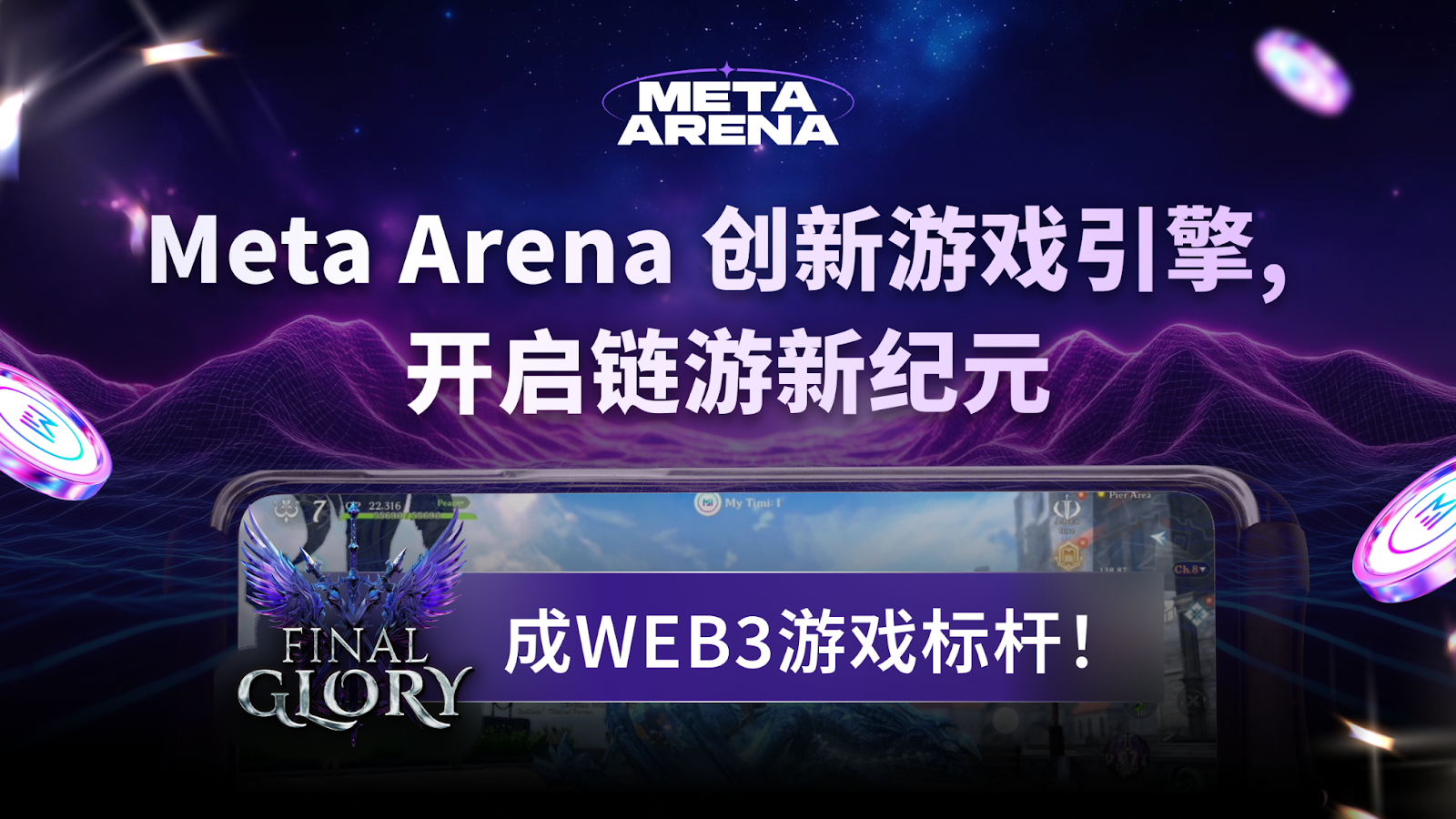
(Final Glory) is a large-scale multiplayer online role-playing game (MMORPG) with a Western fantasy style. Developed based on MetaArena's Realm AI game engine, it provides an immersive gaming experience, allowing players to truly enjoy the fun of 'play to earn.'
In the game, players can choose different professions and achieve growth through adventure battles and resource acquisition. Each profession has unique branches and abilities that determine the player's role in the game society. Players can form powerful guilds, participate in guild tasks and competitions, and compete for core resources. The game adopts a free exploration mode without task prompts.
(Final Glory) game graphics are developed using the efficient 3D rendering engine of MetaArena, achieving top-tier cinematic visual effects while ensuring smooth gameplay and low latency. Meanwhile, (Final Glory) offers rich gameplay options, including PvP, PvE, exploration, and more, with further layered content in each mode. Players can upgrade and combine different items to create various game effects and possess asset ownership. (Final Glory) itself presents a high degree of freedom, allowing players to trade freely within the game, providing numerous business opportunities and laying the foundation for building an autonomous world.
In fact, (Final Glory) is already comparable to traditional large Web2 games in terms of playability and game production, allowing the game to return to its essence rather than continually extending into the financial realm. From the performance of its active player data, it is not difficult to find that the market has developed its own judgment on quality games.
We see that AAA games (Final Glory) are becoming benchmark masterpieces in the Web3 gaming field; they are also important touchpoints for the MetaArena ecosystem to gain visibility. Seeing the development potential of the MetaArena ecosystem and its significance for the blockchain gaming field, the Sei Foundation has extended an olive branch, choosing to become an important partner and investment institution for MetaArena.
Summary
Looking back at the development history of the GameFi market, the essence of short game life cycles and the lack of phenomenon-level games lies in the absence of foundational infrastructure, leading to low game quality. MetaArena is fundamentally solving the problem and laying a solid foundation for achieving a qualitative leap in the playability of on-chain games.
By utilizing a series of infrastructures from MetaArena, developers can develop and deploy AAA large games with low thresholds, and even seamlessly migrate traditional high-quality games onto the blockchain while enabling users to deeply participate in game construction, further enriching game content and expanding ecological boundaries. It is foreseeable that MetaArena will lead the construction of quality Web3 games, allowing players to immerse themselves in the fun brought by games, create intrinsic value over the long term, and attract a broader base of Web2 players by significantly lowering entry barriers, thus promoting the great integration process of the two webs.
Finally, in the current situation where P2E, X2E, and TON mini-games have rapidly fallen after brief popularity, MetaArena is taking over the heat of the on-chain gaming market and will become a new solution to drive the long-term prosperity of the Web3 gaming field.