
Stablecoin Supercycle
The non-dollarization of YBS's native yields, such as using more pure on-chain assets like BTC/ETH/SOL for staking;
YBS 'Lego' combinations, Pendle is just the beginning, and more DeFi protocols need to support YBS until the emergence of on-chain USDT;
Payment products are not technically difficult, and earning interest is conducive to customer acquisition, but the main challenges lie in compliance and the expansion of business scale. Even with USDT/USDC, payments mainly serve as 'middleware' for backend clearing, with direct use as a trading medium being rare.
A triple massacre of stocks, bonds, and currencies within 100 days, accelerating the disintegration of the fiat currency order.
The 2008 financial crisis gave rise to the earliest followers of Bitcoin, and the 'suicide' of the fiat currency system in 2025 will also promote the growth of on-chain stablecoins, especially non-dollar, non-full-reserve interest-bearing stablecoins (YBS, Yield-Bearing Stablecoins).
However, non-full-reserve stablecoins are still in the theoretical stage. The aftermath of the Luna-UST collapse in 2022 still lingers, but under the pressure of capital efficiency, some reserve stablecoins will inevitably become mainstream in the market.
Non-dollar stablecoins are still in the experimental stage. The global currency status of the dollar is still widely recognized. To maintain industrial capacity and employment, China will not actively internationalize on a large scale; the replacement of the dollar will be a very lengthy process.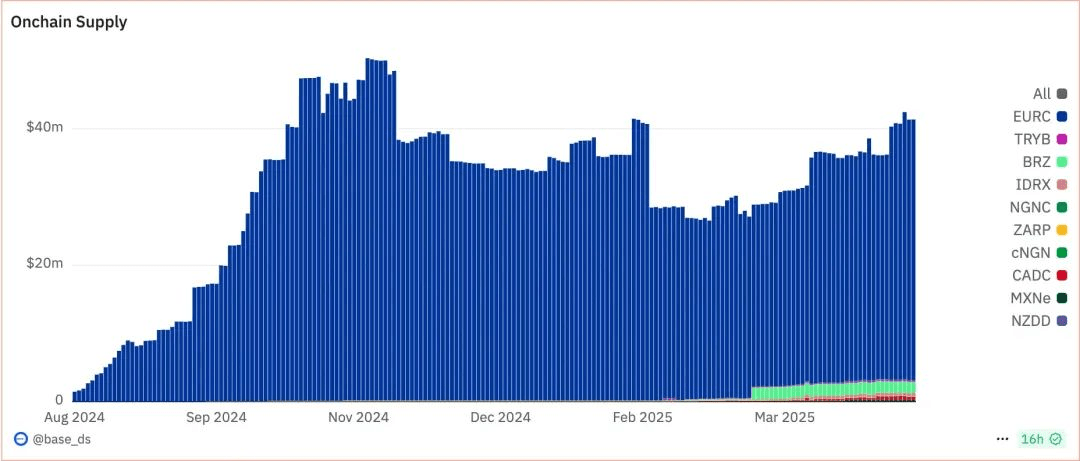
Image description: Non-dollar stablecoins. Image source: https://dune.com/base_ds/international-stablecoins
Based on the above two points, this article mainly examines the latest stage of existing stablecoins, namely the overall appearance of YBS, based on a dollar-backed, fully-reserved on-chain stablecoin system, which contains the fundamental appearance of post-dollar and non-full-reserve stablecoins.
The internal manifestation of the coinage tax is inflation, commonly known as internal debt; the external manifestation is the dollar's tidal cycle.
Trump abandons dollar hegemony.
The issuance of the dollar, from a technical perspective, is a confrontation between the Federal Reserve and the Treasury, which then uses the credit relationships of commercial banks to amplify the money multiplier, creating the circulation of M0/M1/M2/M3... and other different statistical levels of currency.
Under this issuance model, US Treasuries (T-Bills, T-Notes, T-Bonds) are divided into long and short terms, maintaining the slow inflation of the dollar and short-term currency stability. The interest rates of US Treasuries become the pricing foundation of the entire financial world, and the dollar becomes the world's currency, the cost of which is America's external deficit and the dependence of various countries on the dollar.
The cost is always two-sided. The only product that America offers is the dollar itself, while countries around the world need to obtain dollars and realize the purchasing power of dollars.
The purchasing power of the dollar will depreciate over the long term, not shifting according to Trump's will, while countries must obtain dollars to minimize transaction intermediary costs. Bartering is not unfeasible, but using dollars directly is more cost-effective.
Difficultly obtained dollars must be spent quickly on production or financial arbitrage to preserve purchasing power and maintain competitiveness in the next phase of exports to the US.
This current cyclical process is being disrupted by Trump's Schrödinger-style tariff system. Trump is raising tariffs, and he is forcing Powell to cut interest rates. Various countries do not want to continue holding dollars and are fleeing the US Treasury market; the dollar/US Treasury has turned into a risk asset.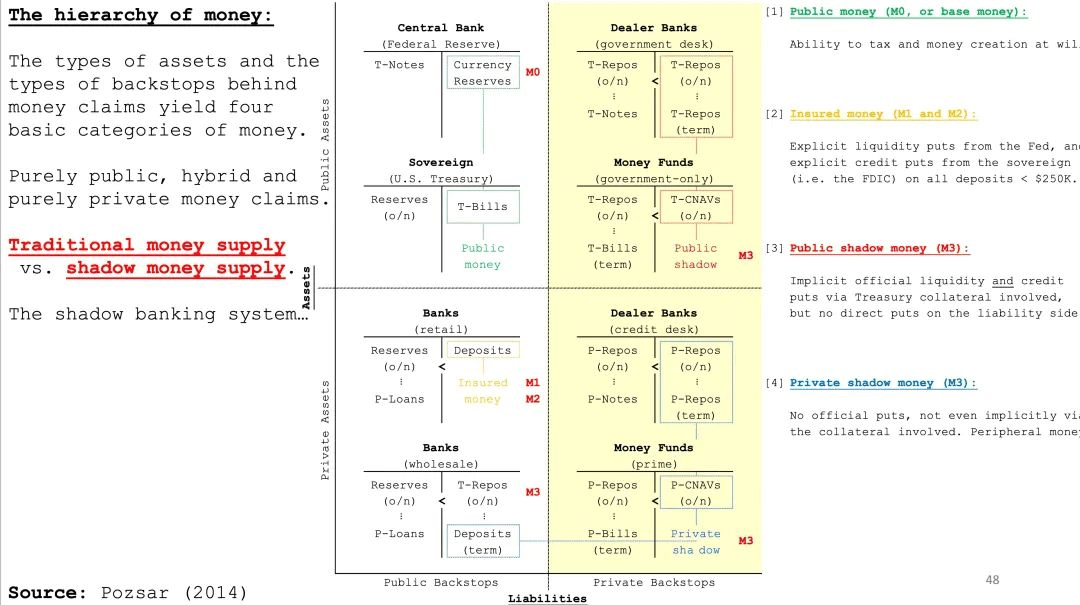
Image description: US dollar operating process. Image source: Pozsar
The slow inflation of the dollar is the tax on the currency printed by each country. Only when countries must hold and partially invest in US Treasuries can the harm to the dollar itself be reduced.
Assuming the following scenario:
• Alice is a textile worker, working hard in a sweatshop, earning $1,000 in cash;
• Bob is a US Treasury salesman. Alice invests $100/$200/$200 in short, medium, and long-term US Treasuries, with the remaining $500 for expanded reproduction;
• Bob uses the bonds purchased by Alice as collateral to borrow $50,000 from the bank Cindy at 100x leverage;
• Bob spends $25,000 to buy property, $20,000 to buy Mag7 stocks, and the remaining $5,000 to buy Alice a new bag.
Within the above cycle, Alice's motivation is to exchange labor for dollars and use reproduction and US Treasuries to guard against devaluation. Bob's motivation is to recover dollars and amplify the asset value of US Treasuries, while Cindy's motivation is to collect risk-free US Treasuries and earn fees.
The danger lies in two points: if Alice invests all $1,000 into US Treasuries, then Bob and Cindy will have no clothes to wear, and $500,000 won't buy a loaf of bread; secondly, if Bob's US Treasuries cannot be used as risk-free collateral to borrow dollars, then Cindy will be unemployed, and Bob won't be able to buy Alice a bag, only underwear, and Alice will face losses in her expanded reproduction.
Once the bow is drawn, there is no turning back. After Trump abandons dollar hegemony, the coinage tax that the dollar charges the world will also face the death spiral of Luna-UST, albeit over a longer time frame.
The fragmented world trade and financial system instead catalyzes the 'globalization' of cryptocurrencies. Embracing power centers can create single points of failure. The dollarization of Bitcoin won't harm Bitcoin, but the dollarization of cryptocurrencies will cause them to disappear.
Interestingly, in the near future, the shocks to the global economic system will lead to ongoing offensives and defenses between stablecoins. In an increasingly fragmented world, there will always be a need for glue languages and cross-chain bridges; the global arbitrage era will undoubtedly exist in the form of on-chain stablecoins.
Sad frog entertains the masses; fun people change the world. Let us explain why this is so.
The tail wags the dog; stablecoins drive out volatile coins.
The market capitalization of cryptocurrencies is 'fake', while the issuance of stablecoins is 'real'.
$2.7 trillion in cryptocurrency market value is just our sense of the 'capacity' of the crypto market, while $230 billion in stablecoins at least has real reserves to support it, although the 60% share of USDT reserves is suspect.
With DAI or USDS adopting USDC standards, fully or over-reserved stablecoins based on on-chain assets have effectively disappeared. The reality of reserves is another side of capital efficiency, or a significant reduction in the money multiplier; for every dollar issued as a stablecoin, off-chain it buys a dollar in government bonds, and on-chain it borrows. The maximum re-issuance volume is four times.
In contrast, BTC and ETH have value that is 'created from nothing', valued at $84,000 and $1,600 respectively. In comparison to the dollar, the M0 of cryptocurrencies should be BTC + ETH, which is 18.85 million BTC and 120.68 million ETH. M1 should include $230 billion in Stablecoins, while the re-issuance volume of YBS based on staking and lending relationships and the DeFi ecosystem constitutes M2 or M3, depending on the statistical caliber.
This expressed appearance will better reflect the current state of the crypto market than market capitalization and TVL. Calculating BTC's market value lacks practical significance; you cannot fully exchange it for USDT or USD, as the market lacks sufficient liquidity.
The crypto market is an 'inverted' market where volatile cryptocurrencies have no corresponding full-reserve stablecoins.
Only under this structure does YBS have practical significance, as it can transform the volatility of cryptocurrencies into stablecoins, but this is merely theoretical; it has never materialized in reality. Even the $230 billion in stablecoins must provide liquidity and entry-exit channels for the $2.7 trillion market.
Ethena is a compromise, an unsuccessful replication of the US Treasury and dollar system.
Ethena's USDe has expanded from $620 million at the time of issuance to $6.2 billion in February of this year, briefly occupying 3% of the market share, only second to USDT and USDC. This is the most successful fiat-reserve stablecoin since UST.
The hedging model of USDe is actually very simple: AP (Authorized Issuer) deposits stETH and other interest-bearing assets, Ethena opens short positions on Perp CEX. Historically, in most cases, long positions provide funds to short positions, and the funding rate arbitrage becomes Ethena's native protocol income.
As for why Hyperliquid does not undertake the short positions, it is because Perp DEX is still a derivative of Spot CEX; the core source of Hyperliquid's price oracle is Binance, and USDe simply goes to the most liquid CEX.
But that's not all; Ethena is also taking further steps in mimicking the real dollar system.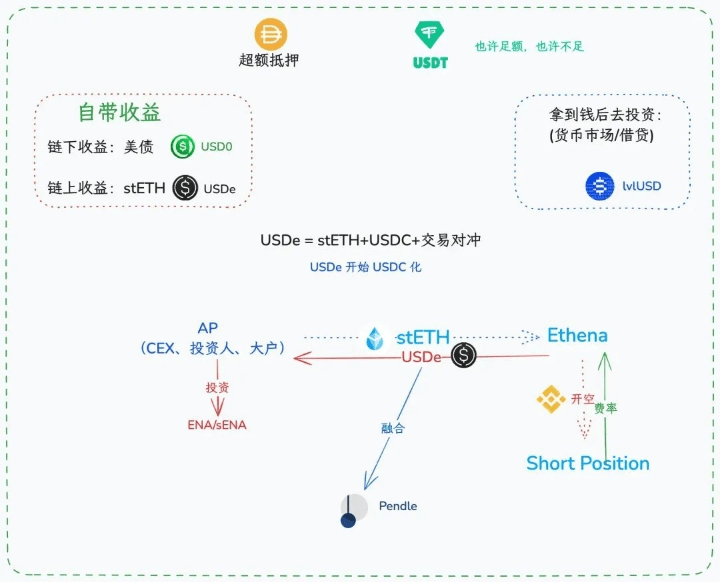
Image description: YBS classification and operation flowchart
On the surface, Ethena has four token systems: USDe and sUSDe, ENA and sENA, but the core of Ethena has always been just USDe, with the most important scenarios being the adoption rates of USDe outside of 'staking and wealth management', such as trading and payments.
Recall the operating process of the US dollar; the dollar cannot be fully reinvested into US Treasuries. The most reasonable scenario is that a small portion of dollars flows back into the bond market, while most dollars remain in the hands of other countries, preserving the dollar's status as a global currency and maintaining its purchasing power.
Earlier this year, USDe attracted about 60% of USDe to be staked as sUSDe with a yield of 9%. Essentially, this represents the liabilities of the protocol. Theoretically, the remaining 40% of USDe must pay a 9% yield to 60% of the participants, which is obviously unsustainable.
Therefore, the alliance between ENA and CEX is incredibly important. For reference, Circle shares profits with Coinbase and Binance for holding USDC, and ENA essentially has to fulfill the 'bribery' role to AP. If large holders do not sell, everything will be fine; sENA serves as another guarantee for stabilizing large holders.
Layer upon layer of nesting, therefore the best model to emulate is neither the dollar nor USDC, but USDT, with $1.4 billion in profits belonging to Tether, and $160 billion in risk shared by CEX and retail investors.
Nothing else, P2P transfers, spot trading pairs, US dollar-based contracts, and assets of retail and institutional investors all require USDT as the most widely recognized trading intermediary, while USDe doesn't even have spot trading pairs.
Of course, whether the collaboration between Ethena and Pendle can reshape the DeFi ecosystem, shifting its focus from lending to yield, still requires time. I will introduce it in a later article.
YBS is essentially a customer acquisition cost.
In 2014, USDT initially explored the Bitcoin ecosystem, and only later reached cooperation with Bitfinex, establishing roots in CEX trading pair scenarios. Subsequently, in 2017/18, it settled in the Tron network, becoming the absolute leader in P2P scenarios.
The subsequent USDC/TUSD/BUSD/FDUSD are merely imitations, never surpassing (just a complaint, Binance naturally conflicts with stablecoins and has already killed several stablecoins).
Ethena, relying on a 'bribery' mechanism, has captured part of the CEX market, but has hardly seized the compliant scenarios of USDC, and has not squeezed into the trading and transfer scenarios dominated by USDT.
However, YBS cannot enter trading scenarios, CEX is also not feasible, and it cannot enter payment scenarios; offline it is also not possible. Relying solely on yields leaves only DeFi as a way out.
The existing YBS can be divided into the following categories: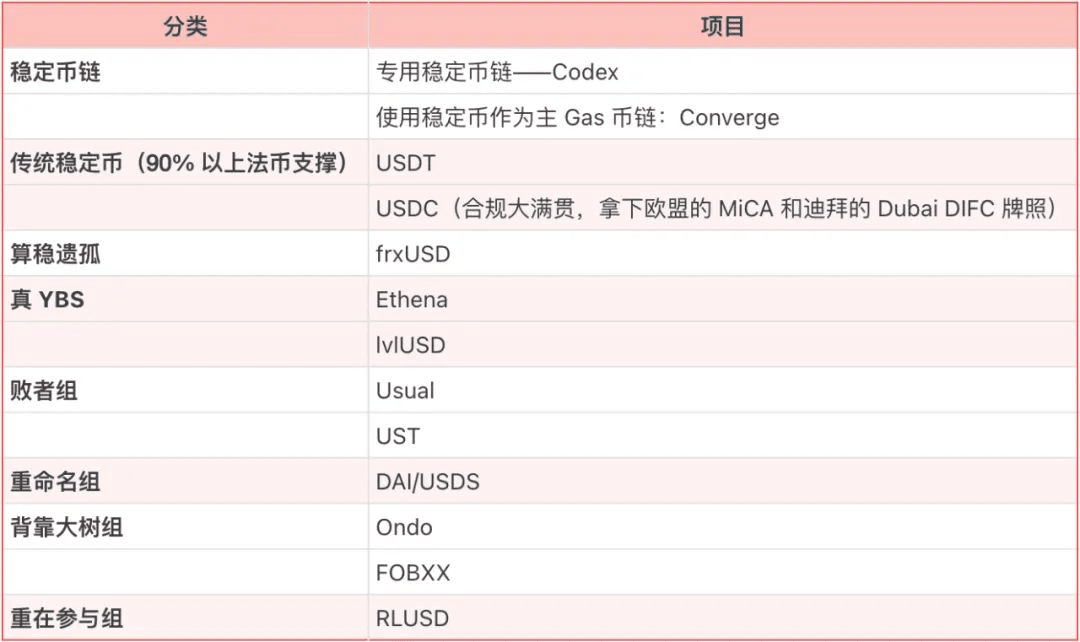
YBS's yield is the liability of the protocol, essentially the cost of customer acquisition, requiring more users to recognize its standards for dollar equivalence and hold it themselves, rather than contributing to the staking system to sustain.
Among the current top 50 stablecoins by market value, exactly $50 million serves as a cutoff, while the APY list for YBS is as follows: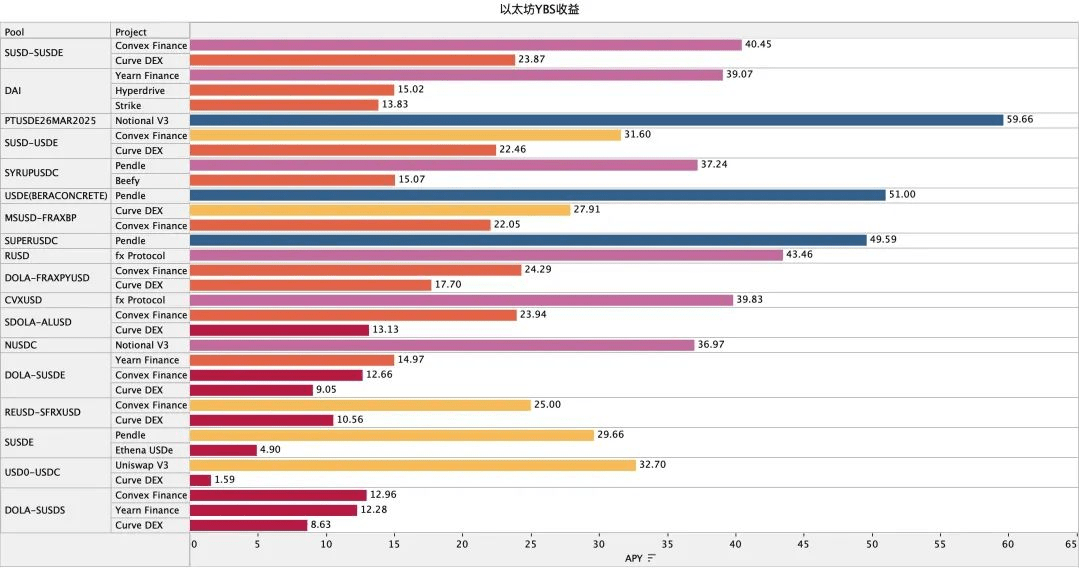
Image description: Ethereum YBS yields
According to data from DeFillama, the yields of Ethereum's YBS can be roughly equated to Ethena and Pendle, which sharply contrasts with the sky-high returns of thousands of times since the DeFi Summer.
The era of exorbitant profits has ended, and the era of low-interest wealth management has arrived.
Profit and loss originate from the same source. Today, US Treasuries have become the underlying income pillar for most YBS, which is not safe. Furthermore, on-chain income requires extremely strong secondary liquidity support; without enough user participation, income guarantees can become the mountain that crushes YBS projects.
This is not surprising. Binance's invested Usual manually modified the anchoring ratio, and Sun's USDD can still guarantee a yield of 20% to this day. Children, this is not funny. If the most successful USDe native yield is only 4.9%, then where does USDD's 20% come from? I can't figure it out.
Here, a distinction needs to be made. The yields in the above chart are the yields of various pools, which even include the yields inherent to LSD assets, and are not entirely equivalent to the yields given by each YBS natively. The yield sources for participating in DeFi likely come from the participants themselves; this principle has always existed.
More and more YBS are emerging. Undoubtedly, the focus of competition remains on market share. Only when the vast majority of people want to use Stable instead of pursuing Yield can YBS maintain high yields while squeezing out the usage space of USDT.
Otherwise, if 100% of users pursue yields, the source of yields will disappear. Whether it's Ethena's fee arbitrage or US Treasuries on-chain, there will always be counter-parties that incur losses in yields or principal. If everyone is making money, then the world is just a giant Ponzi.