

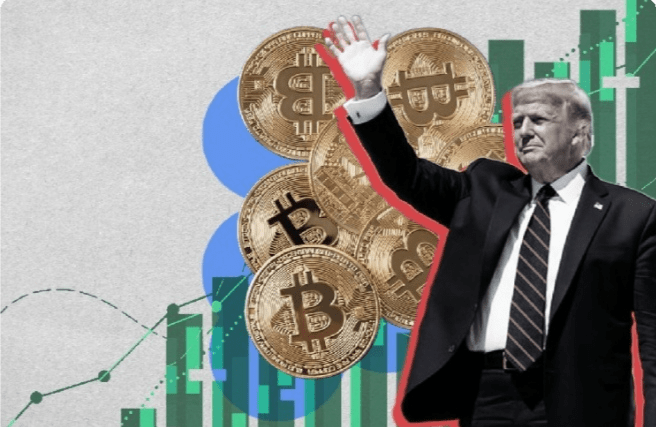
Cryptocurrencies are recovering after the declines recorded over the weekend. Bitcoin (BTC) is trading again at $110,000, while Ethereum (ETH) is nearing $2,600 at this hour on Monday.
Most 'altcoins' are also trading with notable increases. XRP and Binance Coin (BNB) are up around 2%, while Solana (SOL), Dogecoin (DOGE), Chainlink (LINK), and Cardano (ADA), among others, are rising more than 3%, with the latter showing a 5% increase.
The advance of digital assets comes after the agreement reached between the European Union (EU) and the United States to continue negotiations following President Donald Trump's threat to raise tariffs to 50% on products imported from the community bloc.
It is worth noting that Trump imposed a 20% tariff on the EU as part of the reciprocal tariffs he announced in early April, on the so-called 'Liberation Day.' This was before reducing the rate to 10% for 90 days on April 9.
Nonetheless, the president suggested last Friday a "direct tariff" starting June 1, claiming that the EU was being "very difficult to deal with." Now, Trump has granted the community bloc an extension until July 9.
"On one hand, the drop over the weekend showed how quickly crypto can collapse amid macroeconomic shocks. On the other hand, the rapid extension of the tariff deadline reinforces the belief that the worst is over. Traders are cautiously accumulating again," points out Jeff Mei, COO of BTSE, in statements reported by 'CoinDesk.'
In this sense, QCP Capital notes that risk appetite has surged again, with an increase in contracts betting on a price of $130,000 for Bitcoin in September. They also highlight the good performance of exchange-traded funds (ETFs), which have not registered a day with negative net flows since May 13, and of large Bitcoin acquisition movements.
Regarding this last point, Strategy, the largest institutional holder of Bitcoin, has announced that it will raise up to $2.1 billion through the issuance of Series A Perpetual Strife (STRF) preferred shares. The STRF shares, which offer a 10% annual cash dividend, are specifically designed to attract institutional investors seeking exposure to BTC with less volatility than a direct investment in cryptocurrencies.
For his part, Javier Molina, senior market analyst at eToro, believes that doubts about the sustainability of the deficit are calling into question the narrative of American "exceptionalism." "The market no longer sees the United States as a risk-free asset. What we are witnessing is a clear episode of 'regime uncertainty.' We are not talking about specific economic or political uncertainty, but a change of rules on all fronts: fiscal, trade, and institutional. This time it is not even disguised, as the threats are public, maximalist, and lacking technical grounding. It is no surprise that other powers are starting to ignore them. If China already managed to make Trump back down, why wouldn't Brussels or Canada do the same?" this expert questions.
Regarding Bitcoin, this expert believes that the narrative of digital gold "strengthens in a context of structural inflation, persistent deficits, and distrust towards debt markets." "The decoupling from Nasdaq is a signal, where Bitcoin is starting to behave more as a store of value than a technological asset," points out Molina. He also highlights the difference between the low supply of the crypto asset and the high institutional demand, as well as the rotation of "weak" hands (retail and short-term speculators) to strong hands (companies, ETFs, institutional). "Those hands do not sell. This change in holders reduces liquidity, compresses volatility, and raises the market floor," he adds.
Technically, the first support is at $108,000. Above, a new zone of highs if it surpasses $112,000, with a target of $120,000. "The increase in volatility may be signaling some exhaustion and caution," it highlights.