
Bitcoin's rise in May showed strong momentum but faced pressure from profit-taking at the end of the month.
On-chain data suggests long-term accumulation and sustainable institutional confidence despite short-term volatility.
Key drivers in the future: ETF inflows, macro shifts, and reactions at technical levels ranging from $105,000 to $108,000.
Bitcoin's price performed strongly in May, rising nearly 20% to a new all-time high of $111,954. However, selling pressure at the end of the month trimmed those gains, bringing the monthly advance down to about 10%. Nevertheless, the recent surge reflected strong momentum across both technical and fundamental indicators. As June begins, investors are closely watching for signs of another potential rally.
On-chain data confirms long-term confidence
On-chain data indicates that Bitcoin's rise in May was driven not only by speculative demand but also by increasing confidence from institutional and retail investors. Nearly 66,975 Bitcoins - worth approximately $7.2 billion - were withdrawn from exchanges to private wallets during the month. This trend indicates ongoing accumulation and strong belief in Bitcoin's long-term upward trajectory.
Throughout May, this accumulation helped maintain a broadly positive outlook, with prices occasionally rising due to fear-driven buying. At the same time, the increasing share of long-term holders contributed to reducing selling pressure - supporting Bitcoin's steady upward trend.$BTC
Macroeconomic trends favor the bullish outlook
On the macroeconomic front, several factors continue to support Bitcoin's upward trajectory. The decline in global inflation has given central banks more flexibility to shift towards a more accommodative monetary policy. At the same time, the dollar and declining real interest rates have enhanced investor appetite for riskier assets like Bitcoin.
The increasing correlation between Bitcoin and equity markets along with steady institutional inflows indicates that it is becoming increasingly integrated into the traditional financial system. This highlights a broader shift: Bitcoin is now influenced more by global macroeconomic trends than by developments specific to cryptocurrencies.
Key issues shaping Bitcoin's recent price movement include the U.S. stance on tariffs and Federal Reserve policy. The initial ruling by the U.S. Federal Trade Court to block tariffs provided a brief relief to markets. However, this optimism quickly faded when the appeals court halted the cancellation, reigniting uncertainty. With this chaotic environment around trade policy returning, Bitcoin's recent decline gained momentum.
Today, markets are awaiting the release of the Personal Consumption Expenditures (PCE) index, which is the Federal Reserve's preferred measure of inflation. A reading below expectations could ease inflation concerns and reinforce expectations for a more hawkish stance from the Federal Reserve - potentially providing indirect support for Bitcoin.
Meanwhile, Bitcoin spot ETFs, which saw strong inflows throughout May, experienced net outflows at the end of the month. This indicates that short-term investors are taking profits amid market uncertainty. However, the broader trend remains strong. Total inflows are still approaching $45 billion, reaffirming continued institutional interest and resilient medium-term expectations for Bitcoin.
Investors are cautious despite the upward trend
Bitcoin currently has strong potential to extend its upward trend, supported by favorable macroeconomic conditions, strong demand, and ongoing accumulation by long-term holders. However, in the short term, the market remains sensitive to pullbacks caused by profit-taking.
As we approach June, price movements around key technical levels will be critical to monitor. ETF inflows, ongoing accumulation trends, and macroeconomic signals remain the main drivers influencing Bitcoin's path.
Technical outlook for Bitcoin
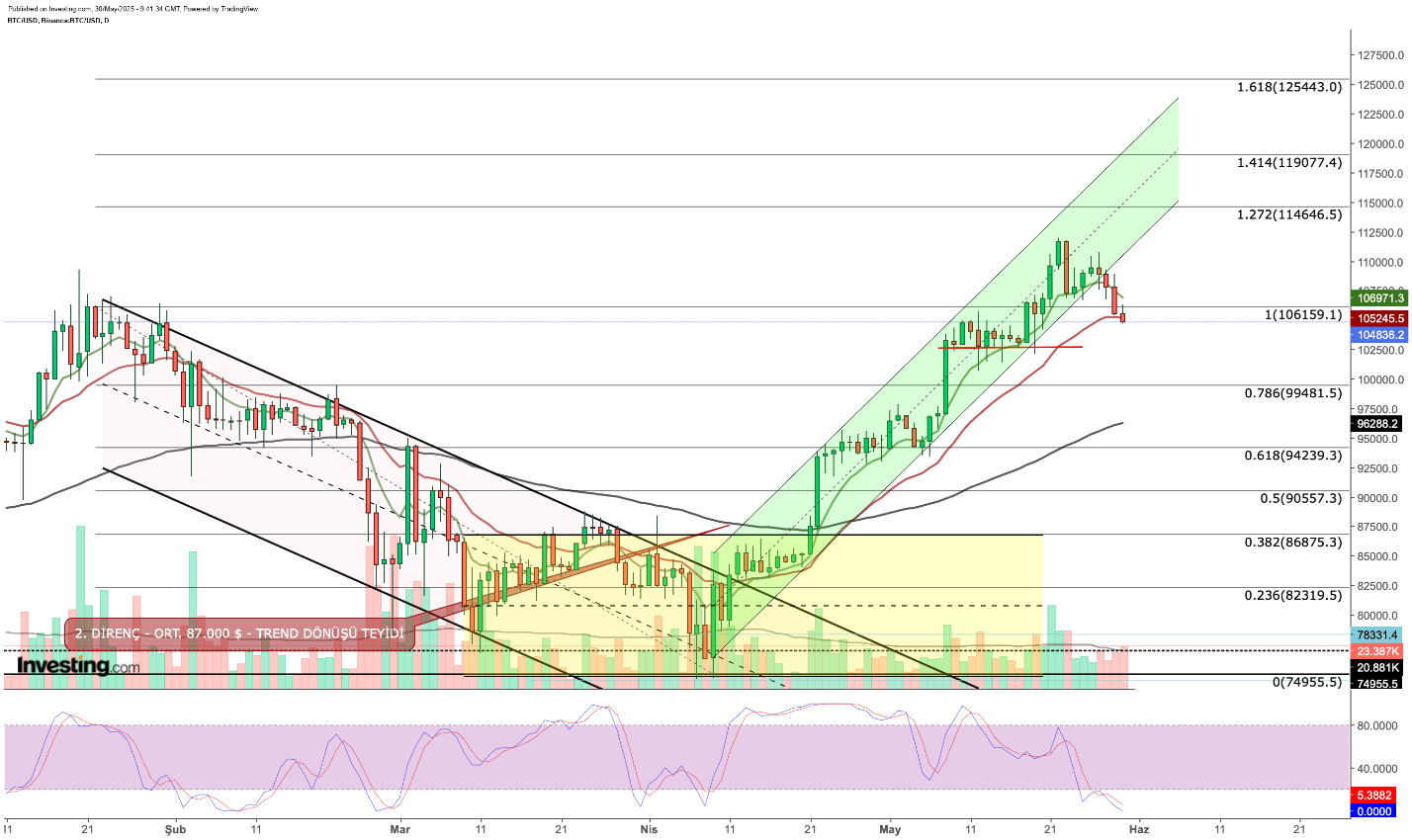
Although Bitcoin made another push towards the $110,000 level earlier this week, profit-taking intensified after the sharp decline on May 23.
Midweek, the cryptocurrency lost support at the $108,000 level, thereby breaking the bullish trend that began in April. The lower limit of the ascending channel also aligns with the 8-day exponential moving average, which has served as dynamic short-term support. By the end of the week, Bitcoin is testing the intermediate support at the 21-day exponential moving average, currently around $105,300.
Maintaining this level at the daily close may help contain the current pullback. However, reclaiming the $108,000 area is crucial for resuming the bullish trend. A successful breakout could restore bullish momentum and open the door for the next target range between $114,000 and $125,000.
On the downside, a breakout below $105,000 could lead to a move towards the support area in early May near $102,500. If bearish momentum persists, the important psychological level of $100,000 will be the next key support to monitor.
Despite short-term volatility, Bitcoin's medium- and long-term outlook remains constructive. Any corrective moves could simply expand the current bullish trend channel and provide new entry points for long-term investors.

