


The choice of cryptocurrency for mining
The choice of cryptocurrency for mining depends on many factors. For example, Bitcoin is primarily mined on ASIC devices due to the high network difficulty, while Ethereum Classic and Ravencoin are suitable for graphics cards (GPU). The choice of cryptocurrency for mining should be made considering factors such as:
Type of equipment — ASIC, GPU, or CPU. Some cryptocurrencies are more efficiently mined on specialized devices (e.g., Bitcoin on ASIC), while others are better suited for graphics cards (Ethereum Classic, Ravencoin).
Hashing algorithm — SHA-256, Ethash, KawPow, RandomX, etc. The algorithm affects the efficiency of the equipment and the complexity of mining.
Network difficulty and reward — the higher the difficulty, the harder it is to form the blockchain, which affects profitability.
Electricity cost — affects the final profit, as mining requires significant resources.
By analyzing these factors, one can choose the optimal cryptocurrency for mining considering the current market conditions.
Comparison of the best coins for mining
In cryptocurrency mining, the choice of coin depends on the available equipment and potential profitability. Let's consider several of the best options for different types of devices.
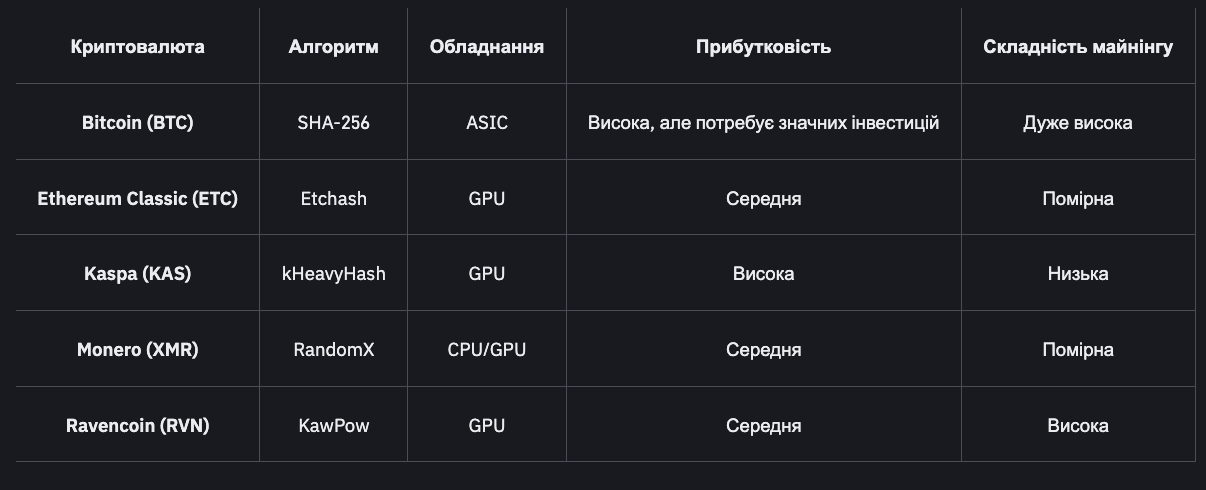
It should also be noted that mining profitability depends on electricity costs, the current rate, and network difficulty.
For ASIC, the best choice is Bitcoin (BTC); for GPU — Ethereum Classic (ETC), Kaspa (KAS), Ravencoin (RVN); and for CPU — Monero (XMR). Before starting mining in the crypto industry, it is important to analyze the size of initial investments and the potential profitability of the chosen coin.
List of coins for mining
Cryptocurrency mining remains a profitable way to earn money if the coin is chosen correctly according to the equipment. Here is a list of the best options:
For ASIC: Bitcoin (BTC) — SHA-256, Litecoin (LTC) — Scrypt, Bitcoin Cash (BCH) — SHA-256, Dash (DASH) — X11, Zcash (ZEC) — Equihash.
For GPU: Ethereum Classic (ETC) — Etchash, Kaspa (KAS) — kHeavyHash, Ravencoin (RVN) — KawPow, Flux (FLUX) — ZelHash, Ergo (ERG) — Autolykos.
For CPU: Monero (XMR) — RandomX, VerusCoin (VRSC) — VerusHash, Dero (DERO) — AstroBWT.
The choice of cryptocurrency depends on the type of equipment and ROI of mining. Before starting, it's worth analyzing electricity costs and mining prospects.
Is mining profitable now? The average reward that miners receive
The profitability of cryptocurrency mining depends on the specific coin. In particular, mining Bitcoin (BTC) has its challenges due to increasing network difficulty and rising production costs.
Basic data on Bitcoin mining profitability:
Network difficulty: On February 9, 2025, the difficulty of mining Bitcoin reached a new historical maximum, increasing by 5.61% to 114.17 T.
Production costs: According to the investment group CoinShares, the average cost of mining one Bitcoin for public companies in the USA in the third quarter of 2025 rose to $55,950.
Market price: As of the end of February 2025, Bitcoin is trading at approximately $102,175, which provides narrow profit margins for miners.
Accordingly, such trends affect the average profitability of miners. Several facts:
Reward reduction: In April 2024, another halving occurred, resulting in the daily number of new coins that miners can receive decreasing from 900 to 450 BTC.
Impact on profitability: The reduction in rewards and rising electricity costs create additional pressure on miners' profitability.
Therefore, it is worth looking for alternative cryptocurrencies for mining. For example, in 2025, mining cryptocurrencies like Ethereum Classic (ETC), Kaspa (KAS), or Monero (XMR) may be more profitable, although it also depends on equipment and electricity costs. These coins may offer better profitability for CPU or GPU mining.
Factors affecting mining profitability
ROI of mining depends on many variables. To achieve optimal results, one must consider market, technical, and financial factors.
Key factors affecting mining:
The price of cryptocurrency and network difficulty — the more expensive the coin, the higher the profit, but as difficulty increases, its mining becomes less profitable.
Block reward and halving — a reduction in rewards (for example, in Bitcoin) decreases miners' profits.
Electricity and equipment costs — high electricity costs and expensive equipment (ASIC, GPU mining) can reduce profitability.
Fees and servicing — costs for mining pools, cooling, repairs, and technical support affect net profit.
Regulation and taxes — legislative restrictions or tax policies can both promote and hinder the development of mining in certain countries.
Mining profitability is determined by many factors, so to succeed, one must analyze the market, choose efficient equipment, and consider all costs.
Mining pools on Binance
Binance Pool is a mining platform integrated with the Binance ecosystem, allowing users to combine their computing power for joint cryptocurrency mining. This enables miners to receive more stable and predictable rewards, reducing the impact of randomness in finding blocks.
Features of Binance Pool:
Support for various cryptocurrencies. Binance Pool supports mining Bitcoin (BTC), Ethereum Proof-of-Work (ETHW), and smaller cryptocurrencies.
Integration with the Binance exchange. Earnings from mining can be directly transferred to your Binance exchange account, simplifying the trading or withdrawal process.
Competitive fees. Binance Pool offers attractive terms with low fees, allowing miners to maximize their profits.
Cloud mining. For users who do not have their own equipment, Binance offers cloud mining services, allowing them to rent computing power and receive rewards without the need to manage physical equipment.
By using Binance Pool, miners gain access to a reliable and efficient platform that provides stable payouts and integration with a wide range of services in the Binance ecosystem.
The future of mining
Cryptocurrency mining continues to evolve under the influence of technological development, regulation, and economic factors. Given the upcoming changes, this sector is undergoing significant transformations.
Among the trends in future mining, the following can be highlighted:
Transition to eco-friendly cryptocurrencies — there is an increasing demand for mining using renewable energy sources to reduce environmental impact and costs.
Development of new algorithms — energy-efficient algorithms (for example, Proof-of-Stake instead of Proof-of-Work) are emerging, changing the approach to cryptocurrency mining.
Centralization of mining — large companies and pools become the main market players, making competition difficult for individual miners.
Increase in regulatory oversight — governments are tightening oversight of mining, which may affect legality and profitability in different countries.
Innovations in equipment — new generations of ASIC miners and graphics processors are becoming more efficient, changing the structure of the cryptocurrency market.
The future of Bitcoin after halving — the reduction in block rewards decreases the profitability of traditional mining, forcing miners to seek alternative solutions.
Mining continues to adapt to new realities, and its future depends on technological innovations, environmental changes, and regulation. For miners, it is important to keep an eye on trends to remain competitive in the rapidly changing cryptocurrency market.
Conclusions
The future of mining is shaped by technological changes, eco-friendly cryptocurrencies, and increased regulation. The use of energy-efficient solutions, new algorithms, and the development of equipment are changing the industry, making it more centralized. Miners will need to adapt to new realities by analyzing mining profitability and the prospects of various cryptocurrencies. Despite challenges, mining remains an important part of the crypto ecosystem and a potentially profitable direction if approached with careful analysis and the right strategy.