
In the early days of DeFi, leveraged trading and stablecoins were like oil and water — powerful on their own, yet difficult to coexist. Leverage means liquidation risk, unpredictable funding costs, and volatility that keeps one awake at night. And stablecoins? They are either centralized 'IOUs' or immature experiments.
But what if you could combine the advantages of both while discarding their flaws?
This is exactly the intention of the f(x) Protocol: a decentralized system dedicated to achieving what others cannot — providing high-leverage trading and yield-bearing stablecoins without relying on centralized entities. We have completed half of our goal with fxUSD (stablecoin) and xPOSITION (leveraged long position). After several months of mainnet operation and a total locked value exceeding $200 million, f(x) Protocol v2.1 completes this equation.
Welcome the arrival of sPOSITION.
The trilemma has finally been resolved.
The original fxUSD directly challenged the 'trilemma' of stablecoins: decentralization, capital efficiency, and scalability. But the f(x) ecosystem needs more: it needs a way for users to trade confidently, earn yields, all while avoiding the drain of funding costs and the threat of frequent liquidations.
xPOSITION is designed precisely for this: it is a fully collateralized leveraged long position that supports up to 7x leverage, with almost no liquidation risk, and zero funding costs under normal conditions. This is not just an exposure to synthetic assets, but true on-chain leverage: modular, atomic, and transparent.
But relying solely on long positions is far from sufficient. When market sentiment shifts, users also need the ability to hedge, speculate, or express bearish views.
This is the starting point for the next phase of f(x): a native shorting mechanism that truly implements it correctly.
The shorting mechanism in DeFi is still cumbersome.
Although shorting tools in DeFi have seen improvements, they still often appear cumbersome, complex, or rely on 'collateral gymnastics' — repeatedly adjusting margin allocations. Most systems depend on passive mechanisms or opaque dependencies, making short positions appear fragile, slow, and inefficient during volatile periods.
f(x) v2.1 introduces sPOSITION, adopting a fundamentally different approach: a fixed-leverage short exposure, atomic execution, and using fxUSD as collateral. No need for active collateral management, no margin call notifications, and no need to monitor positions constantly.
Continuing the consistent features of f(x):
1️⃣ No borrowing costs — just a one-time opening/closing fee.
2️⃣ No forced liquidation — thanks to the same liquidation buffer mechanism as xPOSITION.
3️⃣ Each short operation can be completed in a single transaction: simple, transparent, and trustless.
How does sPOSITION work?
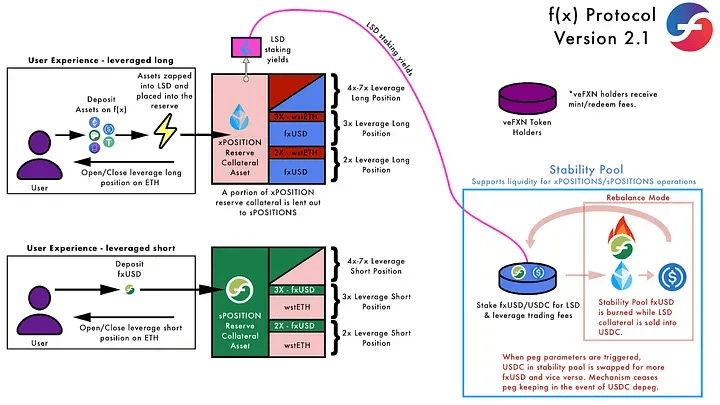
From a high-level perspective, sPOSITION is the mirror version of xPOSITION. xPOSITION borrows fxUSD against collateralized assets and then buys tokens (like ETH) to go long.
In contrast, sPOSITION is the opposite: you deposit fxUSD, use it to borrow tokens (like ETH or BTC), and immediately sell to achieve a short.
But the real core lies in 'atomic execution':
Each sPOSITION is completed through an atomic transaction process powered by a 'flash loan':
1️⃣ The protocol flashes borrow tokens (like stETH or wBTC) from the liquidity pool based on the user's chosen leverage market.
2️⃣ The system immediately sells the token in the automated market maker (AMM) for fxUSD.
3️⃣ The obtained fxUSD (original plus proceeds from the flash loan sale) is used as collateral for sPOSITION.
4️⃣ The protocol borrows an equivalent amount of tokens from the xPOSITION reserves.
5️⃣ The borrowed tokens are used to repay the flash loan.
The final effect: a complete leveraged short position is accomplished in a single transaction, fully automated, without manual management of borrowing or liquidation.
Not just symmetry, but also self-stabilizing.
sPOSITION not only adds directional symmetry to the system but also enhances overall strength.
When a user opens an sPOSITION, it effectively removes fxUSD from circulation, thereby reducing supply pressure when the market declines, helping to maintain the peg of fxUSD. At the same time, it provides users with a native, highly capital-efficient way to express bearish views.
The result is a more resilient, self-regulating fxUSD ecosystem, where stability and leverage complement each other.
Design is pressure-resistant.
Although the shorting feature increases the system's practicality, it also introduces new dimensions of risk. Therefore, f(x) v2.1 comes equipped with multiple proactive protection mechanisms:
1️⃣ The system does not rely on static liquidation thresholds or liquidation waterfalls, but dynamically responds to pressure.
2️⃣ It can actively reduce the leverage of the most at-risk sPOSITIONs;
3️⃣ Dynamically adjust capital flows;
4️⃣ Limit new short openings during reserve shortages.
This is a protocol that will not collapse under pressure: it will bend, absorb, and adapt.
Composable new tools for risk management
With the launch of sPOSITION, the f(x) Protocol is no longer just a stablecoin engine; it has become a full-featured leverage and hedging platform:
1️⃣ Use fixed leverage for long or short trades;
2️⃣ Achieve direction-neutral yield through fxSAVE;
3️⃣ Provide liquidity to the fxUSD pool for mining rewards;
4️⃣ Manage positions without centralized risk;
All functionalities are implemented within the same trust-minimized system.
Complete closed loop
DeFi doesn't just need another stablecoin; it needs a truly balanced system: long and short positions offset each other, yields are real, and exchange rates stabilize automatically.
No illusory 'Internet magic money', no radical token emission mechanisms, only real economic activities support real results: leveraged trading, staking yields, and a self-stabilizing reserve system.
With the introduction of sPOSITION in f(x) Protocol v2.1, this system has finally taken shape.
It is not a synthetic asset, not soft-pegged, and does not rely on human intervention.
That's f(x) — now, it supports bidirectional trading.
