1. True transformation always occurs in a sluggish market.
When everyone is still in the meme coin market PVP, and when everyone thinks there is no narrative in this round, traditional financial markets have actually been surging beneath the surface, rushing into blockchain.
Moreover, in places that many haven't noticed, many leading old blockchain projects are quietly making efforts, seizing the opportunity to merge new narratives.
Currently, the most noteworthy narrative is naturally the fusion of coins and stocks.
There is an event that may be overlooked by everyone: traditional stock trading platform giant Robinhood ultimately chose Arbitrum technology to deploy chains, achieving stock on-chain.
This is not a simple collaboration; it is actually a landmark event in the fusion of coins and stocks.
2. Why did Robinhood choose Arbitrum to deploy chains?
First, the cost of building Layer1 is too high, while Layer2 is a much lighter choice.
It should be noted that Layer2 can directly utilize Ethereum's security and access Ethereum's liquidity, which is much simpler than building a Layer1 from scratch, allowing for more focus on actual business.
Secondly, the Layer2 ecosystem has shown a trend of solidarity, with two major camps led by Arbitrum and Optimism.
Both Arbitrum and Optimism have opened their technology stacks, supporting one-click chain deployment.
The Optimism ecosystem already has the largest compliant exchange in the U.S., Coinbase's Base chain, while the Arbitrum ecosystem urgently needs a top trading platform as a partner.
If Robinhood joins the Optimism ecosystem, it actually won't be able to achieve a leading position, as both brand awareness and liquidity may be siphoned off by the Base chain.
Therefore, Robinhood joining the Arbitrum ecosystem would be a better choice, not only occupying a differentiated ecological position but also gaining strong support from Arbitrum.
Therefore, the cooperation between Robinhood and Arbitrum can be said to be mutually beneficial, a strong alliance. @arbitrum @arbitrum_cn @RobinhoodApp
3. What exactly are Arbitrum Chains?
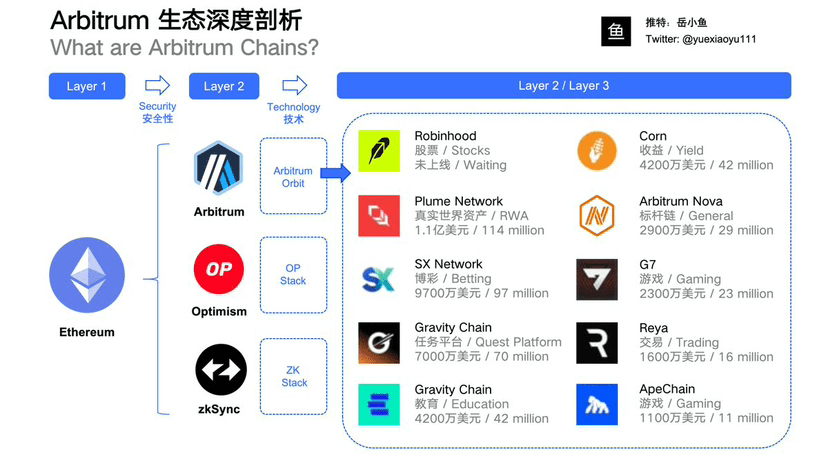
Arbitrum Chains are essentially custom chains developed based on the Arbitrum Nitro technology stack, which can also be called Layer3.
The Arbitrum Orbit framework allows developers to deploy chains with one click, including Layer2 and Layer3, while inheriting Ethereum's security and Arbitrum's Rollup optimization.
L3 chains further subdivide application scenarios based on L2, such as being optimized specifically for gaming, DeFi, or RWA, reducing congestion on the main chain.
In simple terms, if Ethereum is a highway, Arbitrum is an exit ramp, and Orbit Chains are exclusive lanes that allow large vehicles like Robinhood to run faster.
Currently, the Arbitrum ecosystem has already seen various types of sub-chains, covering a wide range including RWA, gaming, NFT, DeFi, and more.
Notable examples include Plume for RWA, the well-known task platform Gravity, yield-focused Corn, and ApeChain from the Bored Ape universe.
Of course, the most anticipated is still Robinhood's Layer3.
4. With a large and mature Optimism ecosystem ahead and a rapidly developing zkSync ecosystem behind, the Arbitrum ecosystem needs to carve out its own path.
Optimism leans towards community and interoperability (such as social/DeFi), zkSync has advantages in privacy-demand scenarios (such as AI/DePIN), while Arbitrum currently seems suitable for high-performance and highly customizable scenarios (such as RWA/games).
The opportunity is right in front of us; it depends on whether Arbitrum can seize this wave of coin-stock fusion narrative, solidify its leading position in Layer2, and make further breakthroughs.