
Opening 10x leverage with 1000U and 2x leverage with 5000U superficially controls a position of 10000U (1000×10=5000×2), but there are essential differences in risk entropy value, volatility tolerance threshold, and capital survival curve levels. For beginners, this is not just a simple leverage choice, but a technical contest of 'liquidation acceleration' and 'tolerance space'. Why does high leverage become a harvesting machine for beginners?
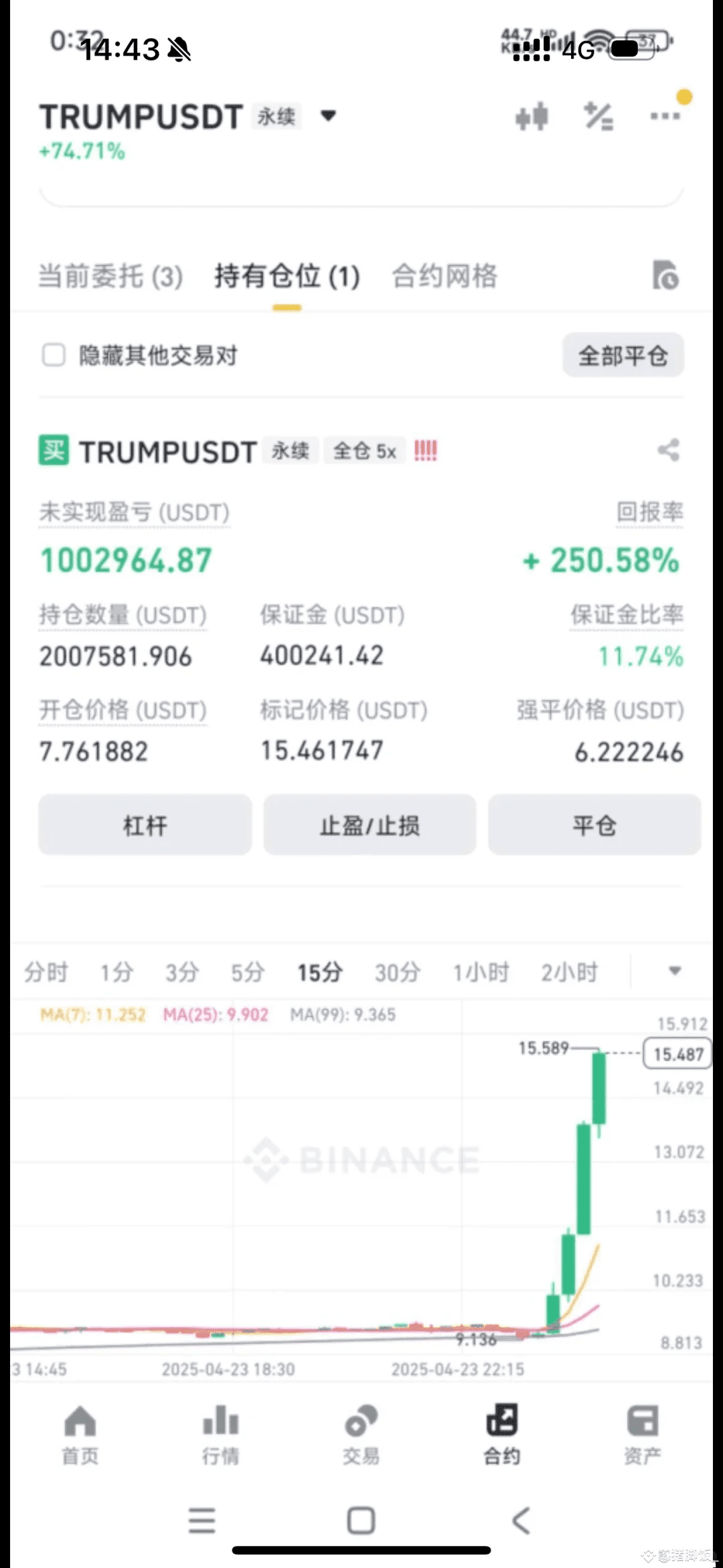
Use data models to break down 90% of the fatal traps in contract trading.
Kelly formula verification:

1. Quantitative comparison of risk matrices for two leverage models
1. Margin anti-volatility coefficient calculation
Opening 10x leverage with 1000U: Margin ratio 10%, when the target asset fluctuates by 1%, loss = 10000U × 1% = 100U, accounting for 10% of the margin (100/1000); a fluctuation of 10% triggers the liquidation line (10000U × 10% = 1000U = total margin). Its risk threshold corresponds to the fluctuation range of a medium bearish candle on the 4-hour line (mainstream coins daily average fluctuation 3%-5%).
Opening 2x leverage with 5000U: Margin ratio 50%, a 1% fluctuation results in a loss of 100U, but only accounts for 2% of the margin (100/5000); it needs a 20% fluctuation to trigger liquidation, equivalent to Bitcoin dropping from $30,000 to $24,000 in an extreme market. The risk redundancy is 200% of the former.
2. Capital survival probability curve
Backtest 48 instances of Bitcoin's daily fluctuations exceeding 5% in 2023:
In a 10x leverage model, the probability of liquidation reaches 83% (40/48).
In a 2x leverage model, the probability of liquidation is only 4% (2/48).
The survival curves of the two show a cliff-like differentiation after 15 fluctuations, with high leverage groups having a capital wipeout rate of 91%.
3. Mathematical model of operational fault tolerance rate.
Assuming the average reaction delay for beginners is 15 minutes (time taken from judgment to placing an order), the standard deviation of mainstream coins for 15-minute fluctuations is 0.8%:
Under 10x leverage, 2 consecutive reverse fluctuations consume 16% of the margin, triggering the psychological panic threshold.
With 2x leverage, 10 consecutive reverse fluctuations are needed to reach the same panic threshold.
This explains why high-leverage beginners easily fall into the negative cycle of 'frequent liquidations - chasing highs and cutting losses'.
2. Technical protection system for beginner contract trading
1. Golden formula for leverage selection
Safe leverage multiplier = (Maximum acceptable daily loss rate × Total capital) ÷ (Target asset 24-hour volatility × Position amount)
Example: With 10,000 U capital, the maximum acceptable daily loss is 5% (500 U), holding a position of 10,000 U, with the target 24-hour volatility at 5%.
Safe leverage = (500U) ÷ (10000U × 5%) = 1x.
This formula reveals: The higher the volatility of the currency (e.g., altcoins with an average daily volatility of 10%+), the lower the safe leverage should be.
2. Technical parameter settings for dynamic stop-loss.
Short-term (15-minute chart): Stop-loss = Opening price ± (ATR indicator ×2), ATR value reflects the recent average fluctuation range.
Medium-term (4-hour chart): Set the stop-loss at 1% outside the most recent 3 trading days' low/high points to filter noise signals.
3% warning line before forced liquidation trigger: Set automatic reduction instruction to avoid instant liquidation in extreme markets.
3. Cognitive ladder of contracts and spot trading.
The core of spot profit is 'trend continuity', while the core of contract profit is 'volatility acceleration'. Beginners need to complete three cognitive leaps:
Able to achieve a monthly return of 5%+ in spot trading for 6 consecutive months (demonstrating trend judgment ability).
Master the MACD divergence + volume verification top-bottom signals (filter out false breakouts).
Establish a 'Loss Log': Record the fluctuation trigger points and stop-loss response times for each trade.
3. Technical architecture of mainstream coin trading systems
1. Dynamic balance strategy for medium to long-term positions
Core position (60%): Allocate Bitcoin (40%) + Ethereum (20%), with the reference indicator being the MVRV ratio (market cap vs realized market cap) <1.2 when adding positions.
Rolling funds (30%): When the price breaks above the 20-week line and the weekly RSI < 60, use 10% of the position to add, reduce by 5% when RSI > 70.
Cash reserve (10%): Used for supplementary positions during extreme markets (fear index < 20), with a single supplementary position not exceeding 5%.
2. Time-space node model of swing trading
Entry signal: A 'large bullish engulfing' appears on the daily chart, and the 5-day moving average crosses above the 10-day moving average to form a golden cross.
Exit node:
First take-profit level: Previous high point ×1.08 (Fibonacci 1.08 extension).
Second take-profit level: Daily MACD histogram volume decreases by 30%+.
Position control: Build a position of 30% at breakouts, add 20% upon confirmation of a pullback, and flexibly adjust the remaining 50% based on volume changes.
3. Multi-dimensional verification of trend judgment
Lifeline system:
Short-term (4-hour): The 20EMA serves as the trend continuation line; if the closing price falls below it for 3 consecutive K lines, reduce the position.
Medium-term (daily): The 50EMA serves as the dividing line for long and short positions; increase position by 30% when crossing above, decrease to 30% when crossing below.
Volume validation: During an increase, trading volume must maintain above 120% of the average for the previous 5 days, otherwise considered a false trend.
4. Reverse thinking algorithm for trading decisions.
1. Risk entropy value calculation for surging markets
When the price increases more than 15% within 24 hours and deviates from the 5-day line by more than 5%:
Risk entropy value = (Price increase ÷ Average volatility) × (Market capitalization ÷ 24h trading volume)
When entropy > 8, trigger a reduction instruction (reduce position by 15% each time).
2. Opportunity coefficient model for market crashes
Opportunity coefficient = (Historical volatility ÷ Current volatility) × (Fear index ÷ 100)
When the coefficient > 1.5, initiate a phased building position (add 5% for every 3% drop).
When the coefficient < 0.8, even if the price drops, observation is necessary (to avoid catching a falling knife halfway).
3. Health indicators of capital curves.
Maximum drawdown rate: Single pullback not exceeding 15%, exceeding this will pause trading for 3 days.
Profit continuity: After 3 consecutive losses, forcibly reduce the position to 20%.
Sharpe ratio: Monthly return ÷ Monthly volatility > 1.2, otherwise optimize strategy.
The essence of trading is not to predict points, but to establish a quantifiable response system. The core difference between opening 10x with 1000U and 2x with 5000U lies in understanding the formula 'Risk exposure = Leverage multiplier × Volatility sensitivity × Reaction delay'. For 90% of beginners, before mastering the ability to capture trends in spot trading, the leverage in the contract market should always be set to 1x - surviving through volatility cycles is the first principle of profit in the crypto space.
I am the big brother, focused on deconstructing trading logic in the crypto space with data. If you agree with the power of compound interest in technical analysis, feel free to follow and like @慢慢赢_带单笔记 , and I will share (5 quantifiable signals for contract liquidation warning) later.