In the wave of cryptocurrencies, stablecoins are seen as a 'safe haven' against market volatility, while algorithmic stablecoins were once the most ambitious financial experiments: they attempted to create an 'absolutely stable' digital currency based solely on mathematical code without backing from gold or the US dollar.
This experiment underwent a complete cycle from technological frenzy to regulatory implementation, with its rise and fall not only reflecting the crypto economy but also revealing the eternal game between financial innovation and risk control.

I. Origins and Early Experiments: Mechanism Exploration and Risk Exposure (2014–2020)
The first algorithmic stablecoin, NuBits (NBT), launched in 2014, attempted to maintain a $1 peg through algorithmic supply and demand adjustments: tokens were issued when the price was above the peg and repurchased and destroyed when below. However, due to a lack of real reserves, the project collapsed during a bank run, becoming the first failed case, validating the fragility of 'no-reserve algorithmic models.'
In 2019, Ampleforth (AMPL) launched an 'elastic supply' mechanism, automatically adjusting all user wallet balances according to price fluctuations. For example, when the price exceeds $1.05, all holders' balances increase proportionally; when below $0.95, they are forcibly reduced. Although nominally maintaining the peg, its price volatility often exceeds 30%, raising doubts as to whether it is 'pseudo-stable.'
A certain research institute pointed out: early models overly relied on market arbitrage games, easily falling into a 'death spiral' in times of insufficient liquidity: price drops trigger sell-offs, which further suppress prices, forming a vicious cycle.
II. Expansion and Speculation Period: Economic Model Frenzy and Defect Eruptions (2020–2021)
The DeFi boom in 2020 gave rise to speculative bubbles in algorithmic stablecoins. Basis Cash (BAC)'s 'three-coin model' became a typical representative:
BAC (Stablecoin)
BAH (Bond Tokens, used to recover excess BAC)
BAS (Governance Token, enjoying issuance revenue)
In the project's early stage, high BAS rewards attracted users, leading to over-issuance and devaluation of governance tokens. When investors realized BAS lacked real value support, panic selling caused BAC's price to remain decoupled at $0.30 for a long time, ultimately ceasing operations by the end of 2021.
The FEI Protocol, which appeared around the same time, attempted to suppress sell-offs with a 'penalty mechanism': deducting part of the principal from sellers. However, this design severely undermined trading willingness, leading to liquidity depletion and exacerbating decoupling. Iron Finance (IRON) adopted a partially collateralized model (50% USDC + 50% governance token TITAN), which completely collapsed during a bank run when TITAN's price plummeted by 80% in one day.

III. Systemic Collapse: UST Incident and Trust Collapse (2022)
In May 2022, the collapse of TerraUSD (UST), valued at $18.7 billion, became a turning point in the history of algorithmic stablecoins. UST achieved arbitrage balance through the destruction/minting of its sister token LUNA: 1 UST could always be exchanged for LUNA worth $1.
The direct trigger for the collapse was the Fed's interest rate hike, causing market panic, with an institution selling over $1 billion of UST in a single day, leading to the failure of algorithmic arbitrage. After UST's price fell below $0.90, users frantically sold LUNA, causing its price to plummet from $80 to $0.0001, with a market cap evaporating by over $40 billion (according to the US SEC 2023 event report data).
Fundamental defects exposed: algorithmic stablecoins lack physical asset buffers, and their stability relies entirely on market confidence. Once panic breaks the arbitrage balance, the 'death spiral' becomes irreversible.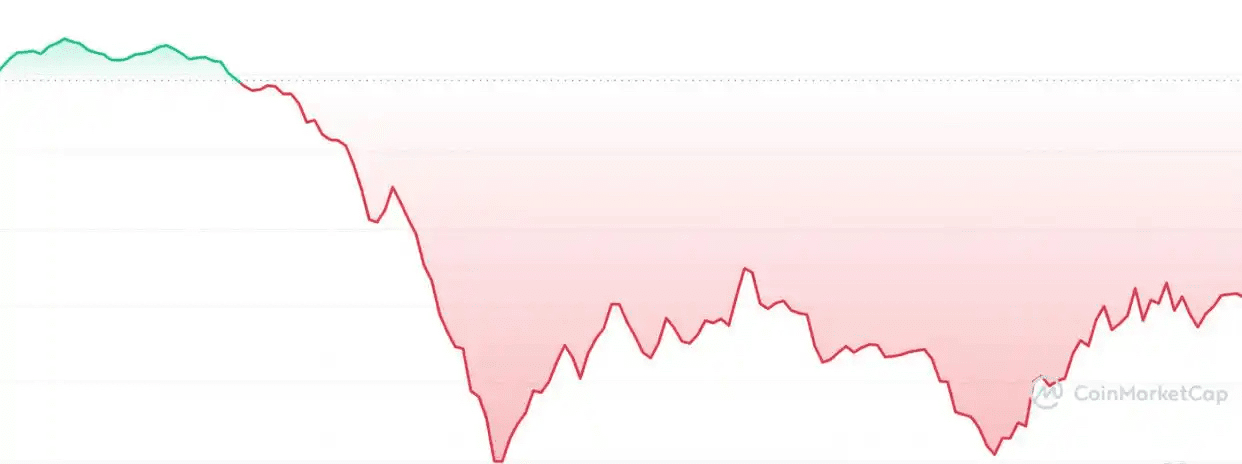
IV. Establishment of Global Regulatory Framework and Market Reconstruction (2023–2025)
The collapse of UST accelerated global regulatory implementation:
United States (GENIUS Act) (Passed June 2025)
Prohibit uncollateralized algorithmic stablecoins.
Require fiat stablecoins to have 100% cash or short-term government bond reserves.
Issuers must hold a federal bank license; violators face fines of $200,000 per day and criminal liability.
Hong Kong (Stablecoin Regulation) (Effective August 2025)
Issuers must apply for a license from the Monetary Authority, with a registered capital threshold of HKD 100 million.
Reserve assets must be 100% custody at locally licensed banks (such as HSBC, Bank of China Hong Kong).
EU MiCA Act
Classify algorithmic stablecoins as 'high-risk asset reference tokens'.
Require daily disclosure of reserve composition.
Regulation directly drives market structure reshaping:
Centralized stablecoins dominate: USDT and USDC hold 90% market share due to transparent reserves;
Collateralized decentralized coins rise: DAI shifts to multi-asset collateral (ETH + government bonds), USDC adopts a 'glass box strategy' to publicly disclose reserve details.
V. Technological Evolution: Hybrid Models and Compliance Survival (2024 to Present)
In the context of pure algorithmic models being negated by regulation, the hybrid design of 'partial collateral + algorithmic hedging' has become mainstream:
Curve crvUSD (2025) breakthrough innovation:
LLAMMA Algorithm: transforms collateral liquidation into a gradual process. When ETH prices fall, the system converts collateral into stablecoins in batches to avoid a one-time sell-off that exacerbates market volatility;
PegKeeper: dynamically adjusts liquidity pool weights, automatically injecting funds when anchoring deviation exceeds 0.5%.
Ethena USDe combines spot ETH collateral with perpetual contract hedging to generate 'synthetic dollars.' After users deposit ETH, the protocol simultaneously shorts an equivalent amount of ETH futures to lock in USD value, and then expands scale through Pendle's split of revenue rights, achieving a TVL (Total Value Locked) of over $6 billion within six months.
Current algorithmic stablecoins face triple survival challenges:
Mechanism level: pure algorithmic models can never solve the 'trust equals reserves' paradox, lacking a last-resort safety net in black swan events.
Regulatory level: major global markets define it as a high-risk derivative, and the US (GENIUS Act) completely closes the space for uncollateralized models, while Hong Kong requires hybrid stablecoins to manage with full reserves.
Economic aspect: Prohibition of interest payments suppresses the attractiveness of interest-bearing designs, leading users to prefer transparent reserve-based stablecoins.
The potential risks of the hybrid model still need to be vigilant:
crvUSD relies on DeFi Lego components, extreme market conditions may breach LLAMMA liquidation buffers;
The perpetual contract hedging of USDe faces funding rate volatility risk, with a single-day drawdown of 15% in March 2024.
The ten years of algorithmic stablecoins represent a rational return from 'code utopia' to 'limited innovation within regulatory frameworks.' Their legacy is not extinction, but integration into the design logic of a new generation of stablecoins: exploring new possibilities for trust mechanisms in the digital age on the balance beam of efficiency and stability, decentralization and compliance.
I am A Yue, focusing on analysis and teaching, a mentor and friend on your investment journey! May everyone investing in the market sail smoothly. As an analyst, the most basic thing is to help everyone make money. I will help you solve confusion, order locks, and operational suggestions, speaking with strength. When you lose your way and don't know what to do, follow A Yue to find your direction.