
1. Market Overview: A phase stop decline does not equal a market reversal.
Currently, Bitcoin's market is experiencing severe fluctuations, and there is a significant divide in the market regarding 'whether the bottom has been reached'. Through a comprehensive interpretation of technical analysis, news, and market funding, we find that although a bullish candlestick with increased volume has appeared on the daily chart, it has not fully engulfed the previous bearish candlestick's body.
It is worth noting that the bearish candlestick with increased volume from the day before yesterday, combined with yesterday's bullish candlestick with increased volume, forms a typical signal of a 'phase extreme market'. Although a V-shaped rebound has occurred on the hourly level, from the daily chart perspective, the price has not yet recovered the key resistance level. Currently, it can only be determined as a phase stop decline, rather than a major reversal of the market. Unless the price can strongly engulf the key resistance line above, we cannot assert that a reversal has occurred.
2. Historical comparison: Beware of the 'trap for new retail investors' targeting them.
Looking back at the previous cycle of bull-bear transition, we often see a phenomenon where a series of bearish candles are followed by a large volume of buying, which usually indicates that the market will enter a period of consolidation. The current trend is very likely to replicate this path, fluctuating between $74,000 and $68,000.
During this process, the market may occasionally break upward, creating false signals of strength to achieve 'trap for retail investors'. This strategy specifically targets new retail investors who still have cash on hand and whose psychological price levels are stuck at previous highs (such as the expectation of $126,000). When retail investors think '70,000 dollars is already the price for a halving' and feel anxious about 'not buying will miss the boat', chasing highs often turns into being trapped at high levels.
3. Technical details: The game of volume decay and high-level pressure.
From the hourly perspective, although the volume at the bottom is significant, the subsequent rebound volume has begun to decline (partly affected by the light trading of US stocks over the weekend). Currently, $72,000 is a clear natural rebound high point, and the price has shown signs of resistance here.
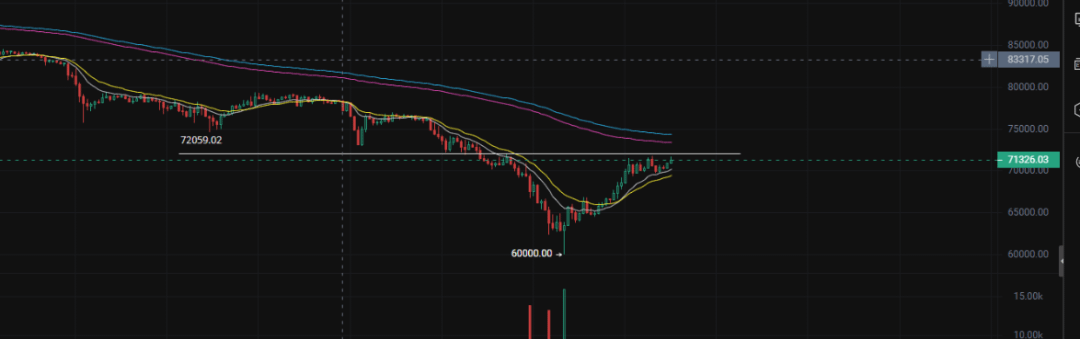
The upper Vegas Channel has formed a heavy selling zone. Investors who previously bought heavily around $74,000 are now deeply trapped, and market sentiment is extremely fearful. Once the price rises back to this range, huge selling pressure from trapped positions will follow. Therefore, with the RSI having entered the overbought zone on the hourly level and a sharp decline in volume, it is absolutely unwise to blindly chase longs at this time.
4. Market data analysis: Long-short conversion under a short squeeze market.
Yesterday's market exhibited a distinct characteristic of a 'short squeeze' market. When the price reached $65,000, short positions should not be blindly sold; however, when the rebound to $69,000 shows weakness, it is a reasonable shorting position.
By observing changes in CVD (Cumulative Volume Delta) and OI (Open Interest), we can see that open interest has quickly decreased during the price rise, which means that a large number of short positions are being closed for profit. This price rebound driven by short covering belongs to the typical short squeeze force. Currently, spot buying is not firm, lacking sustained bullish momentum to support the supply above. Therefore, the market is likely to fluctuate between $75,000 (strong resistance) and $69,000 (support) for digestion, and after liquidity is exhausted, it will likely continue to decline.
5. Practical trading strategies: Layout at highs and risk hedging.
Based on the above in-depth analysis, we suggest adopting the following two practical strategies:
1. High-level layout of short positions (first choice): Pay attention to the vicinity of $72,000. If the price forms a double bottom and stabilizes at this level to take liquidity or is blocked by the Vegas Channel, it is an ideal entry point for short positions. Considering that the overall trend remains bearish, the risk-reward ratio of going with the trend is higher.
2. Short-term buying at low levels (second choice): If the price retraces to $69,000 and can stabilize effectively for a rebound, short-term buying can be executed, targeting $74,000, but must take profits in batches above $72,000.
Special reminder: Although the Coinbase premium index has eased, negative premiums still exist, indicating that large funds remain cautious. Friends holding spot or high-leverage long positions should consider reducing their positions moderately at the current rebound level.
6. Gold price outlook: An upward trend independent of dollar assets.
Unlike Bitcoin following the logic of US AI tech stocks, gold has shown strong independence and safe-haven attributes. Although it has recently experienced a wide fluctuation similar to a 'fish hook' due to global asset volatility, gold's daily level has stabilized above the 12-day moving average (EMA12).
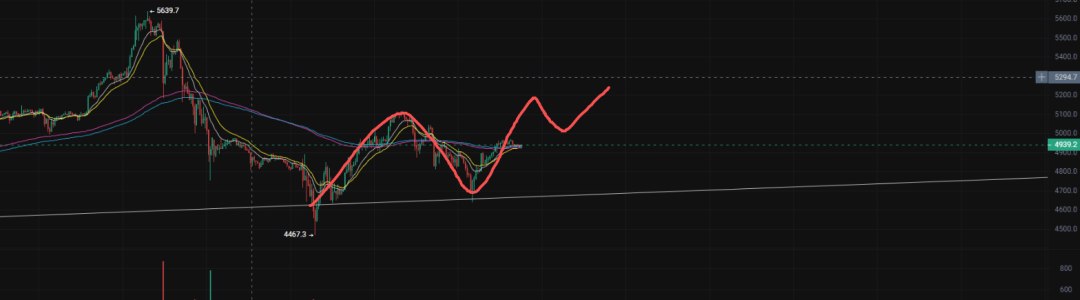
The trading logic for gold is very clear:
· The big trend is bullish: Even if the liquidity environment changes in the future, countries like China and Europe will continue to have strong demand for gold to counteract the volatility of dollar assets.
· Trading suggestion: If gold falls back to the range of $4,500-$4,600 (referencing specific contract levels), a left-side layout can be considered; right-side trading requires waiting for prices to create 'higher highs' and confirm a pullback.
· Outlook for 2026: We firmly believe in the continued upside potential for gold in 2026; it will be a safe haven completely different from Bitcoin.

Old K's conclusion:
Market fluctuations and washing positions are the norm; only by deeply dissecting the interplay between liquidity and technical factors can one remain calm in the trap for retail investors. I hope today's analysis can provide guidance for your investment decisions.