

Dusk Network is built around a very specific problem that most blockchains avoid because it is messy in real markets, which is how to keep financial activity private without turning the system into something that regulators and institutions cannot touch, and the project keeps returning to the same thesis that privacy and compliance should not be enemies if the underlying design is built for both from day one. Instead of treating privacy as an optional layer on top of a public chain, Dusk treats confidentiality as a native property of the network and then designs the rest of the stack around what regulated finance actually needs, which includes predictable settlement, clear asset lifecycle rules, and a way to prove compliance without exposing the entire trading world to permanent surveillance.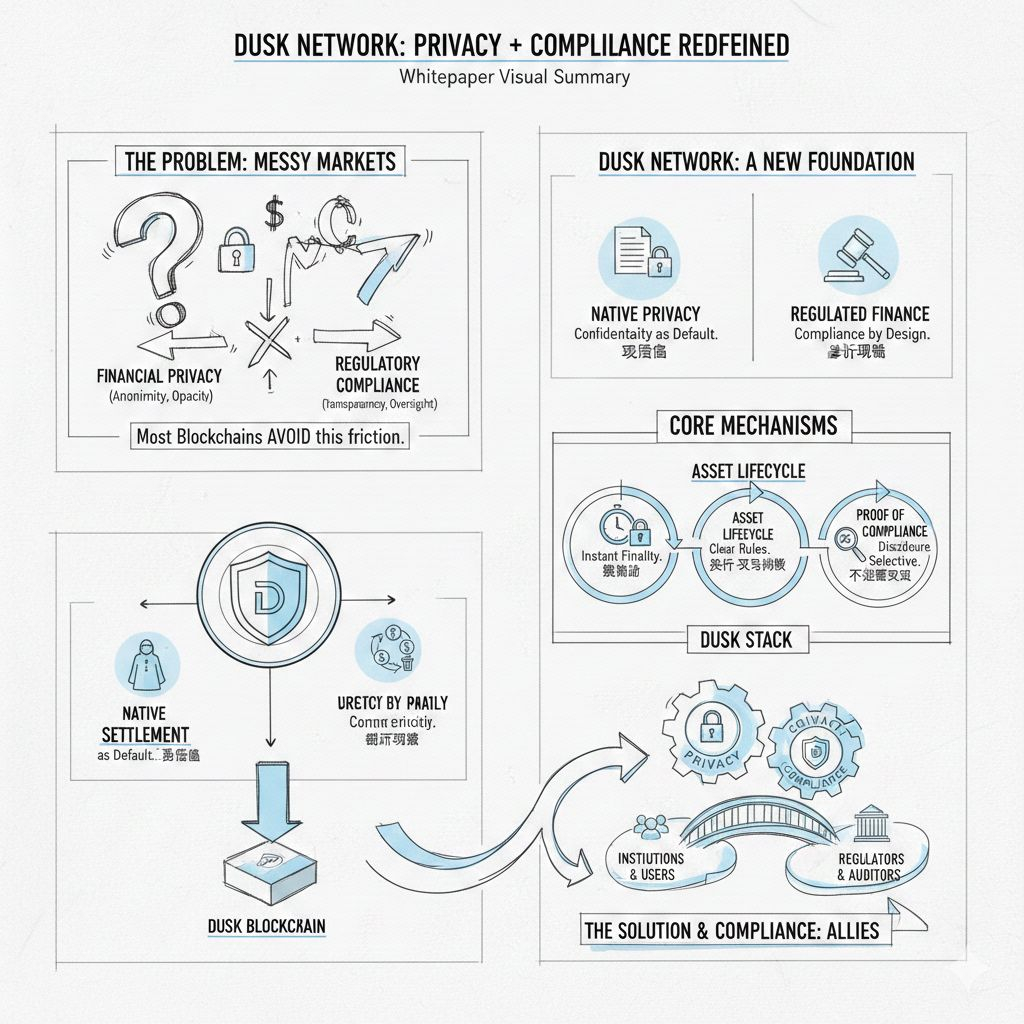
The foundation of this approach is the Phoenix transaction model, which is where Dusk tries to solve the privacy problem at the transaction level rather than through a cosmetic feature, because finance is not only about sending value from one address to another and calling it done, it is about counterparties, strategies, inventory, and intent, and those things become dangerously visible on transparent chains where every flow is searchable forever. Phoenix is designed to make transfers confidential and to extend that confidentiality into smart contract interactions, so that privacy is not only about hiding a balance but also about hiding the logic and activity that produces that balance, and this matters because institutions do not want their positions and movements turned into a real time data feed for anyone with analytics.
What makes Dusk feel different is that it does not stop at private transfers, because securities and regulated assets have rules that cannot be ignored, and that is where Zedger comes in as the second pillar of the design. Zedger is built for the asset layer where compliance and lifecycle management matter, meaning issuance, distribution, restrictions, and the kind of programmable constraints that regulated instruments require, and this is also where the Confidential Security Contract standard sits as a framework for handling security token behavior in a way that keeps sensitive data protected while still allowing the system to satisfy regulatory expectations. In simple terms, Phoenix gives Dusk the confidential rails for value movement, while Zedger aims to provide the controlled structure that financial instruments demand, and the two together form a narrative that is less about anonymity and more about professional grade confidentiality.
Dusk also leans into the idea that finance needs finality that feels like settlement, not a probabilistic promise that might reorganize later, and that design choice shows up in how the network talks about consensus and transactional guarantees, because if a chain is targeting issuance and trading workflows, then settlement cannot be a vague concept that depends on waiting and hoping, it has to be a property that participants can build around with confidence. This is the kind of detail that often gets ignored in hype cycles, but it becomes central the moment real market infrastructure is involved, since the difference between finality and eventual confirmation is the difference between operational certainty and operational risk.
On the engineering side, Dusk has been pushing its maintained implementation forward through its Rust based stack, and that matters because a finance focused chain is judged by how it behaves under real conditions, not by how it reads in a pitch, so releases, tooling maturity, and stability are part of the product, not just background noise. The project has also been public about its rollout and migration path from existing token representations toward mainnet participation, which is important because a network that wants to serve regulated markets has to make the transition to native settlement clean and understandable, otherwise the story remains fragmented between representations, bridges, and competing assumptions about where the real activity lives.
When you look at the DUSK token story, it is easy to reduce it to supply and distribution charts, but the more important angle is how the token connects to network usage, staking participation, settlement flow, and the shift from representation based liquidity toward native network activity. The ERC20 footprint exists as a widely accessible representation and reference point, while the project direction points toward mainnet usage where the token becomes part of the system that secures the chain and powers the confidential finance stack, and that transition is not just a technical step, it is a credibility step, because the strongest version of Dusk is the version where its privacy, asset logic, and settlement properties are all expressed natively rather than as an idea living on top of someone else’s rails.
What Dusk is really trying to prove is that confidential finance can become normal infrastructure rather than a niche experiment, and that proof depends on whether the network can keep confidentiality practical for users and developers, while keeping compliance verifiable for institutions, and while keeping settlement and operations reliable enough that serious counterparties do not feel like they are entering a fragile environment. If those pieces come together, the project stops competing in the crowded category of general purpose chains and starts owning a narrower lane that is harder to copy, because most chains can add another feature, but far fewer can redesign the whole experience around regulated confidentiality without breaking usability.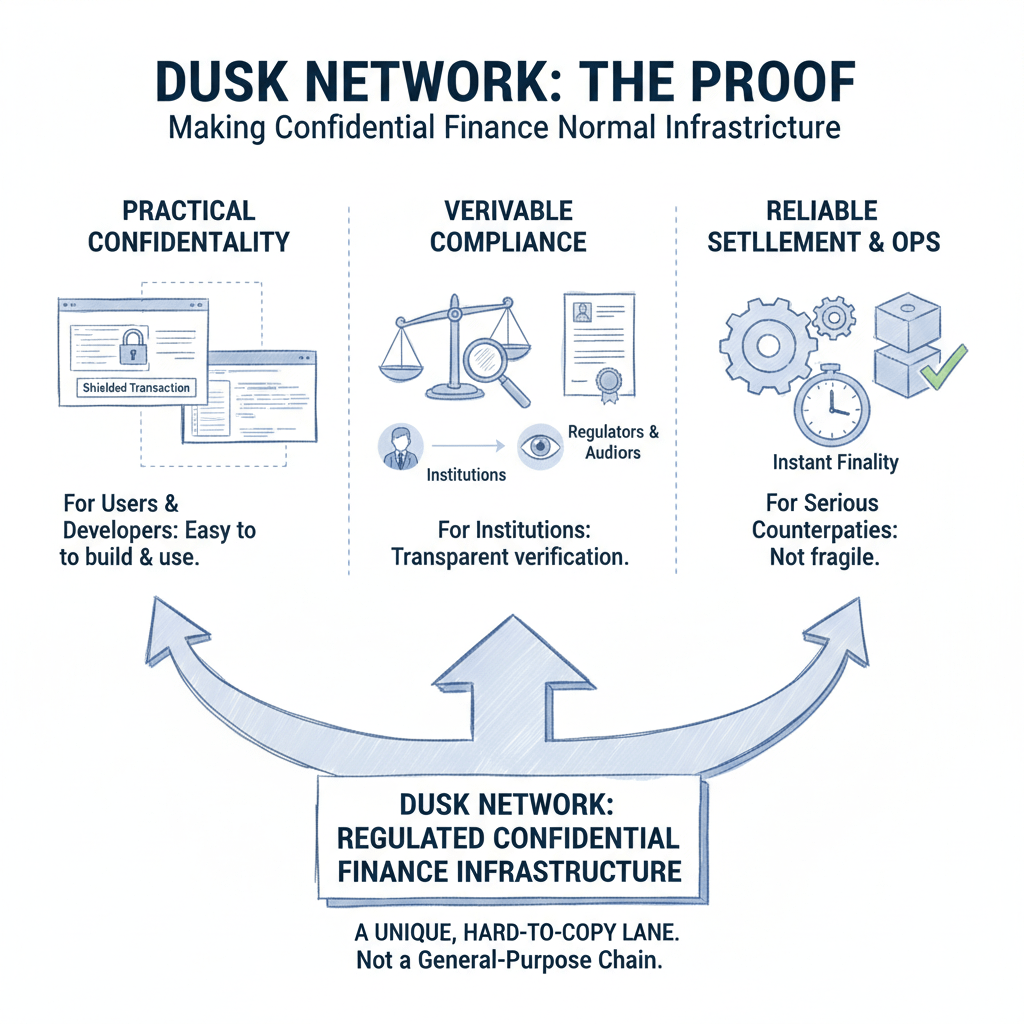
My takeaway is that Dusk reads like a project that is built for the parts of crypto that do not look exciting on the surface, such as settlement logic, privacy guarantees that can coexist with compliance demands, and the mechanics of making regulated assets behave correctly on chain, and that is exactly why it can matter, because the next wave of adoption will not be won only by speed and liquidity, it will be won by networks that can handle real constraints without compromising the core promise of public infrastructure. If Dusk keeps moving in the same direction, improving the Phoenix and Zedger foundation, strengthening the developer stack, and expanding real asset workflows on top of its confidential rails, it can become one of the few Layer 1 narratives that stays coherent across different market cycles.
