

Plasma reads like a project that started with one stubborn observation and then built everything around it: stablecoins are already doing the heavy lifting for real usage, yet most networks still make moving dollars feel like a technical ritual that belongs to power users. Plasma is trying to turn stablecoin settlement into something closer to an everyday rail by keeping the chain fully EVM compatible, pushing for sub second style finality through its PlasmaBFT direction, and designing the user journey so a person can move USDT without first learning how to manage a separate gas token.
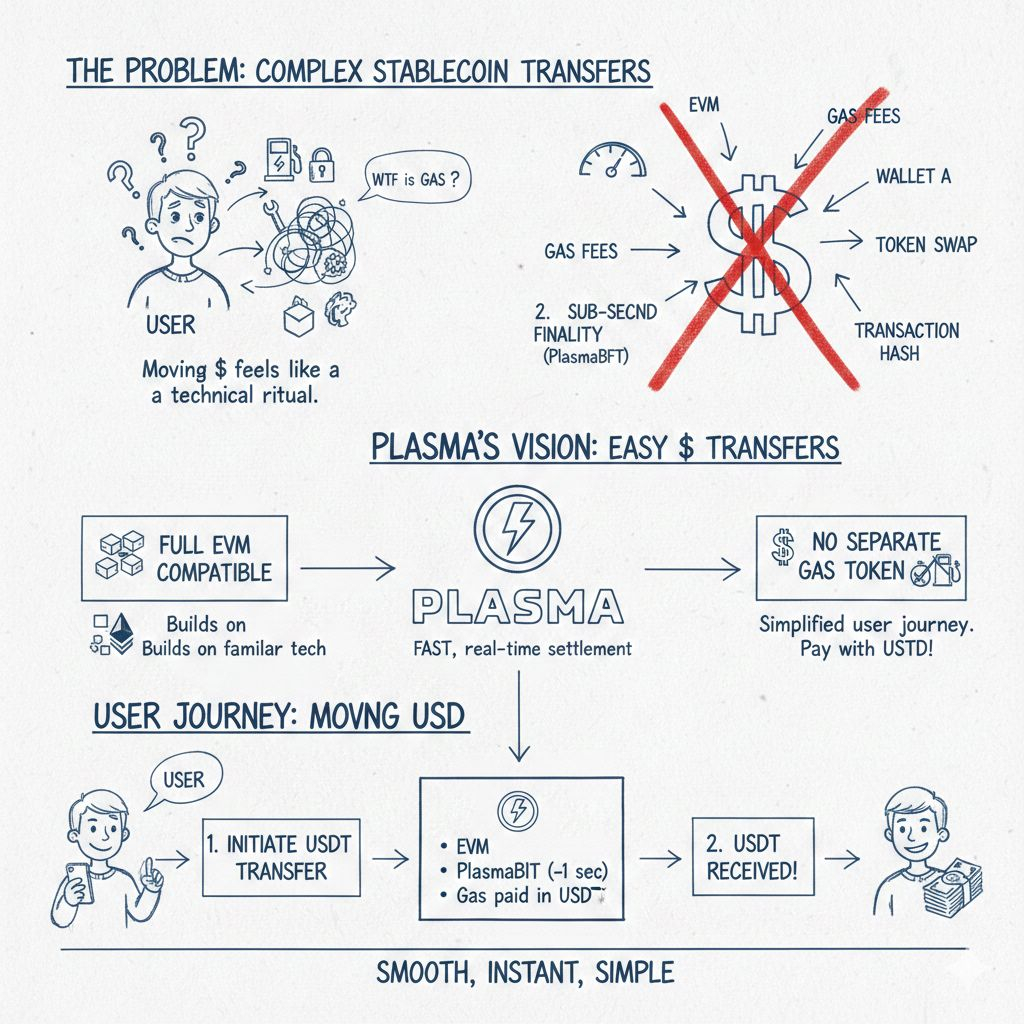
The reason that focus matters is not theoretical, because payments live or die on predictability and friction, and friction shows up in the small moments that everyone ignores until they scale: a fee that feels tiny to a trader can be the difference between adoption and abandonment for remittances, creator payouts, payroll, or merchant settlement. Plasma is positioning itself as the chain where stablecoins are not just another token type, but a first class primitive that the protocol actively optimizes for, which is why you keep seeing gasless USDT transfers and stablecoin first gas framed as core features rather than optional middleware.
Behind the scenes, Plasma is building in a way that tries to keep builders comfortable while still changing the economics and UX of transfers, because the execution environment stays EVM compatible and the stack highlights Reth as the base, meaning Solidity developers and standard tooling can carry over without rewriting everything just to ship on a new chain. What Plasma adds on top is the payments specific layer of protocol managed sponsorship and paymaster style routing for stablecoin flows, where the chain can sponsor restricted transfer calls rather than opening a blank check that could be abused by arbitrary calldata, and where eligibility can be gated and rate limited so gasless does not become an endless attack surface.
A big part of the narrative is also neutrality, and Plasma links that to a Bitcoin anchored direction through a trust minimized BTC bridge concept where verifiers decentralize over time, because the project wants Bitcoin to function as a grounding layer for censorship resistance and credible settlement, while still letting the ecosystem live inside an EVM environment where developers can compose contracts the way they are used to. That direction matters most if Plasma becomes a real settlement hub for institutions and high volume payment operators, since those groups care about who can pressure the system and how the system stays neutral when it matters most.
On the live network side, the cleanest reality check is the explorer, and Plasmascan currently shows a very large throughput footprint with roughly 151.31M total transactions and about 3,529,552 total addresses, while the interface displays around 1.00s for the latest block time, which is exactly the kind of cadence a payments focused chain wants to communicate. The last 24 hours snapshot on the charts page shows ongoing momentum with 401,661 transactions, 3,870 new addresses, 153 contracts deployed, 11 contracts verified, and total transaction fees of 4,484.03 XPL, which tells a simple story of continuous usage alongside steady developer activity rather than a chain that only spikes when marketing spikes.
The token story sits underneath all of this as the long arc incentive layer, and Plasma’s documentation presents XPL as the native token tied to network security and validator incentives, with an initial supply stated as 10,000,000,000 XPL and allocations that split across public sale, ecosystem and growth, team, and investors. The same tokenomics material describes a validator rewards schedule that begins at 5 percent annual inflation and steps down toward a 3 percent baseline over time, while also describing a base fee burn approach similar in spirit to EIP 1559 to help offset inflation as usage grows, and it also notes that inflation activates alongside the rollout of external validators and delegation, which makes decentralization milestones more than just a governance talking point because they directly connect to the economics of the network.
When you look at benefits through the lens of real usage instead of slogans, Plasma is trying to make three things feel natural: sending stablecoins without thinking about gas, settling transfers fast enough that apps can behave like modern payment apps, and giving builders primitives that reduce the need for brittle hacks that break when traffic rises. If the protocol level sponsorship and stablecoin first gas patterns mature cleanly, it unlocks wallet and app experiences where fees can be abstracted in a controlled way and where stablecoins behave like the default unit of account, and if the confidentiality direction becomes production ready with the right disclosure mechanics, it opens a path for privacy preserving payments that still fit into regulated environments rather than forcing users to choose between privacy and legitimacy.
Exits are ultimately about whether money can move in and out without feeling trapped, and Plasma is building those routes in two complementary ways: the infrastructure direction that emphasizes bridging and cross asset flows, and the product direction that tries to connect onchain balances to everyday spending and withdrawals through Plasma One. Plasma One is presented as an app layer that combines spending and off ramp pathways depending on region and partners, which matters because a settlement chain without clean off ramps becomes a closed loop, and a payments chain only becomes real when users can enter, move value, and leave with minimal operational overhead.
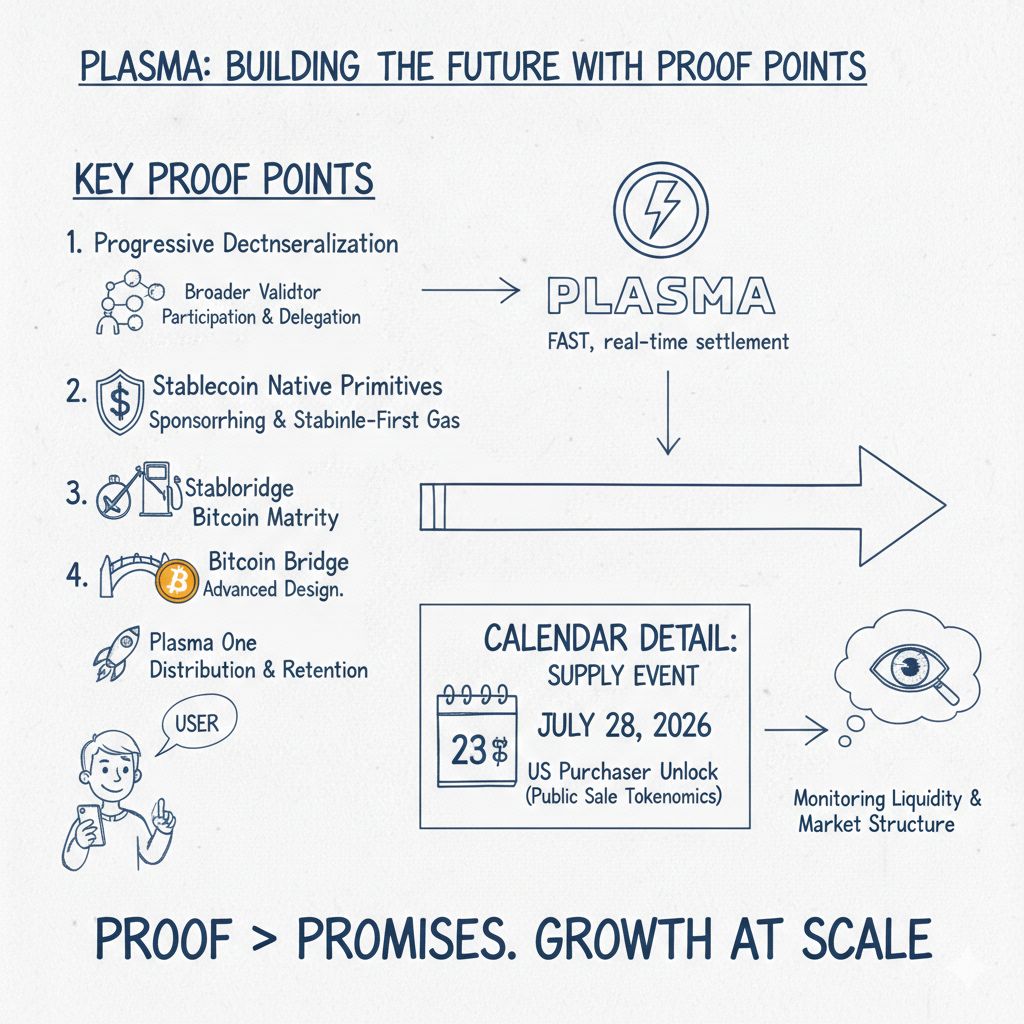
What comes next is most meaningful when it is tied to proof points rather than promises, and Plasma’s own materials point toward progressive decentralization via broader validator participation and delegation, deeper rollout of stablecoin native primitives like sponsorship and stablecoin first gas, continued maturity of the Bitcoin bridge design, and expansion of the Plasma One distribution story beyond early access dynamics into a product that can hold retention at scale. One specific calendar detail that is easy to track is the published July 28, 2026 unlock note for US purchasers in the public sale section of the tokenomics, because supply events like that become important reference points for anyone watching liquidity and market structure around the ecosystem as it grows.
My takeaway is that Plasma feels most compelling when you judge it as a payments system that happens to be EVM compatible, rather than as a general chain that hopes payments show up later, because every major piece of the stack keeps circling back to the same idea of stablecoin settlement at scale. If the project keeps matching the narrative with live throughput, safe protocol level sponsorship, credible decentralization steps, and a distribution engine that brings everyday users without forcing them through the usual crypto friction, Plasma can carve out a position that is less about competing on buzzwords and more about becoming the place where stablecoins simply move the way people expect money to move.

