
There is a foolproof method for trading cryptocurrencies that allows you to maintain 'evergreen' profits.
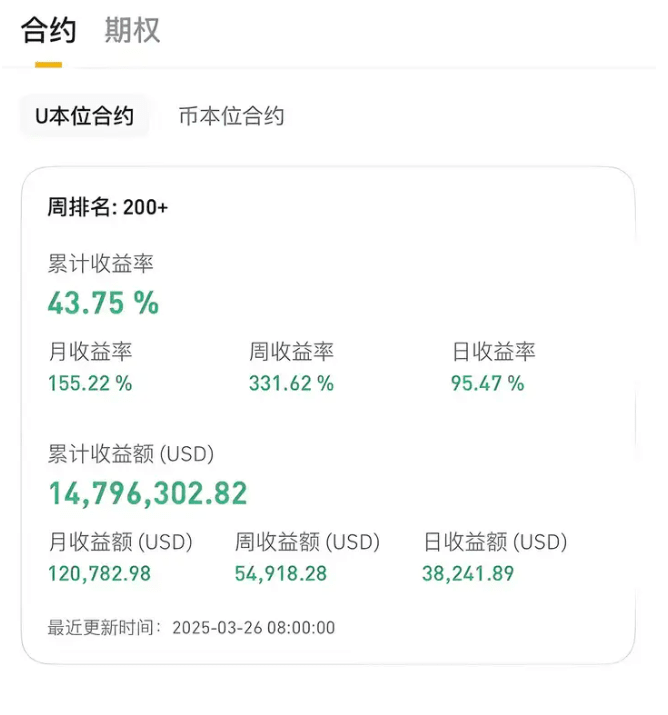
At the end of last year, I played with 100,000 and now have 2 million, easily achieving a hundredfold profit. I am still using this method (suitable for everyone) which is high and very stable.
Don't worry if you can learn it; I can seize this opportunity, and you can too. I am not a god; I am just an ordinary person. The only difference between others and me is that others have overlooked this method. If you can learn this method and pay attention to it during future trading processes, it can help you earn an additional 3 to 10 points of profit every day.
Step 1:
Add cryptocurrencies with upward performance in the last 11 days to your watchlist.
However, it is necessary to note that cryptocurrencies that have dropped for more than three days should be excluded to avoid capital already escaping with profits.
Step 2:
Open the candlestick chart and only look at the monthly MACD golden cross cryptocurrencies.
Step 3:
Open the daily candlestick chart and only look at the 60-day moving average.
As long as the coin price pulls back near the 60-day moving average,
After the volume K-line appears, enter the market with a heavy position.
Step 4:
After entering the market, use the 60-day moving average as the standard, and hold onto it.
Exit and sell offline, divided into three details.
One is to sell one-third when the segment's upward movement exceeds 30.
The second is to sell one-third when the segment's upward movement exceeds 50.
The third is quite important and is the key to whether you can profit, that is, if you buy on that day.
If unexpected situations arise the next day and the coin price directly falls below the 60-day moving average, then you must definitely exit completely, do not hold any other lucky thoughts.
Although the probability of breaking below the 60-day moving average is very small using this method of selecting coins by combining monthly and daily charts, we still need to have risk awareness.
In the crypto space, preserving your principal is the most important thing. However, even if you have sold, you can wait for the conditions to meet the buying point again before buying back.
Ultimately, the difficulty in making money lies not in the method but in execution.
"When the coin price directly falls below the 60-day moving average, then exit completely and do not hold any other lucky thoughts."
In summary, you cannot be rigid in the crypto space.
Being adaptable is the key to long-term survival in the market.
Apart from strong technical skills, the trading principles I have always followed are:
1. Trade only after 9 PM.
During the day, the news is too chaotic, with various false good news and bad news flying around, causing the market to fluctuate like a fit, making it easy to be deceived into the market.
I generally wait until after 9 PM to operate, when the news is usually stable and the candlesticks are cleaner, with clearer directions.
⸻
2. Cash out profits immediately.
Don't always think about doubling your money! For example, if you made 1000 U today, I suggest you immediately withdraw 300 U to your bank card, and continue to play with the rest.
I have seen too many people who 'made three times but still want five times,' only to lose everything in a pullback.
⸻
3. Look at indicators, not feelings.
Don't trade based on feelings; that's nonsense.
Install TradingView on your phone, and check these indicators before trading:
• MACD: Is there a golden cross or dead cross?
• RSI: Is there overbought or oversold?
• Bollinger Bands: Is there a squeeze or breakout?
At least two of the three indicators must give consistent signals before considering entry.
⸻
4. Stop loss must be flexible.
When you have time to watch the market, if you make a profit, manually adjust the stop loss price upwards. For example, if the buying price is 1000 and it rises to 1100, raise the stop loss to 1050 to secure profits.
But if you are going out and cannot watch the market, be sure to set a 3% hard stop loss to prevent a sudden market crash from wiping you out.
⸻
5. Must exit every week.
Not cashing out is just a numerical game!
Every Friday, without fail, I transfer 30% of the profits to my bank card, and continue to roll the rest. This way, over the long term, the account will become thicker.
⸻
6. There are tricks to looking at candlesticks.
• For short-term trades, look at the 1-hour chart: if the price has two consecutive bullish candlesticks, consider going long.
• If the market is stable, switch to the 4-hour chart to find support lines: consider entering when it drops near the support level.
⸻
7. Do not step into these pits!
• Leverage should not exceed 10 times; novices should control it within 5 times.
• Don't touch Dogecoin, shitcoins, and other altcoins that are easy to get cut.
• Do a maximum of 3 trades per day; too many can lead to losing control.
• Never use leverage to trade cryptocurrencies!!
⸻
The last sentence is for you:
Trading cryptocurrencies is not gambling; treat it as a job, go to work at a set time every day, and shut down when it's time. You will find that the returns are even more stable.
In the years of trading cryptocurrencies, I have achieved small success, using 500,000 to achieve a result of 10 million, solely using this trick (moving average), with a win rate of 99%, suitable for everyone!
I believe many traders have heard of moving average crossovers (golden cross/dead cross).
But the question is, is this crossover... really effective?
Is this just another 'scam' in technical analysis? Or has no one told you the truth about it?
Moving average crossover strategy.
We will use historical data and backtest it to see if the moving average strategy is effective in trading.
This strategy must at least outperform the buy-and-hold strategy of the S&P 500 Index to claim it is effective.
Here are the markets we are going to trade...
Trading markets (2000-2018).
S&P 500 Index.
EUR/JPY.
US Treasury Bonds.
Here are the rules for the moving average strategy we will backtest:
Go long when 50 MA crosses above 200 MA.
Go short when 50 MA crosses below 200 MA.
3 ATR trailing stop loss.
1% risk.
This is a demonstration of this strategy.
The blue line in the image is the 50 MA, the black line is the 200 MA on the S&P 500 daily chart.
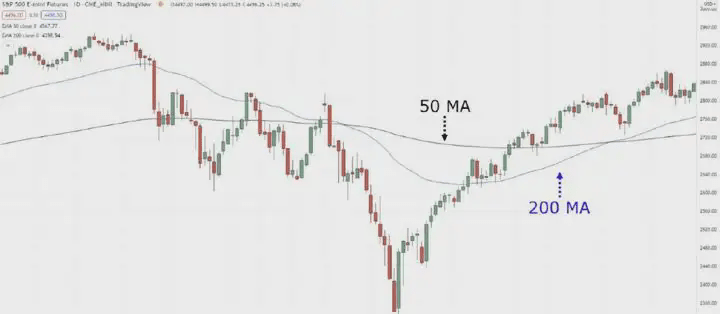
The image below shows the crossover between the 50 MA and 200 MA:
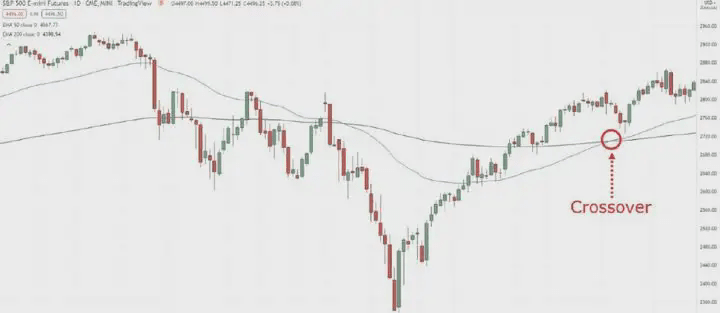
That is your buying signal.
Then, your trailing stop loss is 3 ATR.
For many novice traders, you might ask what 3 ATR is?
It's simple, let me explain.
Once you pull out your ATR indicator and find the value...
When the crossover occurs, you will see the current ATR value on the S&P 500 daily chart is $27.16:
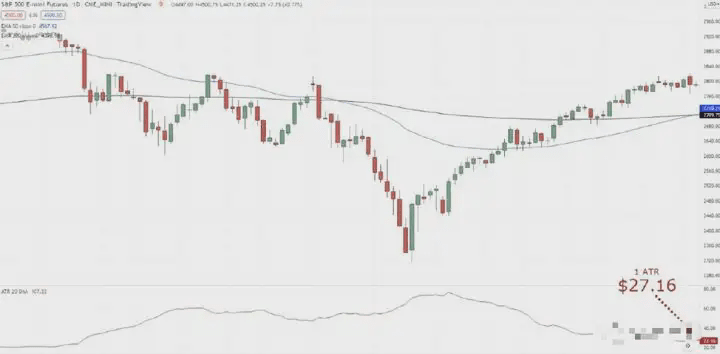
Now, multiply the current ATR value by three (3 ATR), getting $81.48.
Assuming your entry price is $2776.
Subtract 3 ATR $81.48 from your entry price $2776, getting: $2694.52.
So, now this means your entry price is $2776, and your initial stop loss is $2694.52:
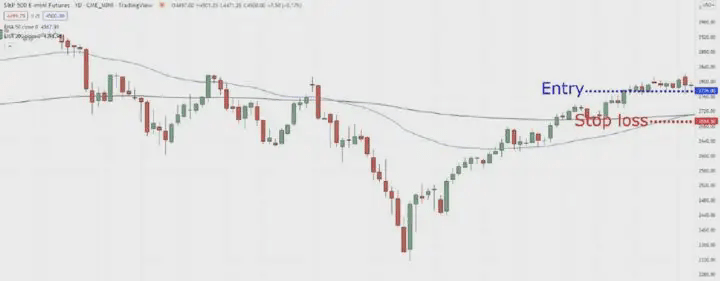
Isn't it simple?
Now, assuming the market trend is in your favor, the current price is $2844, and the ATR value is currently $26.81:
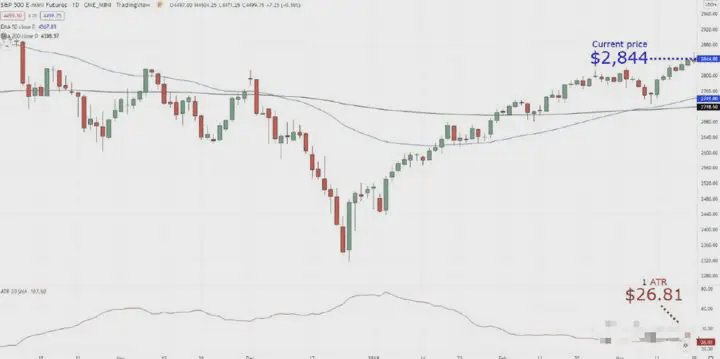
Similarly, we multiply the current ATR value of $26.81 by 3, then subtract $80.43 from the current price of $2844 to get our most recent trailing stop loss, which is $2763.57.
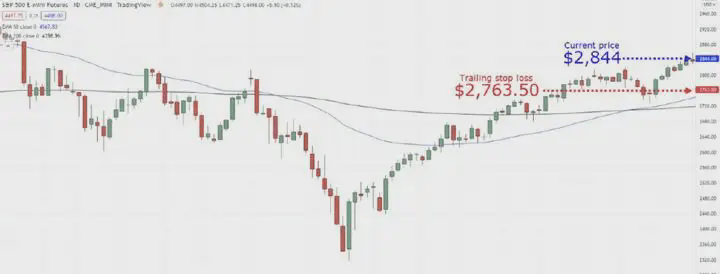
If the current price suddenly drops and closes below the trailing stop level, it means our trailing stop has been swept.
This is the reason I use the 3 ATR trailing stop loss.
At the same time, as the market moves in your favor, calculate how much 3 ATR is and then subtract it from the current price.
Simple enough?
Well, now, what is the result?
Results (3 markets).
Number of trades: 534.
Win rate: 43.26%.
Annual return rate: 1.31%.
Classification of the following results:
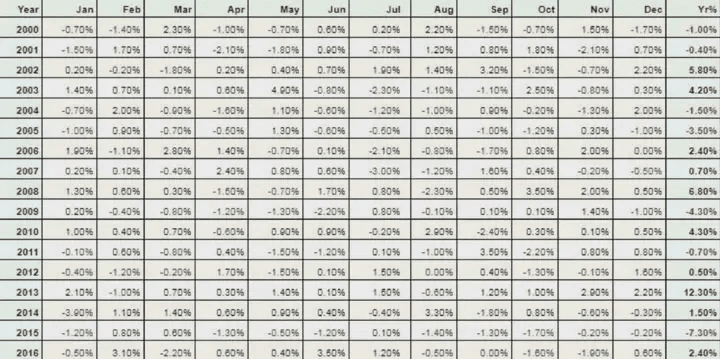
To be honest... this is a losing trading strategy.
What is the reason?
Let me tell you the first secret: why this strategy loses money...
Secret #1: Moving average crossovers do not apply to a few markets.
Before we conclude that this trading strategy is ineffective, let me ask you a question:
How to make money using moving average crossovers?
This is not a tricky question.
I believe you will agree that it makes money when there is a trend.
Now, how is it losing money? If the strategy is used in a range market!
When the market fluctuates, your results will remain unchanged.
So now... how do we improve this?
If we trade more markets, we can manage more trends. If we can manage more trends, we may be able to make more money!
So let's test this idea:
Market (2000-2018).
We are now going to trade 20 markets instead of the 3 markets we traded before:
Gold, Copper, Silver, Palladium, Platinum.
S&P 500, EUR/JPY, EUR/USD, USD/MXN, GBP/USD.
US Treasury Bonds, EUR Bobl, EUR Buxl, EUR BTP, 10-Year Canadian Bonds.
Heating oil, wheat, corn, lumber, sugar.
The rules this time are still the same.
Rules.
Go long when 50 MA crosses above 200 MA.
Go short when 50 MA crosses below 200 MA.
3 ATR trailing stop loss.
1% risk.
Results (20 markets).
Number of trades: 3,537.
Win rate: 41.53%.
Annual return rate: 14.30%.
Here are the detailed results from the past 16 years:
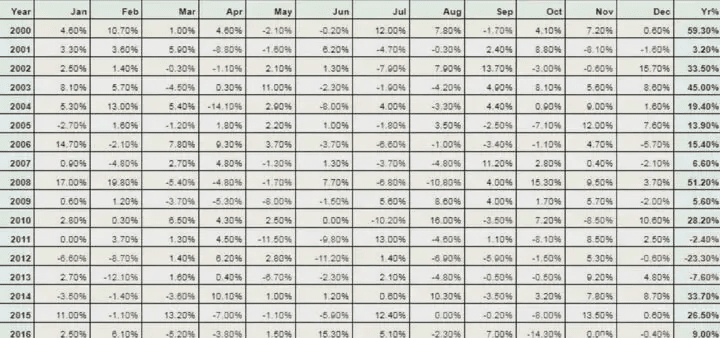
This result is much better than the previous tests.
So what happened?
Did we change anything in the entry and exit rules?
No.
All we did was trade more markets.
This leads to my second secret...
Secret #2: When you trade many different markets, moving average crossovers are most effective.
It's simple.
Moving average crossovers work best during trends, so you can trade more markets to capture more trends, which will yield you more funds.
Many traders make a big mistake because they focus too much on parameters.
For example, if 50 MA and 200 MA are ineffective... they will change 50 MA to 35 and 200 MA to 189 MA.
If you keep adjusting parameters to make the strategy work, then what you are doing is what we previously called 'curve fitting.'
It's like trying to remember the questions and answers from last year's exam! But what happens when you take the same exam this year?
Are the answers you remembered helpful to you?
Not likely.
Why?
Because you can be sure that the questions for this year's exam are different!
So, you see, when the questions change slightly, you don’t know how to answer.
The same goes for 'curve fitting' in trading.
But it doesn't matter.
Assuming you did not remember last year's exam paper answers.
On the contrary, you try to understand the concepts behind these problems.
So when you participate in the exam this year, no matter how they change and modify the questions, if you understand this concept...
I can assure you that you can answer this question.
This leads to my next secret.
Secret #3: Focus on concepts, not parameters.
When your trading strategy is not working, stop tweaking parameters and focus on concepts.
Let me prove this to you now.
Assume we choose 17MA and 189 MA, instead of 50 MA and 200 MA.
Rules
Go long when 17 MA crosses above 189 MA.
Go short when 17 MA crosses below 189 MA.
3 ATR trailing stop loss.
1% risk.
The market we are trading is still the same.
Market (2000-2018).
Gold, Copper, Silver, Palladium, Platinum.
S&P 500, EUR/JPY, EUR/USD, USD/MXN, GBP/USD.
US Treasury Bonds, EUR Bobl, EUR Buxl, EUR BTP, 10-Year Canadian Bonds.
Heating oil, wheat, corn, lumber, sugar.
Finally, the result.
Results (20 markets).
Number of trades: 3,801.
Win rate: 39.46%.
Annual return rate: 12.91%.
Now...
You can change the parameters to any values you like.
However, if your concept is correct, your trading strategy may still make money.
But if you get the concept wrong, you can only say you are unlucky.
Similarly, we use the same parameters of 17 MA and 189 MA, but this time we trade three markets.
What is the result?
Results (3 markets).
Number of trades: 580.
Win rate: 40.00%.
Annual return rate: 1.33%
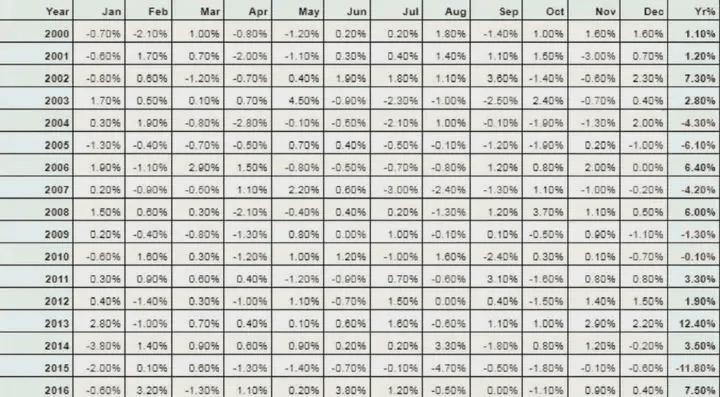
Do you understand the point I am trying to express?
Let's quickly review the key points of this article:
When you trade a few markets, the moving average crossover does not work.
When you trade many different markets, the moving average crossover is most effective.
Focus on concepts, not parameters.
That's about it!
Now, what I want to know is whether you are currently using the moving average crossover strategy? If so, what improvements will you make to your strategy after reading this article? Please let me know in the comments below!
If this doesn't help you, then these 7 major top and bottom candlestick skills will surely have a trick to help you.
Catching the bottom and top is something most novices pursue in trading because it is both thrilling and can initiate a mode of effortless earning! Their psychological activity during trading usually goes like this:
When the price reaches a certain position, it will say: it must reverse!
When you see the price rapidly falling or rising, as soon as you see the trend pause slightly, immediately take the opposite action, firmly believing that you have caught the top and bottom, and say: I don't believe it will keep rising/falling!
If the market continues, I will continue to increase my position, thinking: never mind, place the last order and turn off the computer! I won't say more, usually, there is no good ending.
The culture of China is profound and extensive. As the saying goes: think thrice before you act, plan before you move, balabala... These are all telling people to observe more, analyze more before taking action, and not to act impulsively.
In trading, it is the same; open the candlestick chart and look at the past patterns, with your eyes full of tops and bottoms. Why can't you catch any? The market trend usually divides into one-sided and consolidation phases; consolidation is a form of accumulation, the longer the consolidation, the more likely a one-sided market will emerge, and the larger the market will be; similarly, the longer the one-sided market lasts, the longer the consolidation process will be, and the larger the range of consolidation will be.
Therefore, catching the top and bottom is not unfeasible, but one must think thrice before acting. Do not try to catch tops and bottoms during a one-sided market; it should only be considered during consolidation. But how long should one consider? How to consider? Where to start?
The 7 reversal candlestick patterns to be detailed below are ways to assist you in making 'top and bottom' judgments.
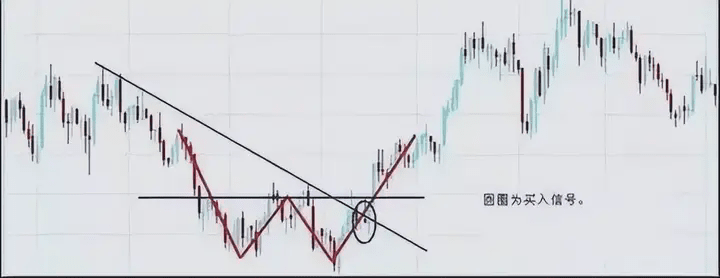
1. Double peak reversal.
The double peak reversal refers to the formation of two wave peaks at the top or bottom of the price, also known as double tops and double bottoms, which people commonly refer to as 'M' type 'W' type reversals.
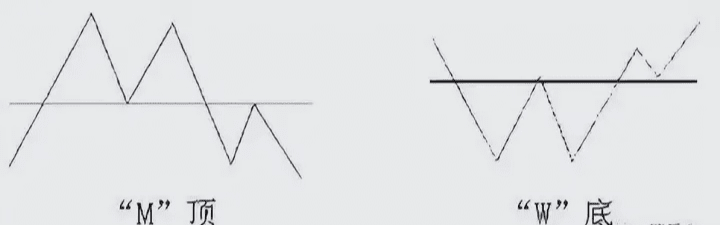
The double peak reversal pattern does not necessarily mean a price reversal; it may also be supported by a support line during the price retracement to the neckline and rise. At this time, the price moves within the area between the support line and the two previous peaks, forming various shapes like triple tops, triangles, etc., but this possibility is very small.
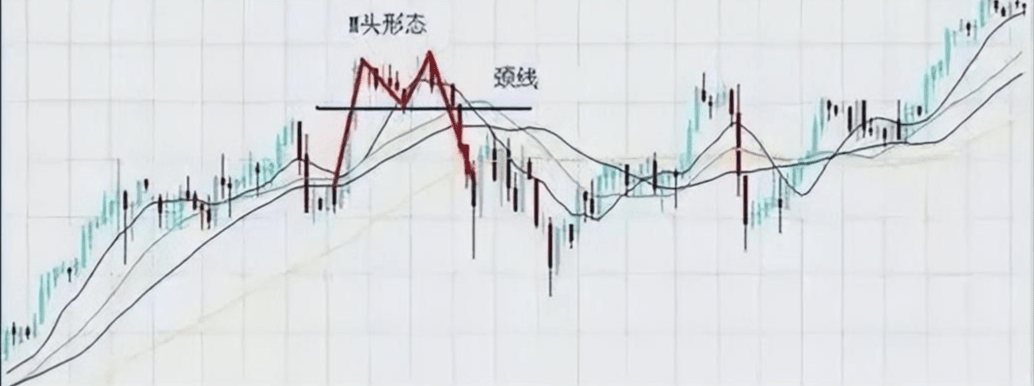
The further apart the two peaks are, meaning the longer the time it takes to form the double top and bottom, the greater the potential for a double top reversal in the future, and the more severe the fluctuations after the reversal.
The rise (or fall) after the breakout of the double peak pattern is 1 to 3 times the height of the pattern itself.
Two, head and shoulders top.
This is a long-term trend reversal pattern, usually appearing at the end of a bull market.
The head and shoulders reversal pattern appears with three peaks; the middle peak is higher than the other two, so it is called the head. The two peaks on the left and right are lower, known as shoulders.
When the head and shoulders top neckline is broken, it is a true sell signal, even though the price has fallen significantly compared to the peak, the downward trend has just begun, and investors who have not sold continue to sell.
When the neckline is broken, we can predict how far the price will drop based on this pattern's minimum drop measurement method. This measurement method draws a vertical line from the highest point of the head to the neckline, then at the point where the right shoulder breaks the neckline, measure the same length downward, and the price measured is the minimum drop that the stock will drop.
Example:
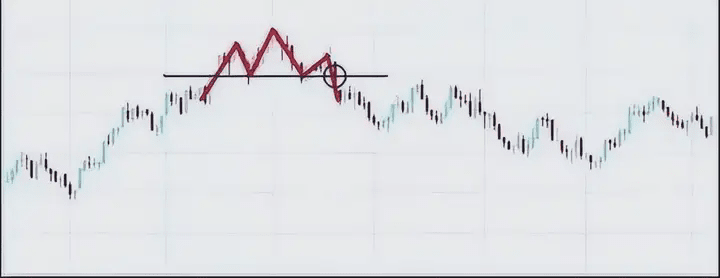
[The blue circle is a reference sell signal.]
Three, head and shoulders bottom.
(1) The shapes of the head and shoulders top and bottom are quite similar.
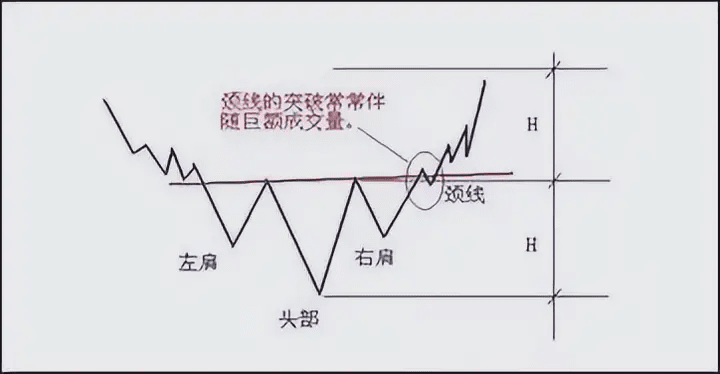
(2) When the neckline of the head and shoulders bottom is broken, it is a true buy signal. Although the price has risen significantly compared to the lowest point, the upward trend has just begun, and investors who have bought should continue to chase in. The minimum upward movement measurement method is to draw a vertical line from the lowest point of the head to the neckline, then at the point where the right shoulder breaks the neckline, measure the same height upward; the measured price will be the minimum upward movement that the stock will rise.
Additionally, when the neckline resistance is broken, there must be a significant increase in trading volume; otherwise, it may be a false breakout. However, if trading volume gradually increases after the breakout, the pattern can also be confirmed.
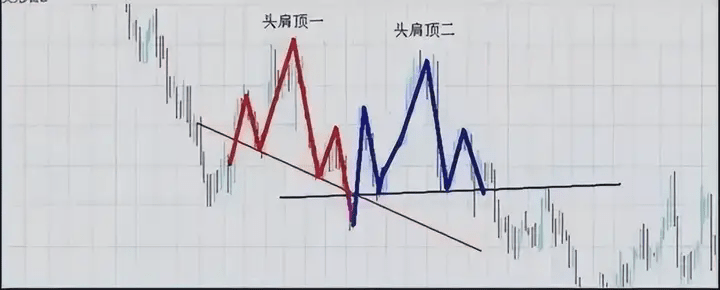
(3) Generally speaking, the head and shoulders bottom pattern is relatively flat, so it takes a longer time to complete.
(4) After breaking the neckline, there may be a temporary pullback, but it should not go below the line. If it pulls back below the neckline, or if the price falls back at the neckline level without breaking the neckline resistance and drops below the head, this may indicate a failed head and shoulders bottom pattern.
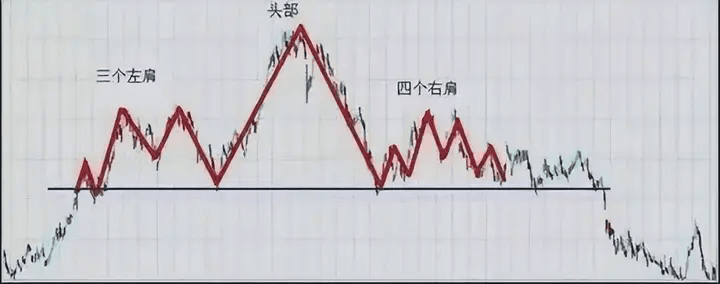
The head and shoulders bottom is one of the most predictive patterns. Once confirmed, the upward movement is often greater than its minimum upward movement.
The head and shoulders reversal pattern has many special forms, namely the complex head and shoulders pattern. The analysis method is the same as the head and shoulders reversal pattern. Here are some common shapes listed to deepen everyone's impression.
Four, triple top (bottom).
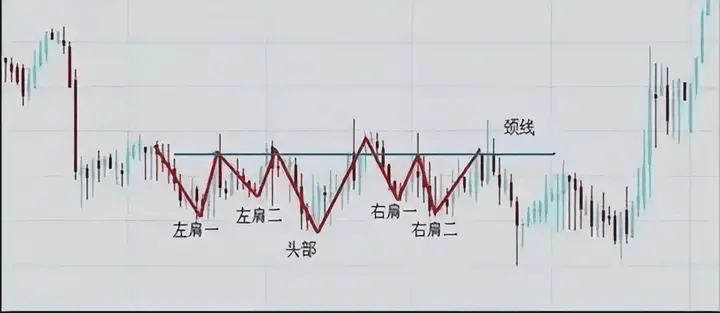
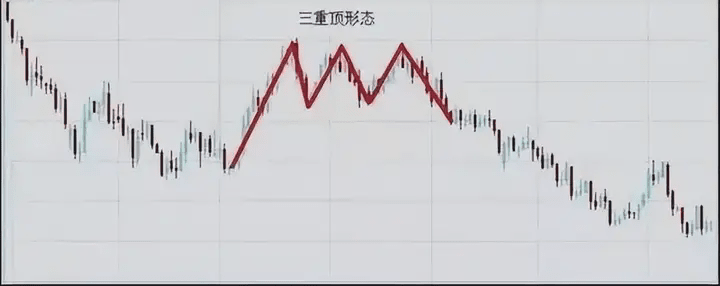
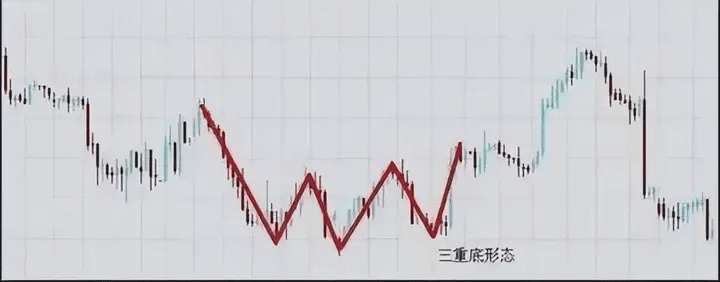
Any head and shoulders pattern, especially when the head does not exceed the shoulders by much, can be called a triple top (or bottom) pattern. The triple top pattern is also very similar to the double top, just with one more peak, and each peak is quite apart and deep. The triple bottom is the inverted triple top, and the analysis meaning is the same.
Five, rounded bottom (top).
The price shows a solitary rise, meaning it keeps rising, but each high point declines shortly after reaching it. First, the new high point is higher than the previous one, then the pullback point is slightly lower than the previous one, and connecting these short-term high points forms a rounded top. There will also be a rounded shape in terms of trading volume.
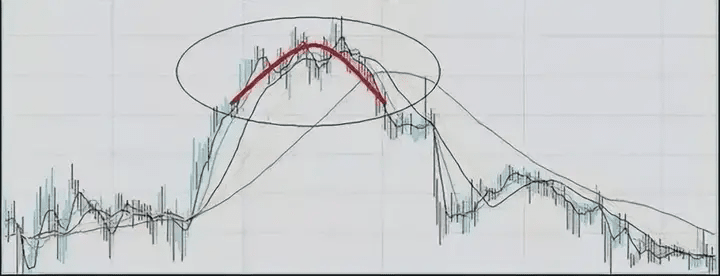
(1) Sometimes when the rounded top is formed, the price does not drop immediately but instead fluctuates horizontally to form a consolidation area, referred to as the bowl handle. Generally, this bowl handle will quickly break out, and the price will continue to trend down as expected.
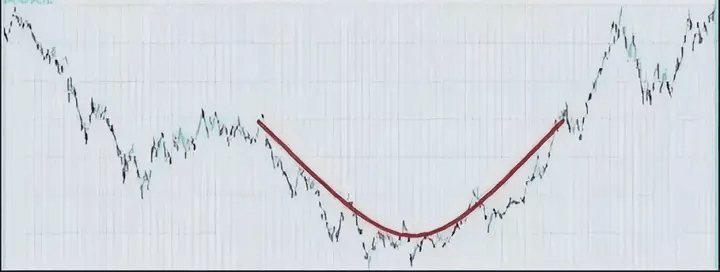
(2) Rounded reversals can appear at both the top and bottom of prices, and their forms are similar but opposite in meaning.
At the bottom, it appears as a solitary drop in price; initially, the selling pressure reduces continuously, causing trading volume to keep decreasing, but the buying force still hesitates, so although the price is dropping, the amplitude is slow and small, and its trend curve gradually approaches the horizontal.
At the bottom, buying and selling forces reach a balanced state, resulting in only a very small trading volume. Then demand starts to increase, prices rise, and eventually buyers completely control the market, leading to a significant price increase and a breakthrough upward situation.
In terms of trading volume, it initially decreases slowly to a level, then increases, forming a rounded bottom shape. This pattern indicates that a huge bull market is about to arrive. Investors can enter when the upward momentum of the rounded bottom begins to accelerate.
Six, V-shaped reversals and extended V-shaped reversals.
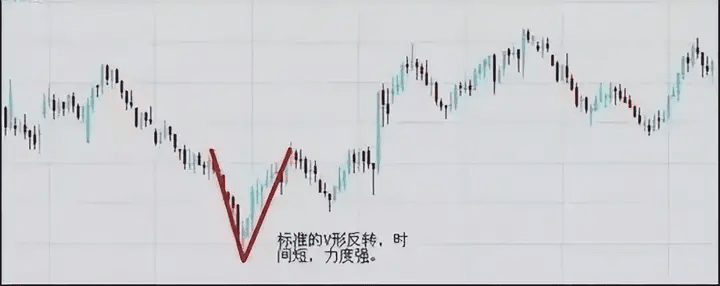
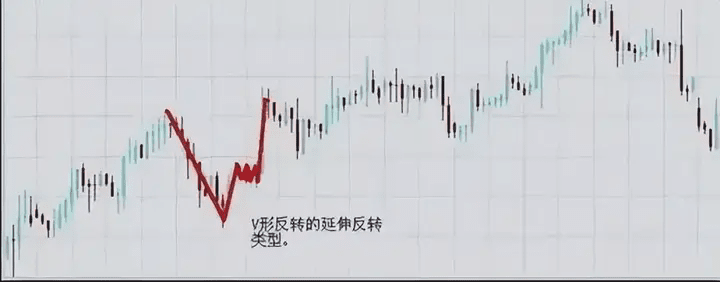
During the down phase: the left side of the V shape usually has a steep decline and lasts for a short time.
Turning point: the bottom of the V shape is very sharp, and generally, the time it takes to form this turning point is only three or two trading days, with trading volume significantly increasing at this low point. Sometimes the turning point appears during a panic trading day.
Recovery stage: then the price rebounds from the low point, and trading volume also increases accordingly.
When the price breaks through the top of the extended V shape, there must be an increase in trading volume; when breaking below the bottom of the inverted extended V shape, an increase in trading volume is not necessary.
Meaning of the pattern:
Due to the strong selling power in the market, prices stabilize and continue to decline. When this selling force disappears, the buying power completely controls the market, resulting in a dramatic rebound in prices, recovering all losses almost at the same speed as the decline; therefore, the price movement on the chart forms a V-shaped trajectory.
The inverted V situation is just the opposite; the optimistic sentiment in the market causes the price to rise steadily. However, a sudden factor reverses the entire trend, causing the sellers to drop at the same speed as the rise, forming an inverted V-shaped trajectory. This pattern is usually caused by unforeseen factors and some informed investors.
Seven, expanded reversal type (trumpet shape).
After a period of rising prices, the price drops, then rises again and drops again, with the rising high point being higher than the last one, and the dropping low point also being lower than the last low point. The whole pattern starts with narrow fluctuations and then expands with both upward and downward movements. If we connect the high points and low points respectively, we can draw a mirror-reflected triangular shape, which is the trumpet shape.
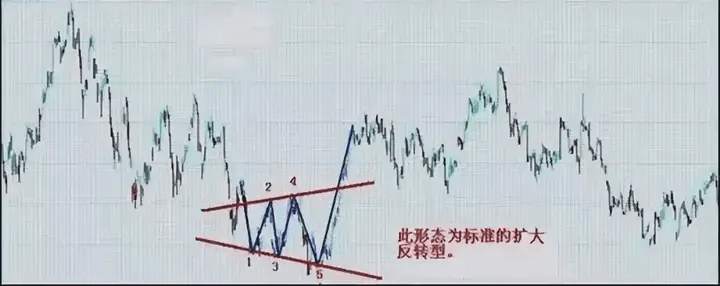
In terms of trading volume, the trumpet shape maintains high and irregular trading volume throughout the formation of the pattern. The trumpet shape can be upward or downward, and their meanings are the same.
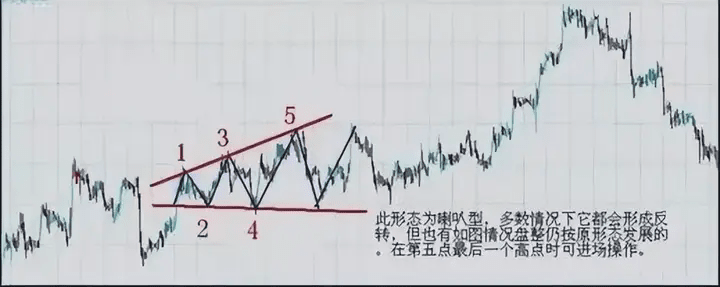
A standard trumpet shape should have three high points and two low points. The three high points are higher than each other, while the two low points are lower than each other; when the price falls back from the third high point and the pullback low point is lower than the previous low point, we can assume the pattern is established. Like the head and shoulders top, the trumpet shape belongs to the 'five-point reversal' pattern, so a flatter trumpet shape can also be viewed as a head and shoulders pattern with a higher right shoulder and a declining neckline.
The trumpet shape is caused by investors' impulsive and irrational emotions, so it rarely appears at the bottom of a bear market. This is because after a period of price decline, the willingness to invest is weak, and therefore it cannot form this pattern in a depressed market atmosphere.
The secret skills have been given to everyone; whether you can become famous in the world depends on yourself.
Everyone should definitely save these methods, look at them a few times, and if you find them useful, you can share them with more people in the crypto space. Follow me to learn more valuable content in the crypto world. Having been through the rain, I am willing to hold an umbrella for the chives! Follow me, and together we will walk the path in the crypto space!


