

@Fogo Official I was at my desk a little after 6 a.m.—radiator clicking, coffee going lukewarm next to the keyboard—watching a fresh fill hit on my second monitor. The order was tiny, but the timing was just weird enough to stick in my head. If this is what people call “market-grade” on-chain execution, how do I actually prove it?
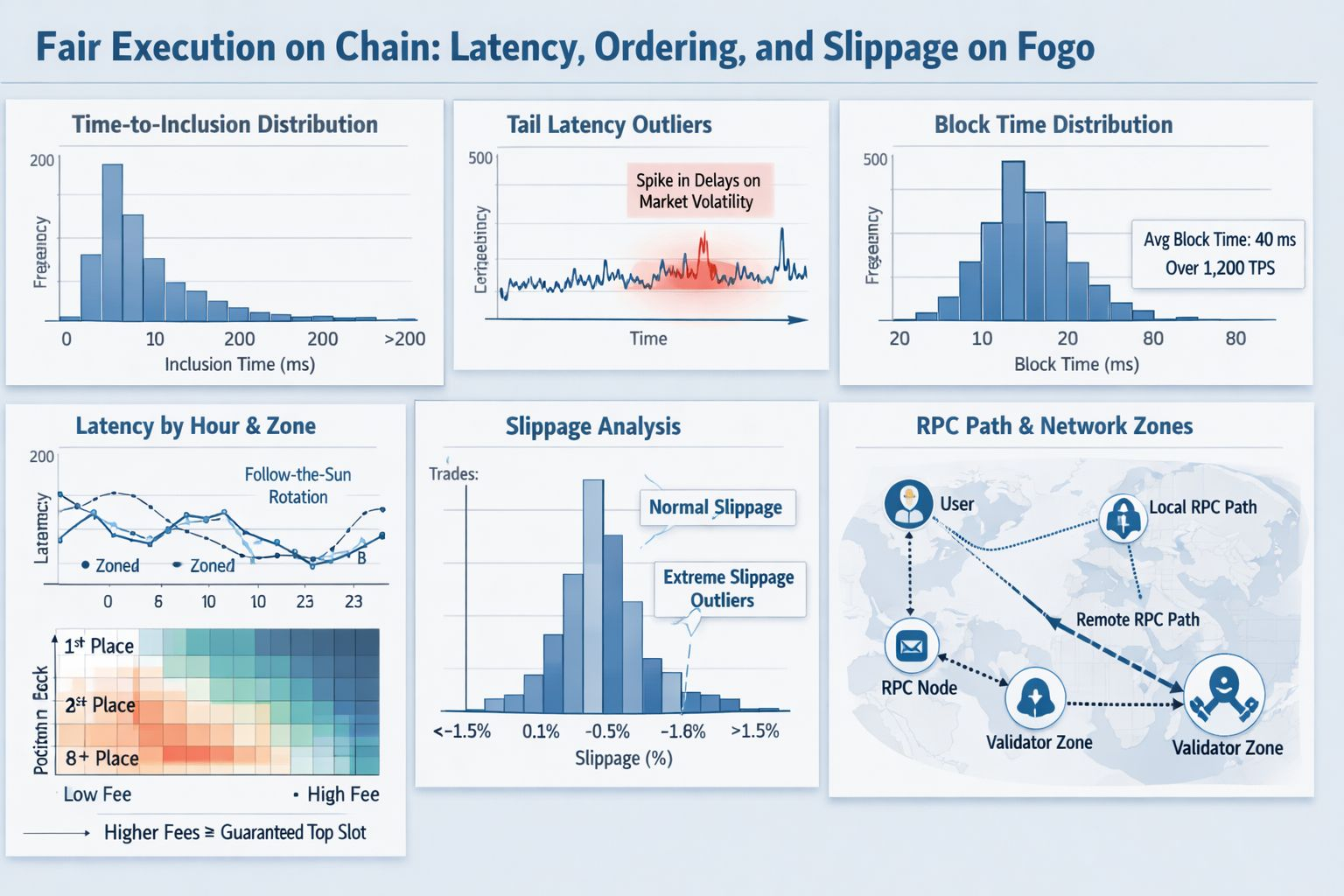
Fogo is in the spotlight because it launched a public mainnet on January 15, 2026, with exchange listings, live apps, and a clear focus on trading performance. A new chain always brings noise, yet the interest feels more specific this time. More teams are admitting that execution quality is the real user experience: whether a trader gets filled where they expected.
When I think about fair execution, I don’t mean fairness as a vibe. I mean three measurable things: latency, ordering, and slippage. Latency isn’t just “how fast” on average; it’s the long tail of slow confirmations that shows up exactly when markets move and people panic. Fogo’s litepaper calls out tail latency and the “weakest link” effect in quorum systems, which matches what I’ve seen in every distributed pipeline I’ve worked with.
Fogo’s design choices make those measurements interesting. The docs describe multi-local consensus aimed at minimal latency, and the litepaper adds validator zones where only one zone participates in consensus for an epoch, with options like follow-the-sun rotation. That can reduce network distance for some users, but it also means my results might depend on where I am relative to the active zone. So I track time-to-inclusion as a distribution, not a single number, and I note the RPC path and the hour.
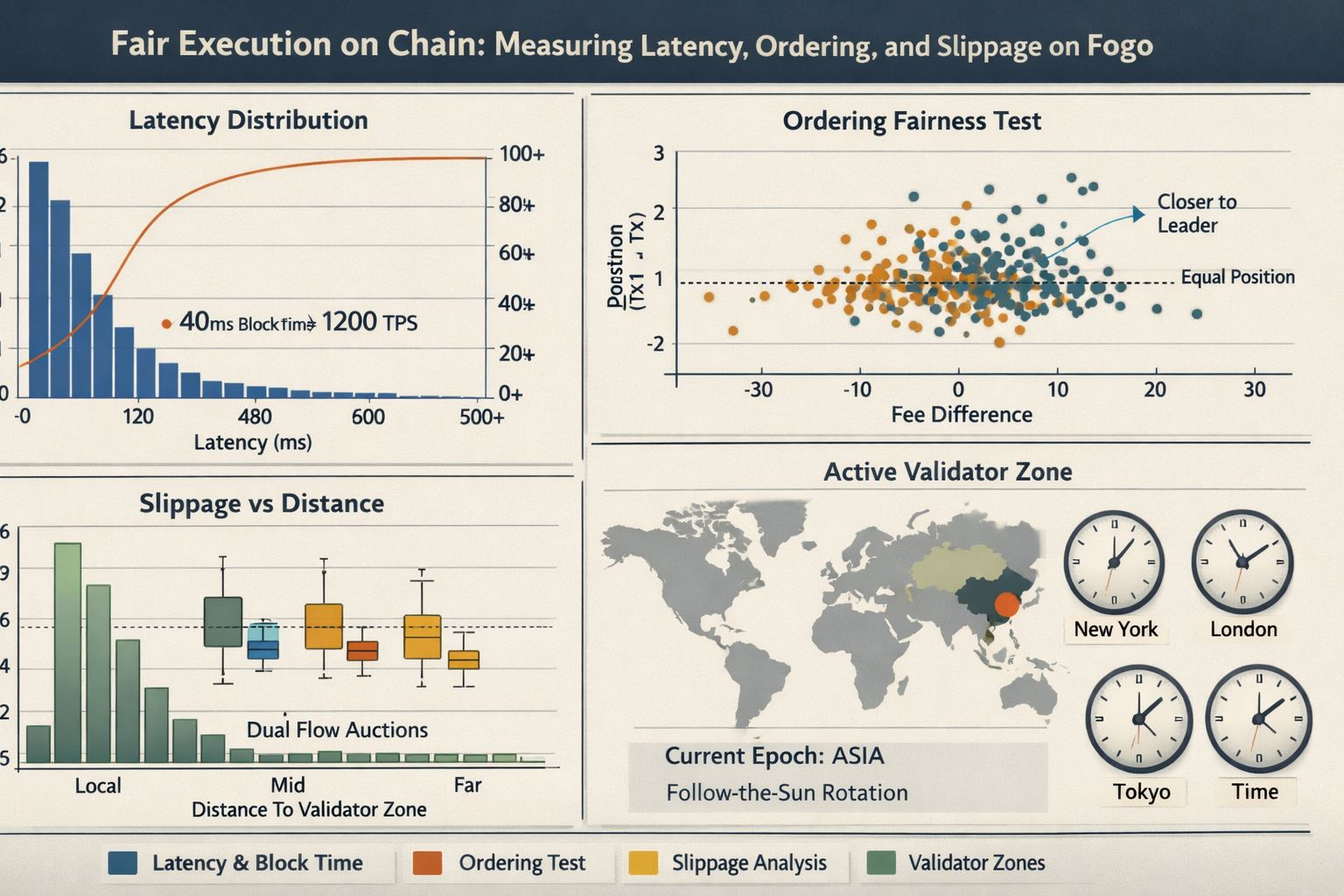
Early reports put the chain at 40-millisecond block times and more than 1,200 transactions per second with its first mainnet application. I’m interested, but I don’t treat that as a permanent property; I treat it as a benchmark to verify under different conditions. The docs list on-chain order books, real-time auctions, precise liquidation timing, and reduced MEV extraction as the kinds of workloads that justify chasing latency this hard. Those are concrete test cases, and each one fails in its own recognizable way when ordering or propagation gets messy.
Ordering is the part most people hand-wave, and it’s where “fast” can turn into “unfair.” On SVM-style systems there’s no public mempool like Ethereum; transactions stream to the current leader, and parallel execution means priority fees don’t guarantee position. That limits some front-running, yet it still leaves early visibility at RPCs and advantages from co-location. Fogo’s tokenomics post mentions builders co-locating near validators. I test this by sending paired transactions with controlled fees and identical accounts, then comparing slot and index outcomes across many trials.
Slippage is what traders remember, and it’s what ties latency and ordering to money. I try to separate movement during the block from extra slippage that looks like pure adverse selection. Some slippage is honest price movement; some is thin liquidity; some is getting picked off because my transaction arrived late or predictably. Fogo’s ecosystem is experimenting with structures that try to reduce speed-based edge. Dual Flow Batch Auctions, for example, batch orders over a block and clear them at block end using an oracle reference price, explicitly aiming to shift competition from speed to price. If that works, I should see fewer extreme slippage outliers and less dependence on being physically close to the leader.
I’m cautiously optimistic because on-chain systems let me audit my own experience. I can pull timestamps, slots, signatures, and trade outcomes without negotiating for a broker’s logs, then compare runs across days and market regimes. But I’m not naïve about incentives. Ultra-low latency can become an arms race, and “fair” can quietly mean “fair for people with servers in the right building.” I’m willing to do the unglamorous measurement work, but I’m still not sure what my notebook will say the first time the market really snaps.