Having personally experienced the cryptocurrency world for 10 years since 2015, I suggest to those new to cryptocurrency, if you want to earn some honest money, put aside your greed, find a good teacher to learn from before diving into contracts, and don't just think about gambling to turn a bicycle into a motorcycle.
In recent days, several friends around me have played contracts and got liquidated, losing so much that their lives are in chaos.
I have repeatedly told them not to trade contracts, but they just can't control themselves.
Those so-called trading teachers rely entirely on commissions to guide you into contracts, it's truly despicable.
Now let's discuss 10 reasons why I don't recommend touching contracts, each point filled with 'bloody' experience.
01 | Principal disappears too quickly
Contracts come with leverage, and even slight price fluctuations can lead to instant liquidation, faster than losing stars in a game!
02 | Addicted like gambling.
When you start making a little profit, you will be overly excited, then you will increase leverage and heavily reinvest, and the result is that before you can regret it, you get liquidated the next second.
03 | Emotional ups and downs, collapse is the norm
Both rises and falls make your heart race, constantly anxious, regretful, and angry; after a trading session, half your emotional energy is gone.
04 | Rising does not necessarily mean making money.
Spot trading can wait for a rebound, but once a contract is liquidated, even if it rises 100 times, you can't come back, 'standing at the wind mouth but already out of the game.'
05 | Letting you ignore risk awareness
Earning quickly makes you think you are a genius, but when losing, you realize: you are nothing; you just haven’t been fully taught by the market.
06 | Platform mechanisms hide traps
Some platforms have slippage, lag, spikes, forced liquidation… you think you’re trading, but you’re actually gambling against the house.
07 | Acting too fast, no time for stop-loss.
A single piece of news, a single pin, can end the battle in seconds, giving you no time to react; stop losses and take profits are all just fantasies.
08 | Exhausted but end up at 'zero'
Staring at the market all day, dreaming about K-lines at night, in the end, feeling exhausted + account balance to zero = double blow.
09 | The more you lose, the more you gamble; the more you gamble, the worse it gets.
Do you think you can recover by losing a little? In fact, you have fallen into the 'gambler's loop', eventually getting deeper and deeper until completely liquidated.
10 | Contracts are a life-and-death game.
Official data shows that over 90% of contract users lose money and exit; don’t make yourself that '1% myth.'
Making money can be slow, but liquidation can happen in an instant.
Contracts are never a 'shortcut to financial freedom'; they are a 'fast track to bankruptcy.'
A word of advice: Stay away from contracts, preserve your principal, and living longer is the way to go!
As the saying goes, standing on the shoulders of giants allows you to reach the shore of success faster. I hope my experience can become a valuable support on your journey.
In addition, at the end of the article, I will also reveal a crucial profit system, which is the essence I have derived from years of experience in the cryptocurrency circle. If you are fortunate enough to have read this far and wish to improve your skills in trading cryptocurrencies, please be sure to savor it, study it deeply, and save it for future reference.
What is leverage? Can it not kill me?
Leverage, simply put, is using small amounts of money to leverage large trades. It’s like using a small crowbar to move a big rock; leverage allows you to use very little capital to make much larger trades. For example, with 5x leverage, you can operate a trade worth 5 times your 1 dollar. Sounds exciting, right? But be careful! Leverage can amplify your earnings but can also amplify your losses. If the market moves slightly against you, you might lose more than your principal. So choose the leverage ratio carefully; don’t jump in with something too high — after all, 'if you play contracts well, you’ll have two houses at home' is no joke.
What do full positions and single positions mean? Will they affect my returns?
In the Binance trading interface, you will see two options: full position and single position (also called isolated position).
Full position mode: As the name suggests, all the funds in the account are counted. When losing, everyone shares the burden. If you open several positions and one position incurs a significant loss, the platform will automatically withdraw funds from other areas of your account to support it until all the money is gone. In this mode, the risk is shared.
Full position is suitable for those who are bold and careful. They believe that using the entire account's funds to withstand temporary fluctuations is manageable. However, if there isn't much money in the account, the risk of liquidation is very high.
Single position mode (isolated position mode): In contrast, isolated position is like opening a small 'independent vault'. You can allocate fixed margin for each position; if you lose, you will only lose that part of the money, and it won't drag the entire account down. This mode is more suitable for conservative players; thus, even if one position gets liquidated, others can remain intact.
For example: You have 1000 USDT; in full position mode, if one position loses, the platform will automatically use this 1000 USDT to support it; whereas in isolated position mode, you can allocate 500 USDT to each position. If one position loses completely, it won't affect the money in another position.
Take profit/stop-loss? How should I set it so that I don't 'die' too badly?
Take profit and stop-loss, as the name suggests, help you set expectations for profits or losses in advance, allowing the trading platform to automatically close positions when these prices are reached. This is to prevent the market from suddenly reversing and causing you to lose everything without being able to act.
Take profit: When the price reaches your set high point, the system will automatically sell for you to lock in profits.
Stop-loss: When the price falls to your set bottom line, the system will help you stop loss in time to avoid further losses.
However, setting stop losses and take profits should not only look at the latest price but also consider the 'mark price'.
What is the difference between mark price and latest price?
Latest price: This is easy to understand, it is the most recent transaction price in the market, changing every second. If you pay more attention to real-time market fluctuations, you can usually use the latest price to set your take profit/stop loss. This way, as long as the latest transaction price reaches your set level, the system will automatically close your position.
Mark price: The mark price is somewhat complex; it is a smoother and more stable reference price calculated by the platform based on market prices, funding rates, and other factors. Its existence is to prevent short-term sharp price fluctuations from causing your positions to be unnecessarily liquidated.
You can think of the mark price as the platform's 'psychological price', which is usually more stable than the latest price. If you don’t want to be 'mis-killed' by short-term market fluctuations, you can refer to the mark price to set your take profit and stop loss.
For example: You set a stop-loss order to sell when Bitcoin drops to 63200 USDT. If you set it using the latest price, when the latest price hits 63200 USDT, the system will immediately sell for you. But if the market suddenly experiences significant fluctuations, you might get liquidated even earlier than this price. If you set your stop-loss using the mark price, it can be steadier during large fluctuations, avoiding some 'false drops' that could wash you out of the market.
Opening positions, closing positions, going long, going short, confused?
These are all terms used in trading. It’s actually quite simple; let’s break it down:
Open position: Opening a position means setting up a new position, deciding to buy or sell.
Going long: You expect the price to rise, so you buy assets (like Bitcoin), and then sell when it goes up; this is going long.
Shorting: You are bearish, believe the price will fall, so you borrow assets to sell first, and then buy them back when the price drops to return them. This is shorting.
Closing position: Simply put, it means to end the position you have opened. Closing a long means selling what you bought, and closing a short means buying back what you borrowed to sell.
Funding rate/countdown, what does it mean?
The funding rate is a unique mechanism of perpetual contracts; every 8 hours, longs and shorts pay each other a fee. If the rate is positive, it means longs pay shorts; if the rate is negative, it means shorts pay longs. This is actually a way for the platform to adjust market supply and demand, preventing the market from being one-sided.
Countdown refers to the time until the next funding rate settlement. When the countdown ends, if you hold a position, you will either pay a fee or receive a fee, depending on whether you are long or short.
After all this talk, you may have gained some new insights into contract trading. Although it seems tempting, the risks are equally huge. Leverage gives you the opportunity to turn small amounts into large bets, but it can also make you lose everything.
Therefore, trading cautiously and controlling risks is the way to go.

Thousand times contracts, at first glance, seem risky, but in fact, they are my most profitable and highest win rate investment type. Initially, I was quite confused about this, but gradually I realized it was mainly due to inadvertently following a set of clear trading rules:
Total position setting: The funds I use for contract trading are always fixed, for example, an account's funds are always 300U. This means my maximum loss is 300U, and once the market trend is favorable, I have a chance to earn tens of thousands of U. This setting allows me to keep risks under control while seizing profit opportunities brought by major market movements.
Initial amount: The trading amount I start with is always very low, based on the philosophy of stock market master Jesse Livermore. He believed that if you are right from the beginning, it’s best to start making money right away. Therefore, the amount I start with is always very small; even if the total position is 300U, I often start with only single-digit or double-digit U, ensuring that I am in a profitable state from the beginning of trading.
Adding to positions strategy: I only use profits to add to positions when there are profits and the trend is clear. This strategy allows me to further amplify profits when market trends are favorable while avoiding increasing risks in unfavorable market environments.
Stop-loss setting: I will adjust my stop-loss position in a timely manner according to market conditions to ensure I do not lose principal. This is an important principle I adhere to in trading; it helps me stay calm during market fluctuations and avoid emotional trading decisions.
These four rules have invisibly made me strictly adhere to trading discipline, and the logic behind them also applies to ordinary low-leverage contracts, as the reasoning is the same. Of course, before starting, I still want to remind new players:
Contract trading is not a game, especially for those who think there are some contract tricks or masters who can predict prices. Don't blindly believe that just by listening to them, you can make big money; this mindset should not exist. I certainly do not have any secrets that will make you wealthy just by listening. Moreover, contract trading tests human nature very much. Unless you can stick to using very little money, like 100U, 300U, etc., this aligns with the strategy of 'small bets for big returns', rather than 'big bets for small returns'. What I share is a method, hoping to give contract players some reference, that's all.
As for the main techniques:
First, transfer USDT into the trading platform's contract account, but the total amount should not exceed 300U. This amount is set according to my personal trading capital ratio. Generally speaking, everyone can determine the trading amount based on 1% of their total capital, but each transaction should not exceed 300U (this limit only applies to thousand times contracts).
Additionally, I actually do not recommend trading methods like hundred times contracts because the risks are too high and the cost-effectiveness is low. You should either choose low-leverage contracts below 5X and hold large positions, or choose high-leverage contracts between 500-1000X and trade with very small positions. It’s best to choose only the latter method, as contract trading is inevitably subject to liquidation, and even low-leverage contracts are not exempt. Thousand times contracts either lead to liquidation at 300U or yield huge profits; overall, the profit-loss ratio is extremely large.
Therefore, if you master the correct method, it is very likely that contracts can be profitable. However, if there is no ADL forced liquidation mechanism in the trading platform, you are likely to lose everything. Previously, my friends and I took the A network's thousand times contract to the point of shutting down...
I want to emphasize: The essence of contract trading is to use small amounts to leverage big bets rather than to use big bets for small returns.
In addition, due to the extremely high multiples of thousand times contracts, transaction fees and funding fees have become relatively minor; whether you can open the right position is the most important. Furthermore, the transaction fees for thousand times contracts are much cheaper than for other contracts under the same ratio. From another perspective, contract trading is essentially borrowing money to open positions, and this borrowed money only requires interest to be paid back. If liquidation occurs, you don't need to pay back the money; this is actually a very good investment target.
Of course, if you don't trade according to my rules, the speed of loss will also be very fast.
Two, initial position techniques.
Assuming BTC is currently at 16500U, having fluctuated for a long time, I still bear a bearish outlook and expect a significant market movement. I would recommend starting with 4U at 500X. Note that it’s 2U out of the 300U.
Once opened, don’t care about rises and falls, unless liquidation occurs; just sit back and watch, stay calm — — it means you choose a direction before opening. It’s best to be over 70% confident in the short term and expect a big market movement to occur.
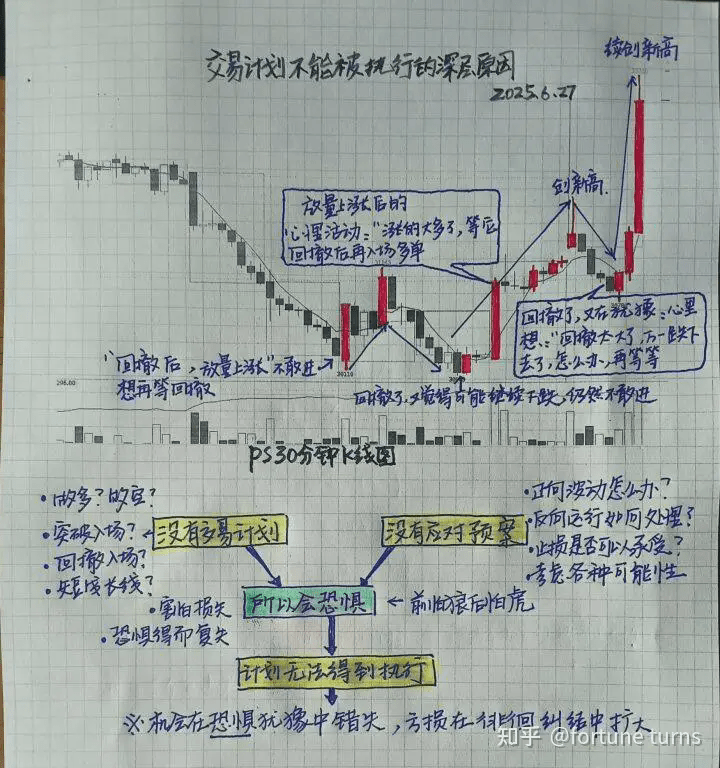
Major market movements generally occur after the K-line flattens, as shown in the figure below:
Market trends after 312
As shown in the figure above, in the market trends after 312, each time fluctuations occur and the K-line becomes flat, there will ultimately be a big market movement either upwards or downwards. Finding opportunities to intervene at this time will be more helpful. As for how to find opportunities, you can refer to some tutorials and observe the appearance of specific K-line patterns, such as the 2B structure.
In many cases, when opening a position, you might feel that the current position is not ideal based on various reasons, so you can lower your initial position, such as starting with 1U. Conversely, if you are particularly confident in a certain position, you can increase it slightly.
However, you should calculate: 300U, if you use 10U to open 500X, then the total position is 5000U, and your principal is 300U, which is equivalent to over 10 times, the risk is relatively high, not recommended!
Because our initial position is key to surviving market fluctuations, do not be greedy!
Three, adding to positions techniques.
For example, if the market indeed falls below 16000, and there is a huge negative news impact, and you observe volume, MACD, etc., and feel there is a great chance of a big drop, then you should consider adding to your position, using profits to add. This is commonly referred to as rolling positions, which is almost the key to using small funds for big returns. However, rolling positions are a technical skill, and most people get liquidated here. Let's discuss the methods below:
At this time, the market is declining, and my position has already made a profit; 300U has become 400U (for example, I didn’t calculate exactly how much), so I will add to my position now.
Before adding to your position, if you observe that your profit has reached 100U, then after adding to your position, it is advisable to set a stop-loss, meaning a loss of 100U, leaving a final position of 300U of capital.
Because at this point, we have already made a profit, and it’s very likely that the direction is correct, there’s no reason to risk the principal anymore.
At this point, you should note that setting a stop-loss of 100U actually means your original position was a capital of 300U, and now it is a profit of 100U. If the position size increases, it may be stopped out at any time.
Because, at this point, you can actually take it step by step. The first step is to set a stop-loss of 100U; don’t rush to add yet, wait until the profit expands and then add a little bit, bit by bit, it's best if you can endure market fluctuations.
The secret here is not to be greedy. If you are not sure, don’t even add. A 500x contract can be really fierce to earn, and the same goes for losses.
There is also a special timing issue with adding to positions; it’s best to add during a small rebound in a downtrend or during a small pullback in an uptrend — — In this regard, the 2B structure is particularly useful and worth learning.
It’s best to add positions only two or three times, then just watch the market run — — the more you add, the more dangerous it becomes during pullbacks.
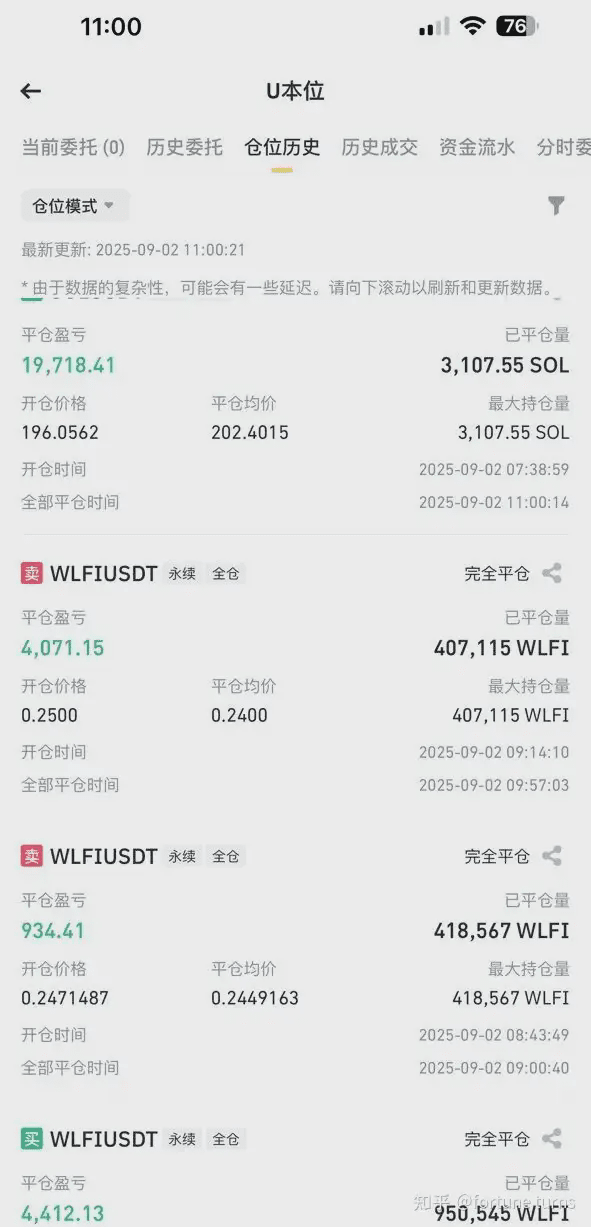
In the above figure, this position ultimately made a profit of 25000U, but in the end, the A network closed my position under the pretense of maintenance... Otherwise, I would have definitely caught the big bull market; my capital was 46U, and the margin shown as 7U is because some costs were deducted.
The reason why A network closed many profitable orders from my friends and me at that time was because they did not have the ADL forced liquidation mechanism, meaning the exchange acted as a counterparty to the players. After I discovered this method, it became easy for A network to lose money, and they had to resort to dishonest tactics. However, Bkex exchange does not have this issue; like Binance, it introduces ADL forced liquidation mechanism, allowing users to compete against each other without affecting the exchange.
Four, additional supplements
High leverage for short-term trading is the correct way to play contracts, high risk but higher returns — — Note, I must emphasize again, I am not suggesting you play with high leverage, especially for beginners, don’t even touch it, because you won't understand. I am just sharing my thoughts and methods.
1. You need to gradually establish your own trading system.
In the trading system, there is no holy grail.
We can see that short-term experts like Lam Williams and CIS have excellent long-term practical performance. The former's book has sold a lot, but I haven't seen a second Williams because everyone's mindset and system change slightly, and the trading outcomes can vary greatly.
Therefore, if you want to wear the crown, you must bear its weight. Forming your own trading system, enjoying its benefits, accepting its shortcomings, and constantly summarizing market rules and making adjustments is the key to success.
2. Understand the profit-loss ratio.
In the trading system, the profit-loss ratio is considered the core lifeline. The real profit formula is quite straightforward: money earned minus money lost, then deduct transaction fees, and the final result must be a positive number.
There are three trading modes; let’s first talk about the first two:
The first type is high profit-loss ratio with low win rate and low frequency. This is typically trend-following, doing medium to long-term trades. Like Ouyang Zhuai's 3000 to open long positions, stubbornly holding until being liquidated by OKEX, it took about half a year; also, a lazy person used a principal of 100,000 to make over 100 million during the 2021 bull market, both are fierce characters in playing trends.
The second type is a low profit-loss ratio with a high win rate and high frequency. Short-term experts often use this method, with profit-loss ratios often at 1:1, which is quite poor. Such legendary figures are very few; I simply cannot play this way. There are also those who rely on quantitative high-frequency trading to eat the arbitrage from trading fees, which is a high-end game, and exchanges will shut down accounts caught in this; ordinary retail traders should not get involved.
The third type is a terrifying profit-loss ratio with medium win rate and extremely low frequency. This is a classification I created, called the third type model, which is a unique killer move in the cryptocurrency circle:
For example, opening a position with 300U, my maximum acceptable loss is 300U. According to my method, I can try many times, but as long as I catch once, the profit-loss ratio will explode. Like the position at 46U, it rose to 25000U. If it weren't for the exchange causing issues, it could have surged to 50000U, nearly 1000 times the profit. In this way, even with a win rate of less than 10%, it can be played — do you think a win rate of below 10% is easy to achieve? Even placing orders with eyes closed would yield more than this number.