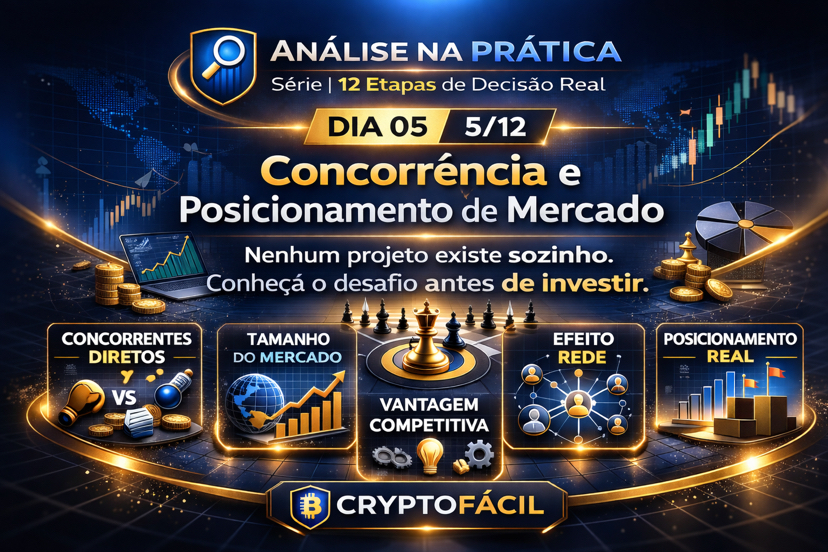
DAY 05 — Competition and market positioning
No project exists alone.
Before asking if a project is good...
ask against whom it competes.
If you don’t know who the competitors are, you don’t understand the size of the challenge.
🎯 1️⃣ Who are the direct competitors?
• Are there projects that do exactly the same thing?
• Which one has greater adoption?
• Who already has a market advantage?
📍 Where to analyze:
• CoinMarketCap → “Similar Projects”
• Messari → Sector comparisons
• CryptoRank → Token category
• DeFiLlama (for DeFi protocols)
🎯 2️⃣ Market size (TAM)
• Is the market large enough?
• Is it a saturated niche?
• Is it in growth or contraction?
📍 Where to check:
• Messari reports
• Delphi Digital
• Token Terminal
• TVL data (DeFiLlama)
Good project in a small market has growth limits.
Average project in a giant market can scale.
🎯 3️⃣ Real competitive advantage
• Superior technology?
• Better user experience?
• Strategic partnerships?
• Already established network?
If the only advantage is “future promise,” the risk is high.
🎯 4️⃣ Network effect
• The more users join, the stronger the project becomes?
• Or can it be easily replaced?
Protocols with network effect create natural barriers.
🔎 Practical interpretation
✔️ Large market + well-positioned project = scalable potential
⚠️ Saturated market + weak differentiator = predatory competition
❌ Isolated project does not exist — it always competes for space
Investing is not asking “is it good?”
It's asking: is it better than the others?
📊 Series tracking
✅ Day 1 — Initial filter: Market Cap, FDV, Supply, and Volume
✅ Day 2 — Tokenomics and economic model
✅ Day 3 — Value proposition and competitive advantage
✅ Day 4 — Team and strategic investors. ( Link to post DAY 04 of the series )
✅ Day 5 — Competition and market positioning
⬜ Day 6 — Real use, revenue, and TVL
⬜ Day 7 — Token value capture
⬜ Day 8 — On-chain analysis
⬜ Day 9 — Liquidity and market depth
⬜ Day 10 — Structural risks
⬜ Day 11 — Risk structure and allocation
⬜ Day 12 — Real decision making