

Between Cutting-Edge Technology and Political Damage Control
1. Introduction: The Institutionalization of Mystery
The recent directive from the U.S. Executive to identify and declassify files related to Unidentified Anomalous Phenomena (UAP) marks a paradigm shift in public perception engineering. What has historically been relegated to the margins of sensationalism and pseudoscience has been elevated, through official orders, to the center of the national security agenda. This movement does not represent a burst of democratic transparency, but a deliberate maneuver of institutional validation. By granting "classified information" status to objects that supposedly challenge the laws of physics, the State gains the ability to modulate social scrutiny. This transition from the "conspiratorial" to the "official" allows the administration to manage the truth asymmetrically: the existence of the phenomenon is validated to capture collective attention, while the core of the technological and political reality that supports it remains locked away. In this context, informational openness is the most sophisticated control mechanism of the 21st century.
2. The "Cui Bono" of the Revelation: Smoke Screens and the Rot of the Elite
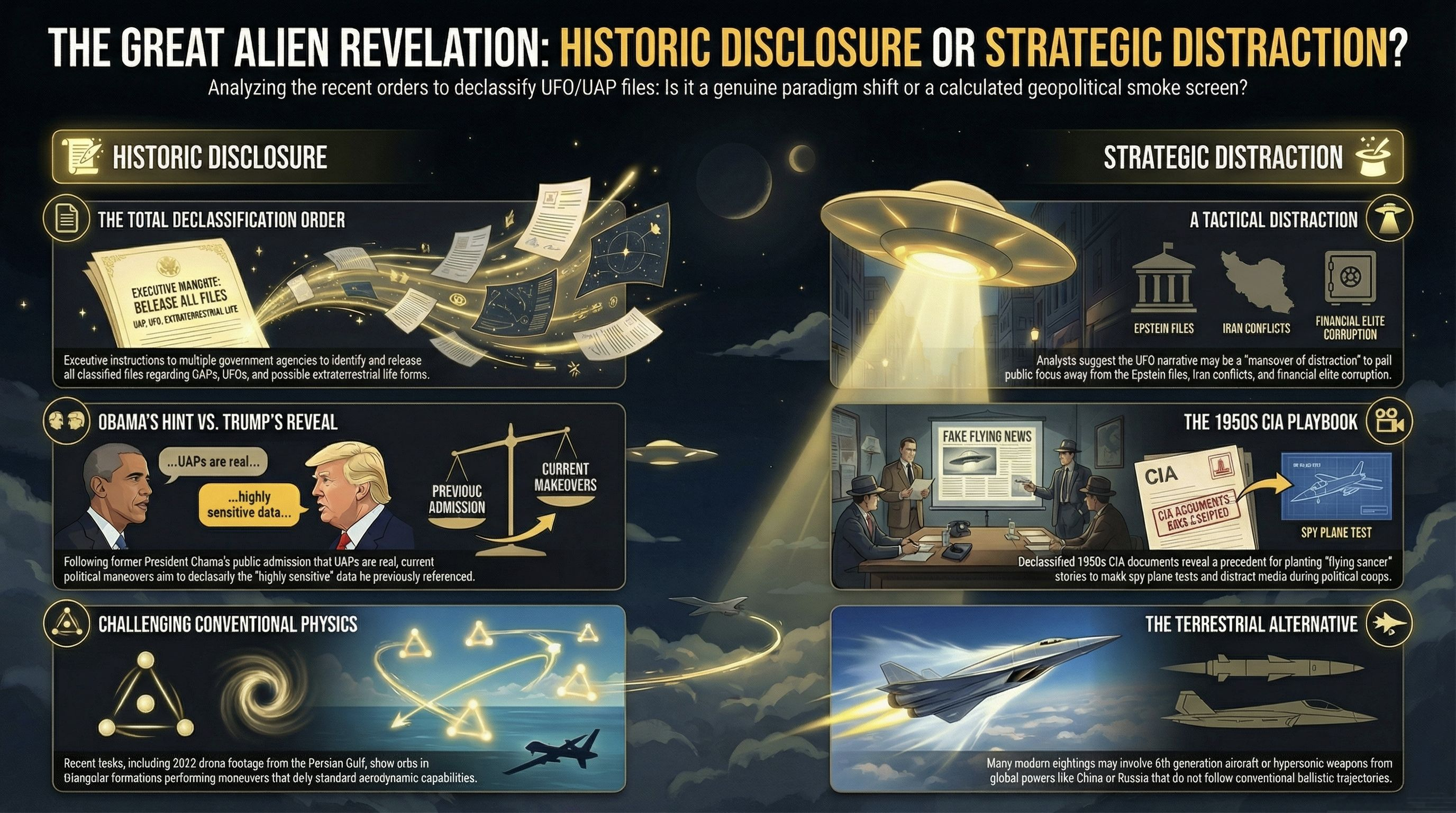
From geopolitical intelligence, the fundamental question before any major revelation is Cui bono? (Who benefits?). The emergence of the UAP narrative at the highest levels of power coincides with critical fronts that threaten the stability of global command structures. We are witnessing what can be defined as the management of the "elite rot": a legitimacy crisis affecting those who dominate finance and the media. The media noise about extraterrestrial invasions or non-human technologies acts as an isolating filter against scandals that, if they reach their critical mass, would dismantle the current institutional order.
The Epstein Curtain and Financial Corruption: The pressure to declassify UAP files serves as the perfect counterbalance to the social demand for total transparency about Epstein's network. The files revealed so far are barely the "tip of the iceberg" of a structure of moral and economic corruption involving the echelons of global financial power. An "alien revelation" offers the necessary level of socio-political shock for the public to lose interest in the investigations into the systemic criminality of their leaders.
Geopolitics of Resources in Greenland: While public opinion looks to the sky, maneuvers for control of strategic regions are accelerating on Earth. Greenland is not just a frigid territory; it is a critical node for the control of Arctic routes and rare earth deposits essential for technological transition. The use of the UAP narrative in these friction zones allows for the cover-up of military tactical movements under the label of "unidentified phenomena."
Instability in the Middle East (Iran): The deployment of drones and surveillance technology over the Persian Gulf generates constant sightings. Labeling these incursions as "orbs of unknown origin" prevents immediate diplomatic crises and hides the real level of technological infiltration in Iranian airspace.
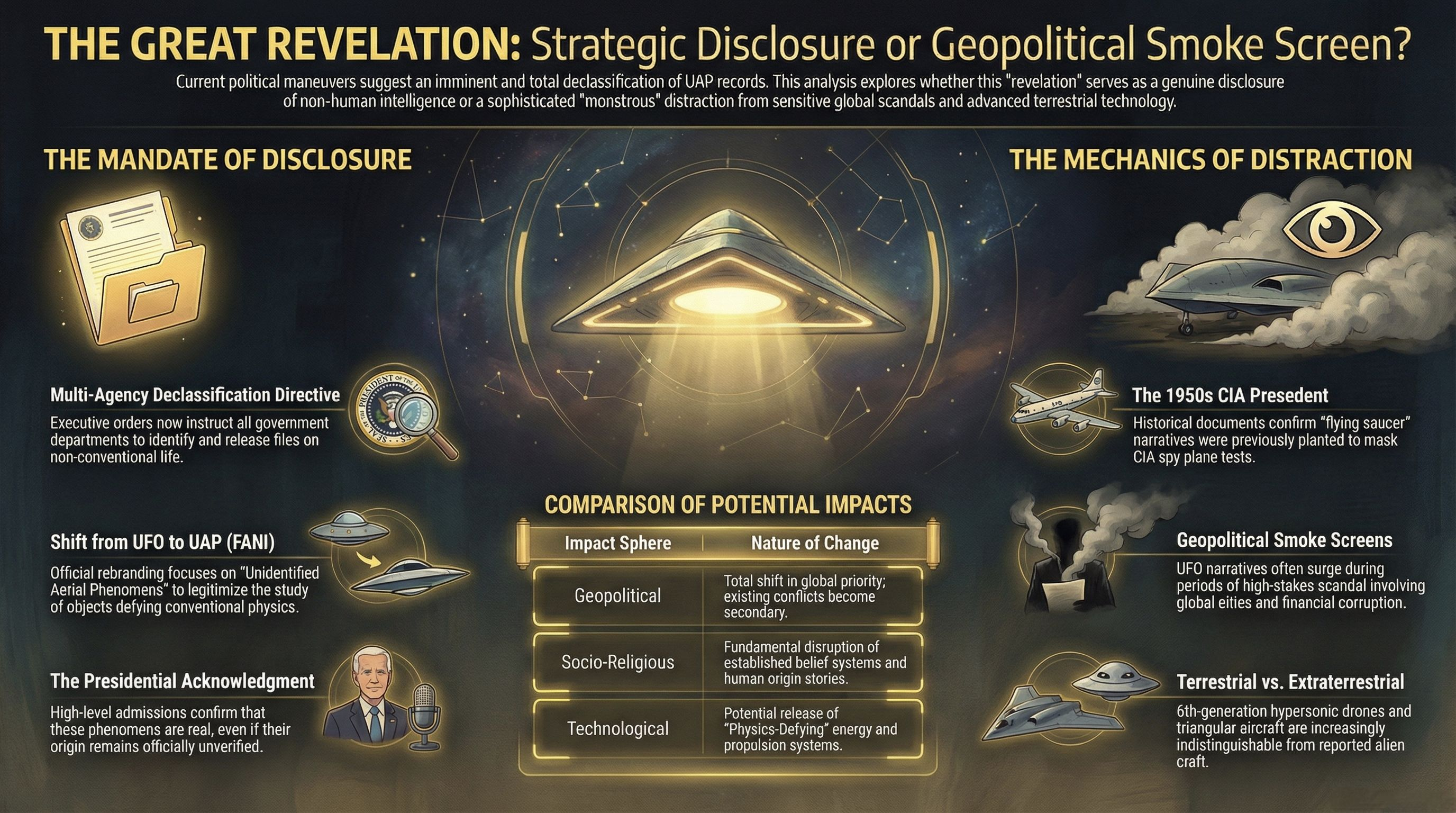
The ultimate goal is to generate a shock of such magnitude —religious, philosophical, and social— that the common citizen is paralyzed. In a state of stupor before the "news of the century," the elites gain the time necessary to restructure their assets and protect themselves from the consequences of their own internal crises.
3. Technological Sovereignty vs. Alien Narrative: The Race for Sixth Generation
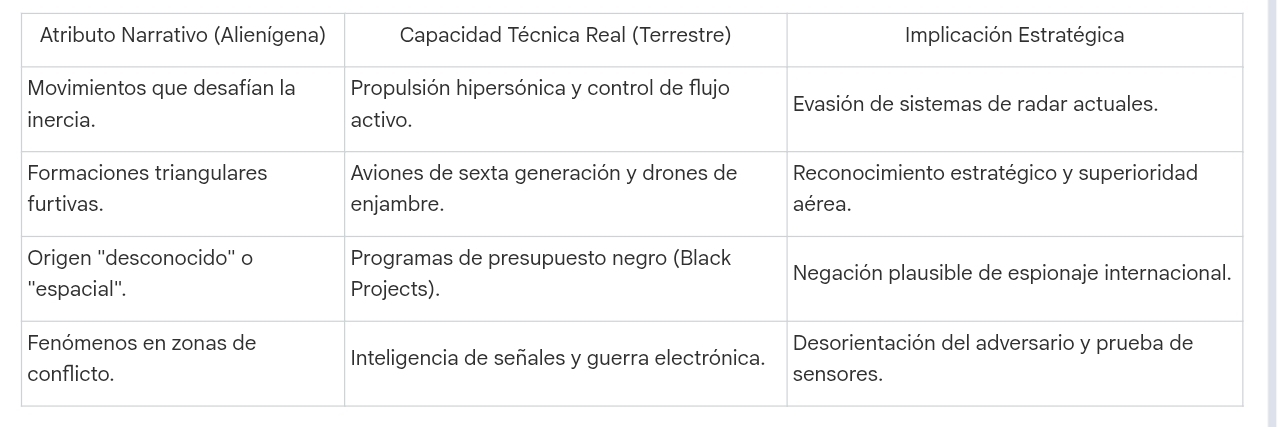
It is imperative to strip the UAP phenomenon of its mystique to analyze it under the cold light of aerospace engineering. Documented sightings, such as the orbs captured by MQ-9 Reaper drones or the triangular formations reported in various no-fly zones, possess a physical explanation linked to military supremacy. Russia, China, and the United States are fiercely competing in the development of hypersonic devices and sixth-generation platforms that do not follow conventional ballistic trajectories.
The use of the "extraplanetary" narrative is a dual-use tool. First, it allows powers to test prototypes in foreign airspaces without admitting violations of sovereignty or revealing technical capabilities to their adversaries. Second, it justifies astronomical defense budgets. One example is the proposal for the "Golden Dome," a massive national defense system intended to protect U.S. territory. Justifying such an expenditure to an economically exhausted population is unfeasible if the threat is merely terrestrial; however, if the threat "breaks the rules of physics," the investment becomes a matter of existential survival for humanity.
4. Lessons from History: The CIA Manual and the Manipulation of Perception
The manipulation of the UAP narrative is not a contemporary innovation; it is a tested tactic from the intelligence manual. Declassified documents from the 1950s reveal that figures like Allen Dulles understood that the "flying saucer" was the perfect vehicle for psychological warfare. In 1954, during operations to destabilize governments in Central America (such as Guatemala), the CIA deliberately planned the dissemination of stories about UFOs to distract the media and enemy intelligence.
The CIA's control mechanism consisted of deceiving the public about the nature of sightings to hide evidence of spy planes (like the U-2). The historical lesson is clear: the State does not declassify information to enlighten the citizen but to manage fear. By classifying something as "secret" and then selectively releasing it, the government creates a sense of "informational generosity" that hides the fact that it still controls access to reality. This tactic paralyzes critical judgment; when the citizen kneels before the possibility of a "higher revelation," they stop questioning the opacity of the offices where the economic and military fate of the world is decided.
5. Conclusion and Strategic Reflection: Truth as a Market Asset
The current game of tensions between political figures —where the "recklessness" of some is criticized for speaking about extraterrestrials on podcasts while others boast of their "generosity" in declassifying files— demonstrates that the UAP issue is a chess piece in the struggle for internal power. Both Donald Trump and Barack Obama, despite their apparent differences, operate within the same narrative management framework: using institutionalized mystery to maintain the relevance of the State as the sole arbiter of reality.
From a global market perspective, this scenario reinforces a fundamental thesis: in an ecosystem where the official narrative is malleable and used for mass distraction, trust must shift towards decentralized systems. Misinformation and the "noise of the stars" are the price paid by those who blindly trust centralized information sources.
In this context, assets that offer algorithmic transparency and decentralization, such as Bitcoin and blockchain technology, acquire a strategic value that transcends the financial. They represent a refuge against a State that can institutionalize mystery at will to conceal its decay. The true revelation will not come from a Pentagon file, but from individuals' ability to distinguish between the political theater of the inexplicable and the real flows of capital and power that move the world. In the information age, critical surveillance is not an option but the only possible coverage against the obsolescence of truth.