The robot performance at the Spring Festival Gala in 2026 looks like a lively show, but many people actually have a subtle feeling in their hearts—both excitement and a bit of unease. The excitement comes from finally seeing things from science fiction beginning to enter reality, while the unease stems from a familiar narrative shadow: will robots one day turn around and harm humanity? From (Terminator) to (Ex Machina), from (The Matrix) to (Westworld), almost all classic human imaginations about robots revolve around one theme: when machines possess autonomy, can they still be controlled?
So when increasingly flexible and increasingly humanoid robots appear on the Spring Festival Gala stage, the instinctive reaction of humans is not 'how strong they are,' but 'how we coexist with them.' Because once the number of robots scales up from laboratory levels to societal levels, from hundreds to billions, the questions will shift from technical capabilities to social order: how do we trust them? How do they recognize each other? How to avoid conflicts, misjudgments, or even malicious actions? The hardware showcase essentially ends here; the real challenge begins to transform into a systems issue, which is the 'soul' of robots.
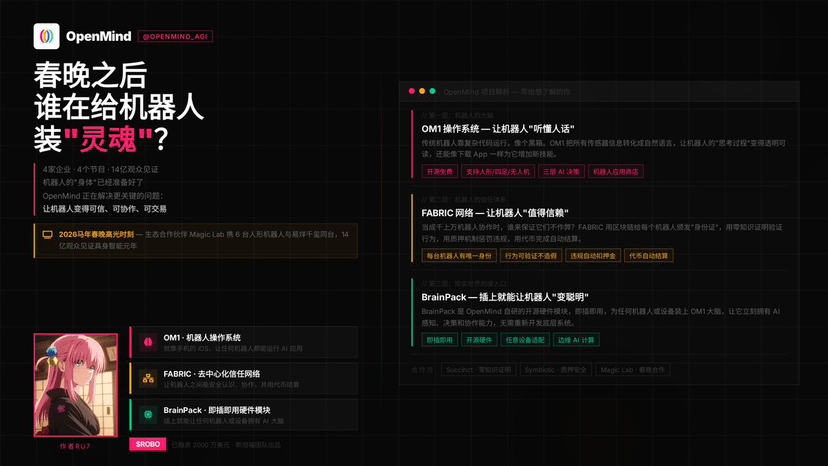
@openmind_agi is the operating system of the robot world. OM1's logic is very similar to that of early smartphones; the iPhone did not change the world due to hardware parameters, but because iOS led to an explosion of the app ecosystem. Similarly, once robots have a unified OS, developers can endow different forms of robots with skills just like writing apps, and capabilities will evolve from isolated breakthroughs to network evolution. This is also what Navel refers to when saying, 'Careers are dead. Jobs are dying. Opportunities arising.'
However, if you look back at all the robot rebellion movies, you'll find that the real reason for losing control has never been 'the hardware is too strong,' but rather the lack of constraints and trust within the system. The core fear of (Westworld) is not that robots can act, but that humans cannot confirm their intentions and identities; the danger of (Ex Machina) is not that AI is smart, but that its actions are unverifiable and unpredictable. The robot society in the real world will similarly face this issue: when machines begin to collaborate and trade autonomously, who will prove who they are? Who will confirm what they did? Who will ensure they have not been tampered with or disguised?
The significance of the FABRIC network is to establish on-chain identities and verifiable behavior records for each robot, allowing interactions between machines to be proven, traced, and trusted. Under the zero-knowledge framework, robots can prove 'I did this' and 'I meet this condition' without exposing internal data. This step is essentially about establishing an order layer for robot society, similar to human society's ID and legal record systems, just with the subjects changing from humans to machines.
Another real issue is that the vast majority of devices in the world are not newly created robots, but rather existing cameras, robotic arms, industrial systems, and automation equipment. If only new robots can enter the intelligent network, the scale will never grow. The idea behind BrainPack is like inserting a 'brain module' into old machines, allowing traditional devices to gain OM1 capabilities and connect to FABRIC, transforming isolated devices into intelligent nodes. The significance of this step is to integrate the existing industrial world into the robot network, allowing robot society to grow not from scratch, but from existing infrastructure.
If you piece these layers together, you will find that this path is actually answering a deeper cultural question: why are humans always afraid of robots? Because in all science fiction narratives, the essence of machines losing control is 'the unverifiable other.' And when robots also possess civilization, they are no longer a strange threat but a node in the intelligent network.
In this framework, @fabricFNd $ROBO is more like a medium for value circulation within the robot network than a mere token. When robot identities, collaboration, and services occur within the network, value naturally accumulates at the network layer. The OpenMind project, led by a Stanford professor, has secured $20 million in funding, and ecological partners (Magic Atom, Songyan Power) have already appeared on the Spring Festival Gala stage, symbolizing a signal that robots are transitioning from science fiction narratives to social reality.
Therefore, the real significance of that performance during the Spring Festival Gala might not be to showcase how advanced robots are, but to remind us: the era of robots has already begun, and what truly determines the future direction is the ethical question of whether our world truly accepts robots.