
We celebrate Newton as the man who explained gravity 🍎✨ — the scientist who could map the motion of planets and predict the behavior of the universe.
But in the early 1700s, even he was pulled into something far more unpredictable than physics: human behavior. 🧠🔥
Newton invested in the South Sea Company — a government-backed venture designed to manage British national debt. On paper, it looked legitimate. Promising. Revolutionary. 📜💰
At first, he played it perfectly.
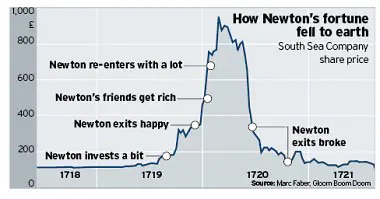
He bought early.He watched the price rise. He sold for an amazing profit — about £7,000. 📈✅ Disciplined. Logical. Brilliant.
But then the frenzy intensified. 🎈🔥
Prices kept soaring. Friends and colleagues were getting richer by the day. The excitement was contagious. The narrative was unstoppable. “This time is different.” 😬📊
So Newton re-entered the market — near the peak.
And when the bubble burst… 💥📉
He lost more than £20,000 — the equivalent of $20–30 million today🤯🤯🤯
Afterward, he famously admitted:
“I can calculate the motions of the heavenly bodies, but not the madness of people.”
During the frenzy around the South Sea Company — much like during speculative manias such as the Dutch tulip boom — investors were absolutely convinced they were witnessing a new financial era. 🌷💎💎💎
They poured in life savings.They dismissed skeptics. They believed it could not collapse. Until it did.
So here is a question worth sitting with — calmly, professionally, and honestly:
When every generation believes its new asset is revolutionary… when crowds insist “this is not a pyramid”… when savings flow in faster than understanding… Are we certain we are witnessing innovation — or are we simply watching another beautifully packaged pyramid take shape, just as investors once did before the fall?
#crypto #bitcoin #TrumpNewTariffs