

Fabric Protocol is emerging at a time when crypto is searching for its next real purpose beyond finance. For more than a decade the industry revolved around trading tokens lending capital and building decentralized financial systems. Innovation was measured in total value locked and exchange volume. Yet while the spotlight remained on financial speculation a deeper transformation was quietly advancing in the background. Automation was accelerating. Artificial intelligence was improving. Robots were leaving research labs and entering everyday industry. The next frontier for crypto may not be about money moving between people. It may be about machines becoming economic participants in their own right.
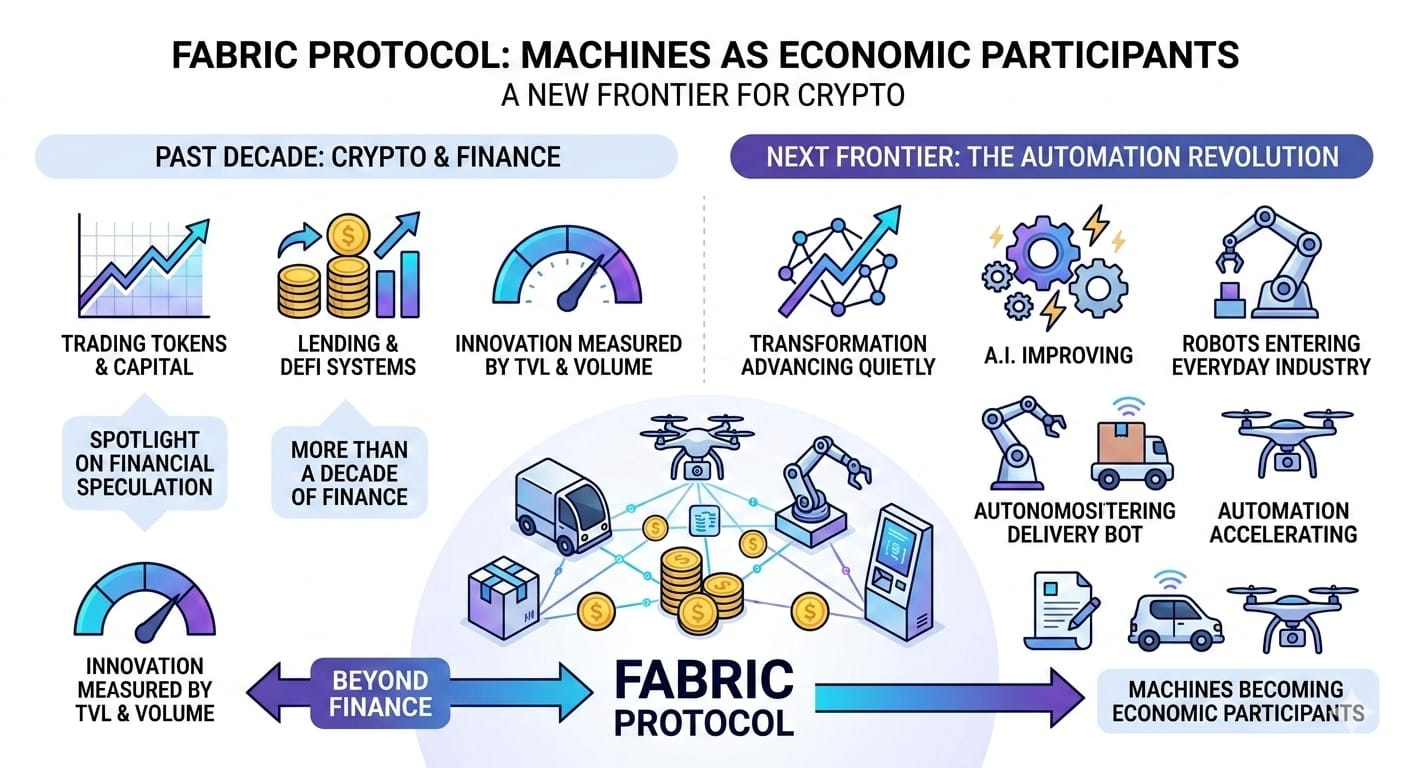
Across logistics agriculture manufacturing and infrastructure inspection robots are already performing meaningful work. Autonomous warehouse systems sort and transport goods with speed and precision. Smart agricultural machines monitor soil health and crop growth. Industrial robotic arms operate continuously in factories. Drones inspect bridges pipelines and electrical grids. These machines are becoming more intelligent each year as AI enhances their ability to interpret data make decisions and adapt to changing environments. However despite their growing autonomy their economic existence remains tied to centralized human systems.
When a robot completes a task today a company invoices on its behalf. When it fails a human supervisor is held responsible. Banks do not provide accounts for machines. Legal contracts do not recognize robotic identity. Payment infrastructure assumes human agency. As automation scales this structure becomes increasingly inefficient. If a robot independently negotiates charging access sells collected data or coordinates with other machines it requires direct settlement mechanisms. It needs identity verification. It needs accountability that functions without waiting for manual oversight.
This is where blockchains begin to look less like speculative platforms and more like infrastructure. A wallet can serve as machine readable identity. Smart contracts can automate payments instantly once predefined conditions are met. Tokens can create incentives and penalties. Staking introduces collateral backed accountability. Transparent ledgers create audit trails that cannot be quietly altered. Governance frameworks allow rule adjustments without central authority. These primitives were initially designed for decentralized finance but they align naturally with the needs of autonomous machines.
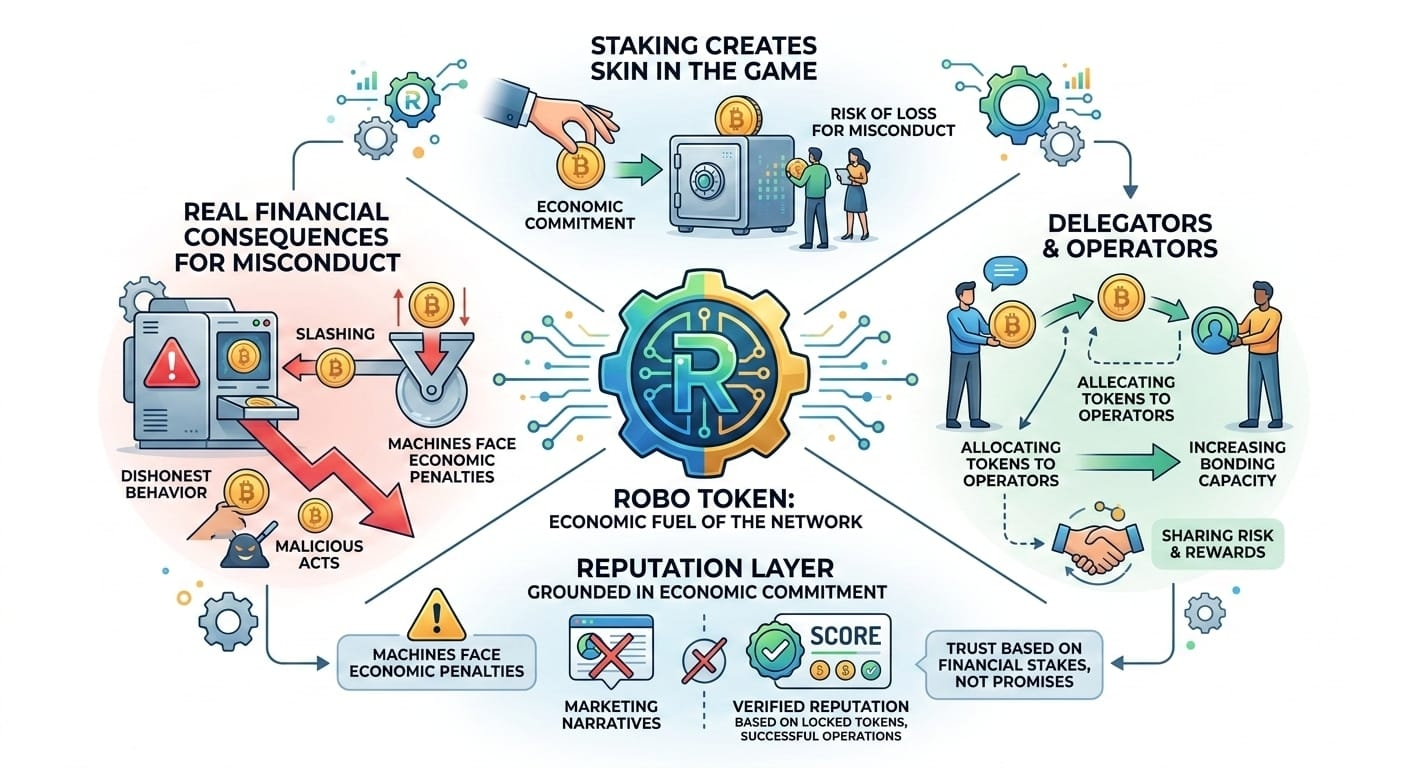
Fabric Protocol is attempting to combine these primitives into an economic coordination layer built specifically for robots. Rather than producing hardware it focuses on creating a network where machines can register on chain identities perform tasks receive payment and stake collateral as a guarantee of honest behavior. Operators who run robots must bond tokens before offering services. If their machines behave reliably they earn rewards. If fraud or persistent failure is proven part of the bond can be slashed.
At the center of the system is the ROBO token which functions as the economic fuel of the network. Its purpose is not merely speculative trading but alignment of incentives. Staking creates skin in the game. Delegators can support operators by allocating tokens to them increasing their bonding capacity while sharing risk. This builds a reputation layer grounded in economic commitment rather than marketing narratives. The model aims to ensure that machines operating within the network face real financial consequences for misconduct.
One of the most difficult challenges in building a robot economy is verification. It is relatively simple to confirm that a digital transaction occurred. It is far more complex to prove that a physical robot delivered a package accurately or collected environmental data truthfully. Fabric addresses this through challenge based mechanisms in which validators monitor activity and can dispute suspicious claims. Instead of verifying every single action at high cost the system incentivizes oversight and rewards detection of fraud. By making dishonest behavior economically irrational the network seeks to maintain integrity at scale.
Fabric also references graph based evaluation methods to reduce manipulation through fake accounts or coordinated activity. By analyzing contribution patterns across the network it becomes harder for operators to inflate rewards artificially. This reflects an understanding that economic design must anticipate adversarial behavior especially when physical world outputs are involved.
The broader context reinforces the relevance of such experimentation. Automation is accelerating due to cost efficiency labor shortages and rapid AI advancement. Venture capital continues to invest heavily in robotics infrastructure and intelligent systems. If machines begin interacting economically on a large scale machine to machine payments could become routine. Autonomous delivery drones might pay charging stations instantly. Agricultural robots could sell verified soil data to analytics platforms. Warehouse fleets might bid for tasks dynamically based on performance metrics. Industrial robots could subscribe to software upgrades that enhance their efficiency.
In this emerging landscape the invisible infrastructure coordinating these interactions becomes critically important. Without embedded accountability automation risks becoming opaque and difficult to regulate. With programmable incentives and transparent audit trails machine activity can operate inside clearly defined economic boundaries.
Of course significant challenges remain. Binding on chain identity securely to physical hardware requires reliable attestation methods. Verification in physical environments introduces complexity and unpredictability. Governance systems must evolve carefully to prevent concentration of power. Regulatory treatment of autonomous machine markets remains uncertain in many jurisdictions. Adoption depends on demonstrating that staking and slashing mechanisms provide tangible operational benefits rather than unnecessary friction.
Yet transformative infrastructure rarely appears obvious in its early stages. The internet was once considered impractical for commerce. Mobile technology faced skepticism about scalability. Cloud computing raised fears about security. Over time these systems became foundational because they solved coordination problems at scale.
The deeper significance of Fabric Protocol lies in its attempt to embed accountability directly into automation. As machines gain greater independence society will demand mechanisms that ensure transparency and enforceable incentives. Designing economic consequences into machine coordination networks may prove more effective than relying solely on external regulation after problems arise.
Crypto began by challenging centralized control over human financial systems. The next phase may challenge centralized control over machine coordination. If robots become productive actors within the global economy they will require programmable identity settlement and governance frameworks that operate continuously and transparently.
The future economy could involve billions of autonomous transactions each day executed by devices negotiating resources exchanging value and verifying outcomes without direct human mediation. In that world blockchains may function less as speculative arenas and more as silent coordination backbones.
Fabric Protocol represents an early attempt to build that backbone. Whether it ultimately becomes the dominant infrastructure or contributes to a broader ecosystem its direction reflects a clear trend. Automation is accelerating. Machines will increasingly transact collaborate and generate economic output. The systems that govern those interactions must evolve alongside them.
When machines begin earning staking and coordinating within transparent networks crypto will no longer be defined solely by finance. It will be defined by infrastructure. And that quiet shift may shape the next era of digital progress.