

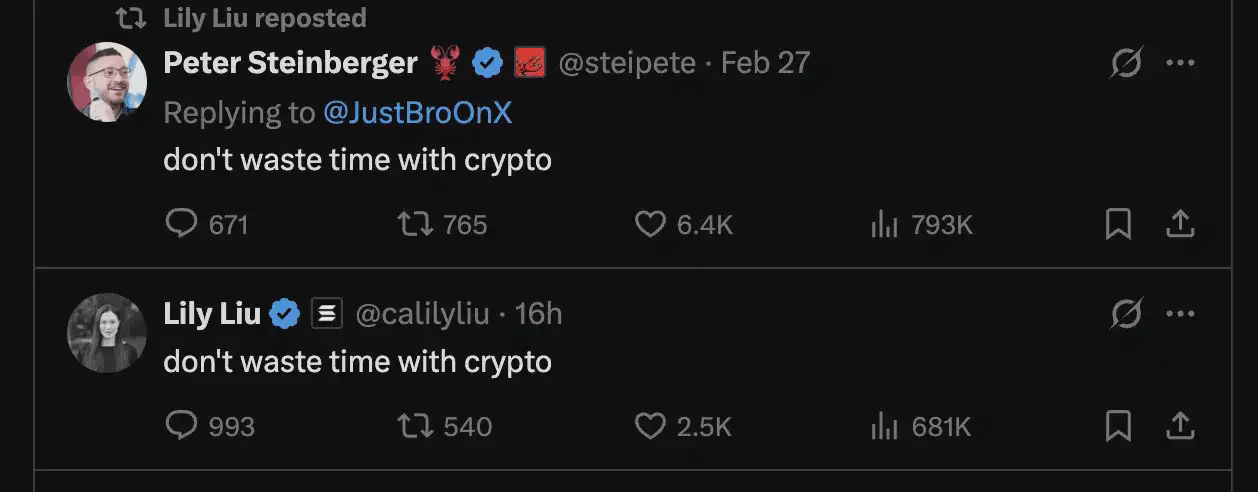
Peter Steinberger, the founder of the open-source project OpenClaw, responded to a user's question on X yesterday, asking, 'What advice do you have for young people in their 20s?' His answer was just one sentence: 'don’t waste time with crypto.' This tweet was subsequently retweeted by Lily Liu, the chair of the Solana Foundation, and she also posted the exact same sentence.
The two tweets combined received over a million views, and a large number of questioning voices quickly appeared in the comments section. Is Lily Liu really fighting back with irony? Or does it mean that the crypto industry has already gone into decline?
Steinberger has reason to detest the industry, but what about Lily?
OpenClaw, its predecessor underwent two name changes from Clawdbot to Moltbot, and officially launched under the name OpenClaw on January 30 this year. The project has currently garnered over 200,000 stars on GitHub, becoming a rare phenomenon in the recent open-source community.
After the project became popular, a large amount of noise unrelated to technological development followed, as speculators flooded into the community urging token issuance, attempting to capitalize on the project's popularity. Thus, Steinberger's extreme aversion to the crypto industry is understandable; he even implemented a comprehensive ban on Discord, where any mention of 'crypto' or 'bitcoin' would lead to immediate bans (regardless of whether it was promotion, spam, or pure technical discussion).
According to CoinDesk, the background and cause of the ban stem from January, when the project was originally named Clawdbot and decided to rename due to a trademark warning from Anthropic. During the brief window of a few seconds when the old GitHub/X account was released to register a new account, someone immediately hijacked the account and quickly launched a fake $CLAWD token on Solana.
The fake token's market value surged to $16 million within hours, but after Steinberger publicly denied it, it plummeted by over 90%, leaving latecomers with nothing. He was subsequently harassed by victims, leading him to speak out: 'Please stop harassing me in the crypto space; I will never issue tokens. Anyone labeling me as a token holder is a scammer!'
In this context, his statement about not wasting time on cryptocurrencies is a direct response to the ongoing harassment, clearly pointing out that it is not a comprehensive denial of cryptocurrencies as a technology or asset class.
Lily's situation is completely different. Under the market's high attention to Steinberger's original post, she chose not only to retweet but also to personally reiterate the same sentence. The external interpretation roughly divides into two categories: one believes it is a pessimistic signal about the industry's current state; the other thinks that the statement itself is ironic, pointing to specific behavioral patterns in the crypto industry rather than the industry as a whole.
But regardless of Lily's original intention, the market-level reaction to this statement has been largely negative. Several industry insiders publicly criticized her, believing that this move is clearly inconsistent with her identity and responsibilities: 'As the chairman of the foundation, it is equivalent to telling holders that what they are betting on is not worth it. Whether it is a joke or not, this signal itself is quite bad.'
However, it must be acknowledged that in the current industry narrative, the rapid issuance of tokens, the creation of short-term wealth effects, and the lack of substantial technological development have long been core issues discussed within the industry. The long-term overdraw of this ecosystem has accelerated the flight of funds and talent, and it is AI that is taking on these resources.
Funds and talent are fleeing, where is the crypto industry headed?
Well-known investor Stanley Druckenmiller mentioned in an interview with Morgan Stanley that the younger generation's interest is shifting from cryptocurrencies to the field of artificial intelligence.
This aligns with the current phenomenon in the crypto industry, where a large number of technical talents and early entrepreneurial capital are concentrating towards AI, and the narrative heat of the crypto market has dropped to freezing point.
Upon careful consideration, the current AI industry is still in the early stages of infrastructure construction and technological capability expansion, characterized mainly by value creation. The technological dividend has not been fully released, the entrepreneurial window is still open, and the return expectations for early participants are relatively clear. The flow of young talent in this direction is a rational response to real opportunities, rather than an active abandonment of cryptocurrencies.
Historically speaking, the development of the mobile internet has also gone through similar stage evolutions. In the later stages of the value creation cycle, when the technological dividend becomes saturated and market competition intensifies, squeezing entrepreneurial returns, capital and attention will begin to seek new outlets. The concentrated explosion of the cryptocurrency market in 2017 coincided with the mobile internet entering its mature phase, which to some extent confirms that the opening of the value redistribution cycle is often accompanied by a new asset class taking on the overflow of capital.
Whether the development cycle of AI will follow a similar path is still inconclusive. However, if we take this as a reference, when the homogeneous competition in the AI market begins to lower overall entrepreneurial returns and market attention begins to flow away from AI, the cycle of value redistribution will truly begin. At that stage, the crypto market, with its low asset thresholds and high liquidity, will still be attractive to the younger generation with limited capital accumulation and will not be permanently ignored due to today's short-term attention shift.
For the crypto industry, the maturation process of any emerging industry cannot bypass this stage: the loss of attention, valuation adjustments, and the clearing of speculative projects are all components of the industrial cycle, not the endpoint.
Tides rise and fall, which is normal; what is truly worth paying attention to is what remains after the low tide.#美以袭击伊朗 #伊朗证实哈梅内伊已死 #Anthropic美国政府争议 #X移除加密禁令 #美国撤离中东公民 $BTC $ETH