
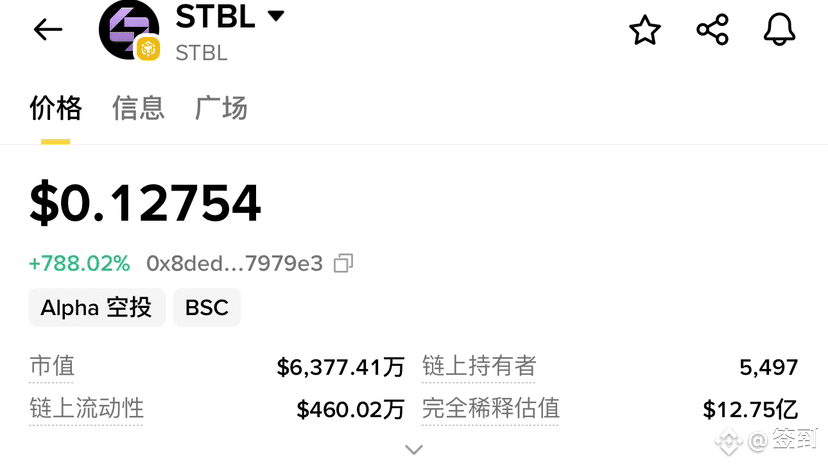
Last night, the stablecoin project launched on Binance Alpha and Kraken, directly staged a 'opening myth':
The price jumped from $0.0168 to $0.2084, a maximum increase of 554%.
24-hour trading volume $367 million, market value briefly surged to $61 million.
Smart money net inflow of $448,000, the top 50 holding addresses increased from 36 to 100 in one day.
Speaking of the underlying reasons? Technological innovation + exchange endorsement + FOMO sentiment (KOL online calls), jointly pushed up this wave of increase.
What is new about it?
The interest income from traditional stablecoins (USDT/USDC) is all eaten by the issuers, and users get nothing.
$STBL used a 'three-token' mechanism that separates principal and interest:
USST stablecoin: pegged at 1:1 to the US dollar, used for payments and circulation.
YLD earnings NFT: captures interest income separately and can also be traded.
STBL governance token: used for community voting, deciding protocol parameters and distribution methods.
Simply put: you can spend stablecoins and also keep the interest income for yourself, no longer being 'exploited' by the issuer.
Moreover, the reserve assets are U.S. Treasury bonds and money market funds (RWA), making their safety more reliable than algorithmic stablecoins. All collateral and yield conditions can be checked on-chain in real-time, with transparency higher than USDT.
Market performance after launch
Surge logic: TGE hype + dual backing from Binance/Kraken + founder's halo (Tether co-founder Reeve Collins endorsing).
Trading is booming: a daily trading volume of $367 million, but the liquidity pool is only $2.9 million, indicating insufficient trading depth, making volatility easy to amplify.
Token distribution: the number of the top 50 addresses has nearly tripled in 24 hours, indicating funds are beginning to disperse, showing that tokens are being rapidly distributed.
Smart money has also entered: 21 tracking addresses net bought nearly $450,000, mostly concentrated on PancakeSwap.
KOL and community voices (consistently optimistic)
Technical analysts: call this 'stablecoin 2.0', with yield separation being a real innovation.
DeFi researchers: optimistic about its model of returning stablecoin interest to users.
Trading faction: believes that the founder's background and support from top exchanges are enough to create a short-term market surge.
The community discussion atmosphere is relatively positive, with hardly any FUD (bearish voices) seen.
Risks and opportunities
Short-term risk:
The current price has dropped to $0.12, and technical indicators show correction pressure, with key support at $0.10.
The liquidity pool is too small ($2.9M against $367 million in trading volume), making it easy to be manipulated by market makers.
Medium to long-term opportunities:
If RWA reserves can be continuously replenished, it can indeed form a differentiated advantage for stablecoins.
Phase 2 will introduce governance and staking, and Phase 3 plans to create an EVM Solana cross-chain bridge, making ecosystem expansion worth looking forward to.
The biggest highlight is: can it really 'play' the user's interest rights rather than just being a fleeting concept hype.
Summary
STBL has solved the old problem of stablecoins through a 'yield splitting' model, gaining backing from top exchanges and market popularity upon launch. The short-term market is explosive, but technical indicators show a risk of correction.
To succeed in the long term, one must rely on RWA asset acquisition capabilities + DeFi ecosystem integration.