
I am 35 years old this year. Ten years ago, I entered the crypto world with only 100,000 as my starting capital and began my career in trading. Now my assets exceed 30 million. There is a very simple method for trading, but this method can almost eat away all profits, so I learned slowly.
How do I make money: I just need three tenfolds to earn 10 million.
First, a basic theorem: In a person's life, you only need to continuously bet three tenfolds to achieve a laid-back lifestyle.
The first step is to prepare 10,000 yuan.
10000-100000 100000-1000000 1000000-10000000
Break down 10 million into 3 tenfolds, look for corresponding opportunities in the first, second, and third tenfolds, repeat profitable operations 100 times in each tenfold, and you can basically handle 10 million. Of course, this method also applies to earning 1 million or even 100 million; the underlying methodology is the same.

With this method, my total position has increased sixfold! Many people become more and more confused as they trade, not because of their poor skills, but because they have too many routines.
[Step 1] Coin selection: only select “main rising trend coins”
The principal cannot be scattered, and you must concentrate your firepower on betting on the "trend + control" currency: breaking through the previous high and starting with large volume: For example, when SOL broke through $25, it increased five times before retail investors reacted.
Leaders in the sub-sectors: MEME, AI, Layer2, avoid pseudo-hotspots that are "old wine in new bottles"
Small circulation, easy to pull up: The market capitalization is between 100 million and 1 billion U, the dealer is easy to control the market, and it is easy to pull up the market.
[Step 2] Rolling strategy: only use profits to increase positions, and the principal only increases and never decreases
500,000 U does not seek to double overnight, but only seeks to proceed step by step:
First transaction: 200,000 trial position, the signal must be clear - breakthrough + large volume (such as PYTH breaking through 0.6)
Stop loss: Cut losses when you lose 10%, don’t talk about feelings, save money
After the profit reaches 50%, increase the position: invest another 300,000 (principal + profit) to catch the main rising wave
After doubling, roll in the whole position: 1 million U will impact 3-5 times, do not be greedy, do not hesitate, take half of the profit when it retreats 15%, and hold the rest to the end
Key discipline: Never increase your position when you are losing, only increase your chips when you are winning.
[Step 3] The Iron Rule of Warehouse Control: Increase your profits 20-fold by controlling yourself, not by being brave
A single coin should not exceed 40% of the total position: at any time, you cannot bet everything on one thing.
Withdraw the principal when the profit doubles: When the profit reaches 1 million from 500,000, withdraw 500,000 as the minimum first, and the stop loss for each transaction shall not exceed 5-10% of the total position: if it falls to the expected position, you will win if you cut it.
Those who truly reach 10 million are never the best at reading candlestick charts, but rather those who can resist temptation and control their hands. The market provides opportunities, but profits belong only to those who have a system, are disciplined, and are ruthless.
You can also roll over your position, but ask yourself: It's not whether you have $500,000, but whether you have the patience and determination to see it through. If you don't want to keep spinning in circles, then let -- lead you in rolling over your position. The current market is a great time to recover and roll over your position.
The right approach + stable execution + a good team leading the charge is far superior to just hustling around on your own! Anyone looking to turn things around will definitely find me.
The following proven cryptocurrency trading model has a winning rate of up to 98.8%. Once mastered, it can help you avoid most pitfalls and make your journey from 100,000 to 10 million more stable.
1. Separate funds and strictly control risks
Divide your funds into five parts, and only use 1/5 of your position at a time. Set a 10-point stop-loss. Even if you make a single mistake, you'll only lose 2% of your total funds. Five consecutive mistakes will only result in a 10% loss. If you're right, set a take-profit of more than 10 points to fundamentally reduce the risk of being trapped.
2. Go with the flow and improve your chances of winning
If you want to further improve your winning rate, the key is to "follow the trend".
In a downward trend, every rebound is often a trap to lure investors into buying more; in an upward trend, every decline is often a golden opportunity to buy low.
Compared with the extremely risky bottom fishing, the probability of making money is much higher if you follow the trend and buy low.
3. Avoid currencies with short-term surges
Whether it is mainstream coins or altcoins, very few can go through multiple waves of major upward trends.
After a short-term surge, it is extremely difficult for the currency price to continue to rise. When there is stagflation at a high level, it will inevitably fall if it is unable to rise further.
This is a simple truth, but there are always people who enter the market with the mentality of "taking a gamble" and end up getting trapped.
4. Use MACD to determine entry and exit signals
Use MACD to assist in decision-making: When the DIF line and DEA form a golden cross below the 0 axis and break through the 0 axis, it is a stable entry signal; when MACD forms a dead cross above the 0 axis and runs downward, you need to decisively reduce your position to avoid profit taking.
5. Refuse to cover losses, only add to profits
"Replenishing positions" has harmed countless retail investors - the more they lose, the more they add, and the more they add, the more they lose, eventually forcing themselves into a desperate situation.
Remember the iron rule: never add to a position when you are losing money, only add to a position when you are making a profit, let the profits roll in, rather than let the losses expand.
6. Volume and price are the key, follow the capital flow
Trading volume is the "barometer of funds" in the cryptocurrency market and is more reliable than simply looking at the K-line.
When the price of the currency breaks through the low level with large volume during consolidation, it is important to pay close attention; when there is stagflation with large volume at a high level, it means that the funds are weak and you need to leave the market decisively.
7. Only trade in the upward trend and don’t waste time
Give priority to currencies that are on an upward trend, as they have a higher chance of winning and are more efficient.
The 3-day line turns upward, which is a short-term rising signal; the 30-day line turns upward, corresponding to the mid-line rise; the 84-day line turns upward, and there is a high probability of the main rising wave; the 120-day moving average turns upward, which is a long-term upward trend.
8. Keep reviewing and adjust strategies in a timely manner
After each day's trading, you must review the market: check whether the logic of holding coins has changed, verify whether the trend is in line with the prediction through the weekly K-line, and determine whether the trend direction has shifted.
Only by adjusting your trading strategy based on the review results can you continuously optimize your operations and avoid repeating the same mistakes.
Let me share with you a set of practical strategies that I have used for many years. The average winning rate has reached 80%, which is a rare achievement in the cryptocurrency trading world.
A trading strategy with a 95% winning rate in the cryptocurrency world (trend line drawing). Once you learn it, you can earn a stable monthly income of 7 figures and an annual income of 8 figures!
It can be said that this chapter is very important and very detailed. It may be a bit difficult to study it for the first time. I hope you can read it repeatedly.
Let's first explain how to draw a line, mainly based on the following three steps:
Confirm the trend, determine the highs and lows, and draw the lines correctly
Let’s look at the first one first, confirming the trend. We have said before that not all structures can use the Fibonacci tool. At least we don’t use it in a volatile market. We only use this tool in a trending market.
So how do you confirm the trend?
Of course, you can use the previous trend line lessons to help you identify a trend. If you can draw a line through two points and have it verified at the third point, then this trend line is a valid trend line.
At this time, you can also confirm this trend with the help of trend lines, which is also a method.
Of course, you can use other tools to judge the trend, such as moving average. There is really no unified standard for this. Today we will use another method to confirm the trend, which is more concise, that is, using EMA200.
EMA (Exponential Moving Average), also known as MA, is simply the sum of the daily closing prices and divided by the number of days.
EMA is different. It has weight. The meaning of weight is that yesterday's price has a more important impact on today, and the price of the day before yesterday also has an impact on today, but the impact is not as powerful as yesterday's price. Then the impact of the price of the day before yesterday on today is smaller than that of yesterday and the day before yesterday.
The EMA moving average is smoother than the MA moving average, and I personally prefer to use EMA.
Of course, we will give a detailed introduction to the detailed usage and differences between MA and EMA in the moving average chapter.
We use EMA200 to judge the market trend. Let's first look at the following Figure 2.4-17.
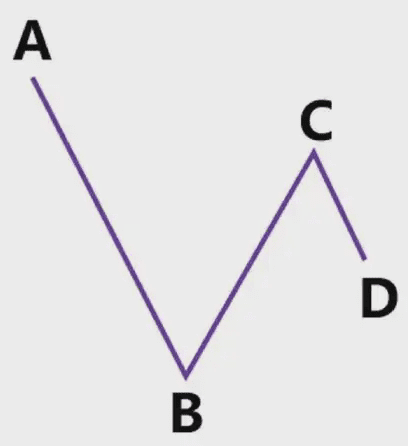
Figure 2.4-17
We can see that the price dropped from high point A to low point B, and then rose to high point C. However, C did not break through the previous high point A. At this time, the price reached position D. How should we draw it? Should we draw it based on the high and low points AB or BC?
At this time, it is very simple. We add the EMA indicator and change the parameter to 200. As shown in Figure 2.4-18, it represents the setting of EMA200.

Figure 2.4-18
If the price is circling around EMA200, as shown in Figure 2.4-19,
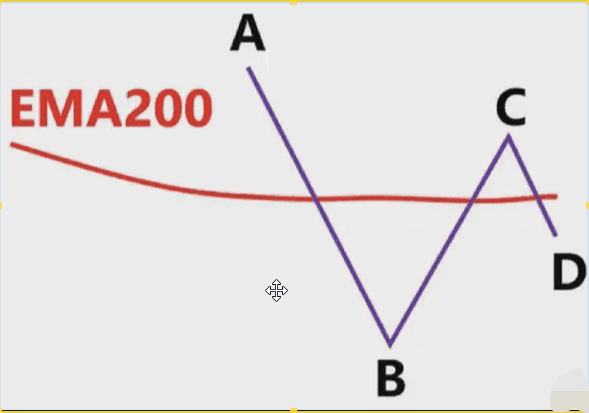
Figure 2.4-19
Then we believe that the current market is a volatile or disorderly market, and we will not participate in this type of market.
If the price is above EMA200, then we believe that the current market trend is mainly upward, as shown in Figure 2.4-20.
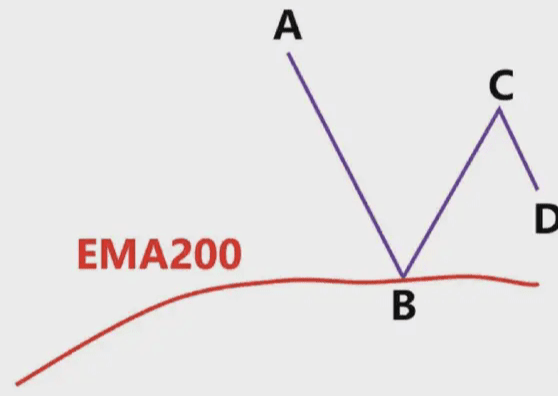
Figure 2.4-20
At this time, we should draw the Fibonacci retracement line based on the high and low points to observe the price reaction when it pulls back to the 0.382-0.618 area, so as to make corresponding strategies.
If the price is below EMA200, then we believe that the current market trend is mainly downward, as shown in Figure 2.4-21.
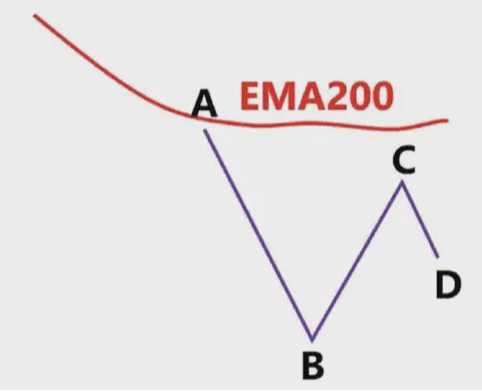
Figure 2.4-21
At this time, we should draw the Fibonacci retracement line based on the high and low points to observe the reaction when the price rebounds to the 0.382-0.618 area, so as to make corresponding strategies.
After confirming the trend, we enter the second step, confirming the highs and lows, that is, how to find the highs and lows.
Because drawing Fibonacci areas is relatively subjective, if you define the high and low points differently, then your Fibonacci areas will definitely be different, which will inevitably lead to different support and resistance areas, which may cause misjudgment. So how should you find the high and low points?
Let's assume that the market is rising, as shown in Figure 2.4-22. What should we do?
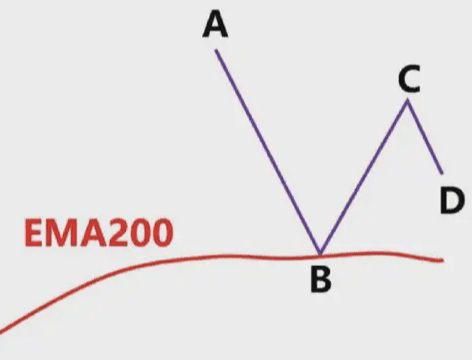
Figure 2.4-22
First of all, we cannot directly connect the high and low points of the band BC and then draw the Fibonacci.
At this time, the price has been falling from the high point C to point D. At point D, it may fall or rise. Let's first consider the assumption of a fall.
Then we need to draw the Fibonacci based on the previous band high point A and the previous band low point, and then observe whether the area of point B is the 0.382-0.618 position area of this Fibonacci retracement.
If area B is in the callback area of 0.382-0.618, as shown in Figure 2.4-23,
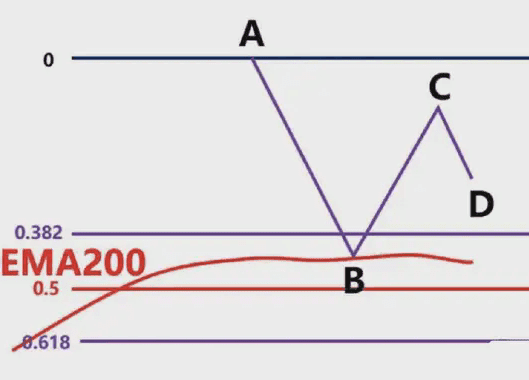
Figure 2.4-23
Then, at this time, a second test of the band low point B may be done, that is, the previous low position of B will be tested again to form a double bottom pattern, and then rise directly.
Remember, double tops and bottoms are more powerful when they are in the direction of the trend.
In other words, we need to look for double bottoms in an upward trend and double tops in a downward trend.
Therefore, we need to draw a horizontal support line at point B, as shown in Figure 2.4-24. When the price reaches this area, we will see whether the price behavior will form a double bottom.
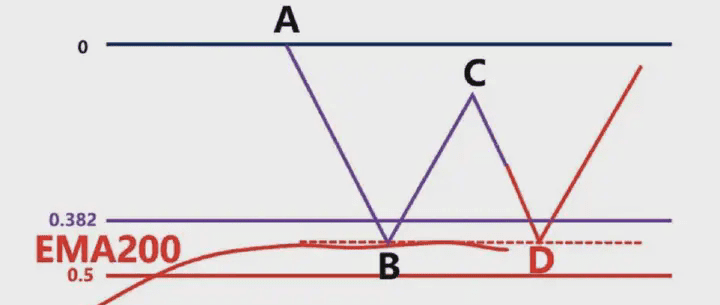
Figure 2.4-24
If area B is not in the callback area of 0.382-0.618, but above 0.382, that is, above the mild callback, as shown in Figure 2.4-25,
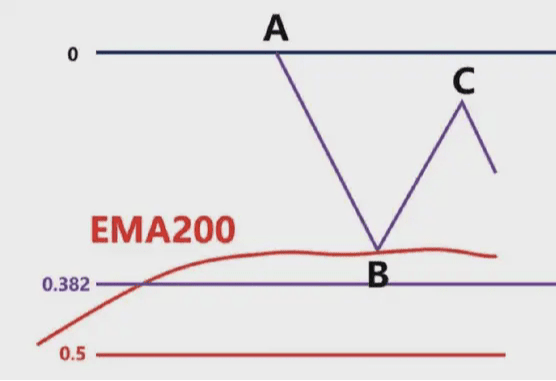
Figure 2.4-25
At this time, we also need to draw a horizontal support line at point B. The price may be the same as above, and undergo a second test at the low point B of the band to form a double bottom pattern, and then rise directly.
It is also possible that the price will fall below the support area to D, forming an equal distance between AB and CD, and D will just call back to the Fibonacci 0.382-0.618 area, and then continue to rise, as shown in Figure 2.4-26.
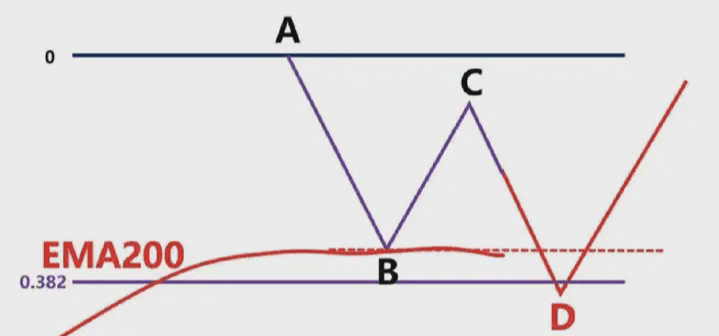
Figure 2.4-26
In other words, the callback at this time is not a simple callback, it is a two-stage equidistant callback.
Because traders who shorted at point C will, based on the principle of equidistant lines AB and CD, immediately close their positions at point D. Shorts will then be exhausted, bulls will continue to push, and prices will continue to rise. Of course, a three-stage correction is possible, followed by further price increases. However, as long as the trend remains intact, we should follow the trend and trade with it.
If area B is not in the 0.382-0.618 range, but below 0.618, that is, it is in a deeper callback, as shown in Figure 2.4-27,

Figure 2.4-27
That indicates a deep correction has occurred, which means that the upward momentum is insufficient and the buyer's power has become somewhat weak. At this time, the seller will also realize this situation, so the seller may intervene in the market.
At this point, we also need to draw the horizontal support line at point B. We can pay attention to the reaction when point C falls back to this horizontal support position, as shown in Figure 2.4-28.
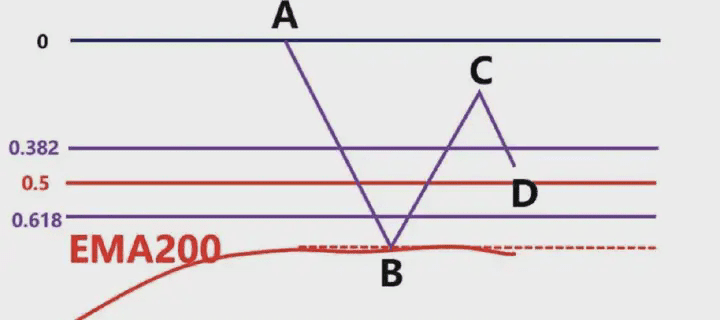
Figure 2.4-28
As we have said many times before, before the market reverses, we should follow the trend, because following the trend is always the easiest way to make money.
If the above point B is broken, a range consolidation pattern may occur.
At this point, we need to pay attention to the price performance of the horizontal support area drawn by the low point before the band low point B. These will be explained in detail in subsequent courses. Here we mainly talk about how to find the high and low points of the band.
The situation we discussed in the above figures is that the CD segment did not stop falling after reaching point D, but continued to fall, and the response strategy we made.
What if there is no decline at point D but an increase, how should we draw the high and low points of the band?
As shown in Figure 2.4-29,
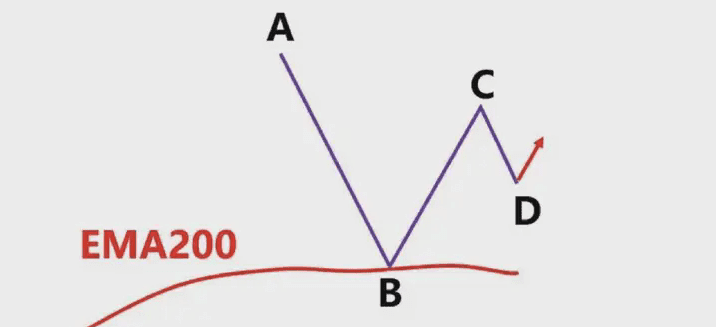
Figure 2.4-29
At this time, we should draw a horizontal resistance line from the previous band high point A, and wait for the price to break through the previous band high point A.
If the price breaks through the previous swing high A and then creates a new swing high E, and then falls, we can draw the Fibonacci area with the swing low B and the swing high E, and observe the price behavior reaction between 0.382 and 0.618, as shown in Figure 2.4-30.

Figure 2.4-30
At this time, if the horizontal resistance line just drawn at point A is also in this area, regional resonance will be formed, and we must pay close attention to this area.
Of course, when the price breaks through the previous band high point A, it may be blocked and fall back, and then break through again to form a dense range, as shown in Figure 2.4-31. At this time, it is a position where momentum is accumulating and waiting for an outbreak.
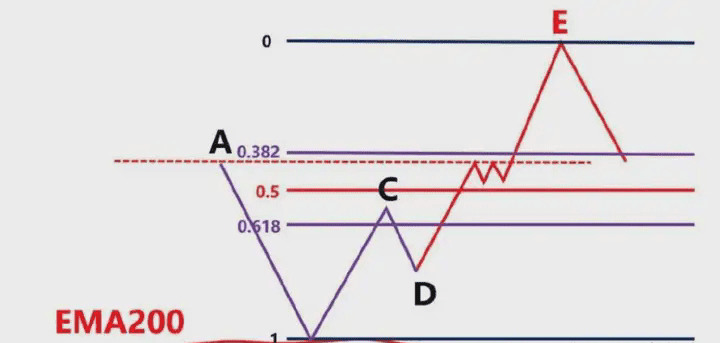
Figure 2.4-31
The most important thing is to see whether it can eventually break through and form a new high point. After the breakthrough, we can find the high and low points to draw the Fibonacci area.
So, the above is the whole process of how to confirm the high and low points of the band in an upward trend.
Let’s assume that the market is falling, as shown in Figure 2.4-32. What should we do?
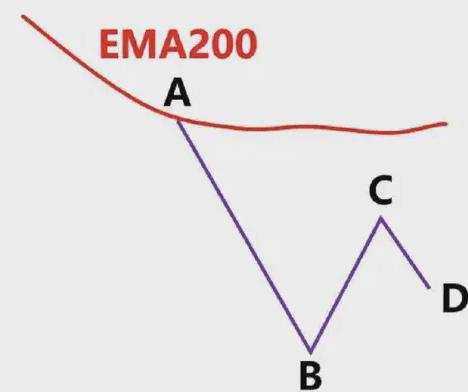
Figure 2.4-32
First of all, we cannot directly connect the high and low points of the band BC and then draw the Fibonacci.
At this time, the price has fallen from the high point C to point D. At point D, it is possible for it to rise or fall. Let's first consider the assumption that it will rise. How should we draw the Fibonacci area?
At this time, we need to draw the Fibonacci area based on the previous band high point A and the previous band low point B, and then observe whether the position of point C is in the 0.382-0.618 position area of this Fibonacci retracement.
If the position of C is in the rebound area of 0.382-0.618, as shown in Figure 2.4-33,
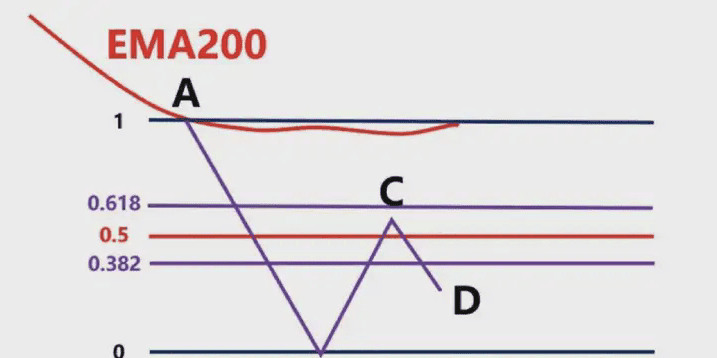
Figure 2.4-33
Then, at this time, a second test of the band high point C may be made, that is, the previous high position of C will be tested again, forming a double top pattern, and then falling directly.
That is what we said before, we need to look for double bottoms in an upward trend and double tops in a downward trend, and we must remember to trade with the trend.
Therefore, we need to draw a horizontal resistance line at point C, and then wait for the price to reach this area, observe the price behavior, see if a double top pattern appears, and then decide how to enter the market, as shown in Figure 2.4-34.
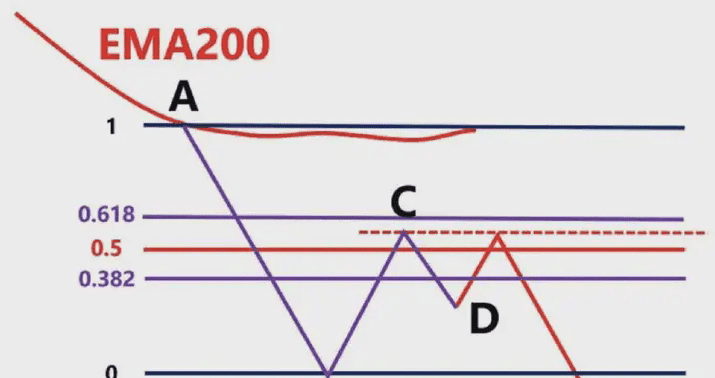
Figure 2.4-34
If area C is not in the 0.382-0.618 range, but above 0.382, that is, above the mild rebound area, as shown in Figure 2.4-35, what should we do at this time?

Figure 2.4-35
At this time, we also need to draw the horizontal resistance line at point C. The price may be the same as above, and conduct a second test at the high point C of the band, forming a double top pattern, and then directly fall, as shown in Figure 2.4-36.
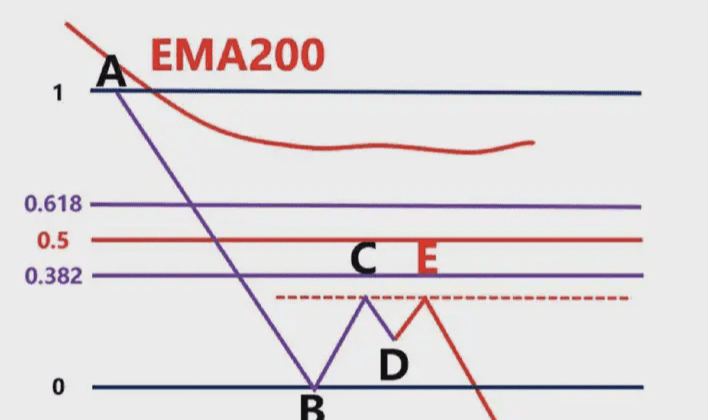
Figure 2.4-36
It is also possible to break through the resistance area to position E, forming equidistant BC and DE, and the rebound position of E just reaches the Fibonacci 0.382-0.618 area, and then continue to fall, as shown in Figure 2.4-37.
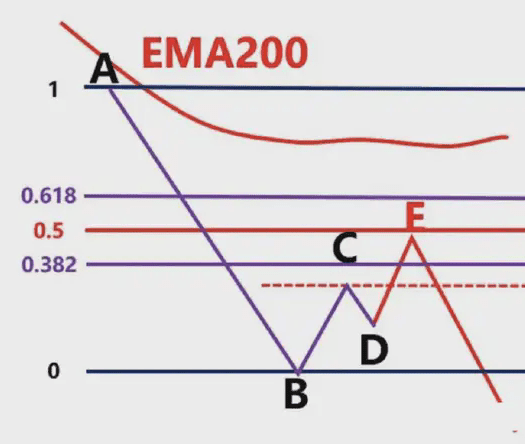
Figure 2.4-37
In other words, the rebound at this time is not a simple rebound, it is a two-stage equidistant rebound.
Because traders who go long in the short term at point D will directly close their positions with profits at point E based on the principle of equidistant lines between BC and DE. The bulls will be exhausted, the bears will continue to exert their strength, and prices will continue to fall.
Of course, it is also possible to form a three-stage rebound and then continue to fall, but as long as the trend is not broken, we should follow the direction of the trend and trade with the trend.
If the position of C is not in the 0.382-0.618 area, but below 0.618, that is to say, it belongs to a deeper rebound, as shown in Figure 2.4-38,
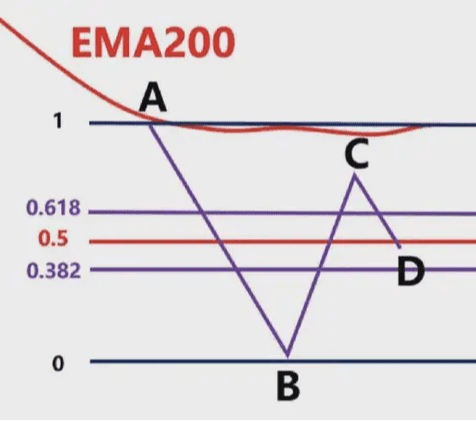
Figure 2.4-38
This indicates that there has been a deep rebound in the decline, which reflects the lack of seller power and may cause market fluctuations or reversals.
At this point, we draw the horizontal resistance line at point C. We can pay attention to the reaction when the price rebounds to the horizontal resistance position, as shown in Figure 2.4-39.
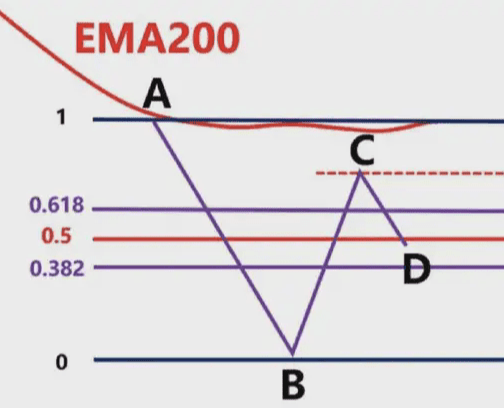
Figure 2.4-39
As mentioned many times before, if the market has not reversed, we should follow the trend, because following the trend is always the easiest way to make money. We should pay attention to whether it will form a double top, as shown in Figure 2.4-40.
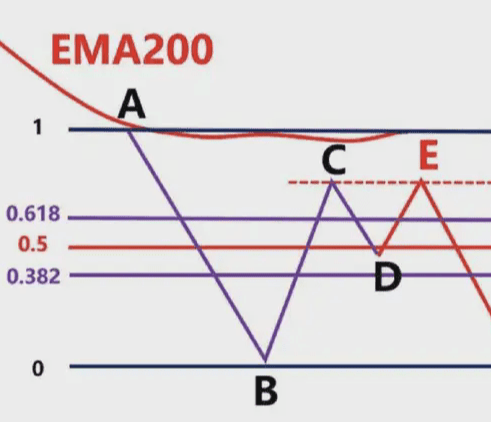
Figure 2.4-40
Therefore, it is possible that it will form a double top at the resistance line drawn at the high point C and then continue to fall. Of course, it is also possible that it will directly break through this resistance line. If point C is broken, we will focus on the band high point A, draw a horizontal resistance line through A, and then observe the price reaction near this resistance line, as shown in Figure 2.4-41.
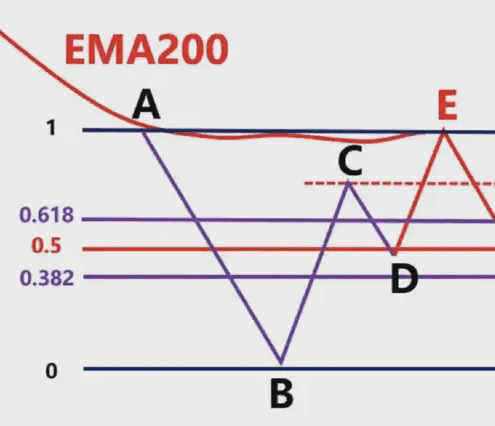
Figure 2.4-41
It is possible that it will enter a range consolidation pattern, or reverse, or it may continue to fall after consolidation. These are all unpredictable. What we have to do is to pay close attention.
The above figures mainly assume several situations where the price rises at point D. If the price does not rise at point D but continues to fall, as shown in Figure 2.4-42, how should we find the high and low points of the band?
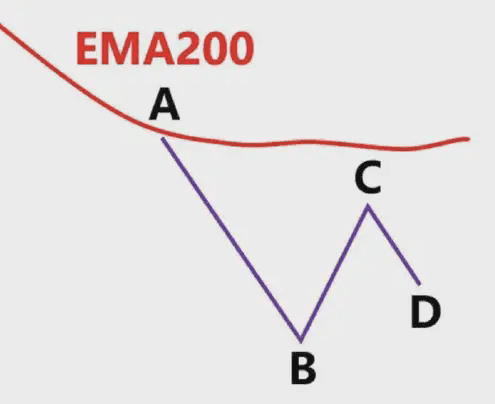
Figure 2.4-42
At this time, we should draw a horizontal support line with the band low point B, wait for the price to fall below the band low point B, and then create a new band low point E.
At this time, we can draw the Fibonacci area with the band high point C and the band low point E, and observe the price behavior reaction between the 0.382-0.618 area, as shown in Figure 2.4-43.
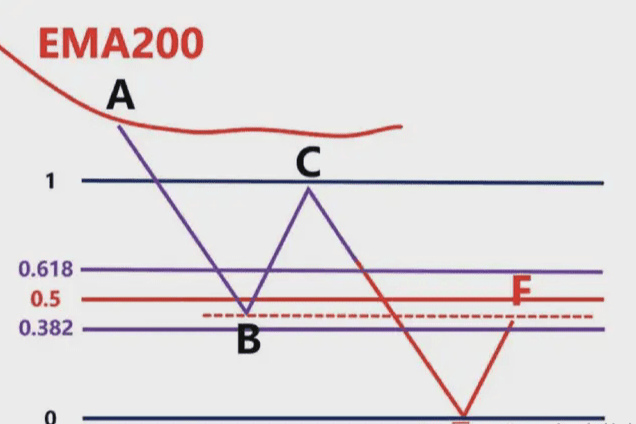
Figure 2.4-43
At this time, if the horizontal support line just drawn at point B is also in this area, regional resonance will be formed, and we must pay close attention to this area.
Of course, when the price falls below the previous band low point B, it may support a rebound, and then fall below it again, forming a dense range, as shown in Figure 2.4-44. At this time, it is a position that is accumulating momentum and waiting for an outbreak.
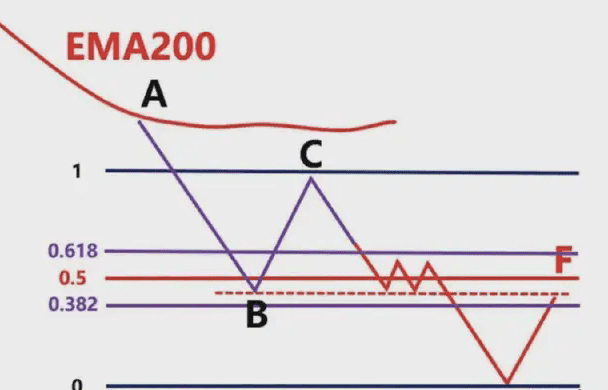
Figure 2.4-44
The most important thing is to see whether it can eventually fall below and form a new low point, then we can draw the Fibonacci area in this way.
The above is the whole process of how to find the high and low points of the band in a downward trend.
Now that we have determined the trend and confirmed the high and low points of the band, how do we draw it correctly?
It's very simple. If it's an upward trend, the rule for drawing lines is to first find the low point of the band, then the high point of the band, that is, draw from bottom to top. At this time, we can see that 1 is at the bottom and 0 is at the top. If you find the high point of the band first, then the low point of the band, the numerical display of the graph you draw will be different, as shown in Figure 2.4-45.
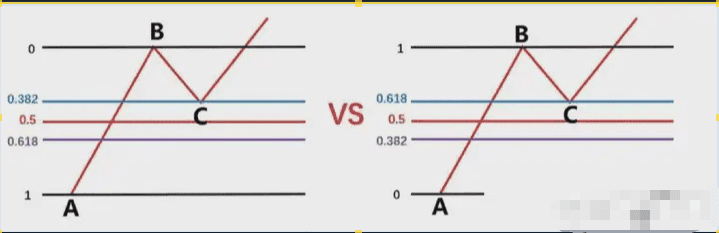
Figure 2.4-45
Obviously, the left side is correct, and the right side is the opposite. Some people don't pay attention when drawing, and draw very casually, which will lead to bad drawing habits. So in the early stages of learning, try to learn the correct habits, otherwise it will be difficult to change them later.
If it is a downtrend, the line drawing rule is to find the high point of the band first, then find the low point of the band, that is, draw from top to bottom. At this time, we can see that 0 is at the bottom and 1 is at the top. If you find the low point of the band first, then the high point of the band, the numerical display of the graph you draw will be different, as shown in Figure 2.4-46.
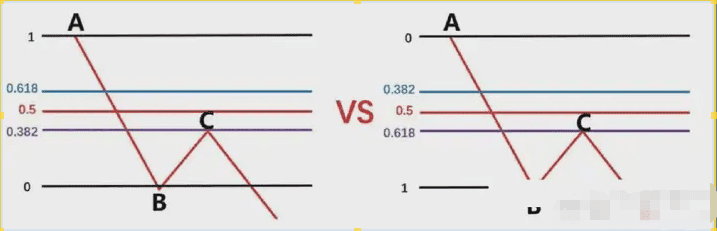
Figure 2.4-46
Obviously, the left side is correct, and the right side is the opposite. So the above is the detailed process of how to draw Fibonacci.
Then there is a question here, that is, when connecting high and low points, should we connect the shadows or the entities?
My personal understanding is that it is to connect the highest point and the lowest point, so it is naturally to connect the shadows, not the entities.
Finally, let's take a look at the explanation of the real market chart to deepen our impression, as shown in Figure 2.4-47.
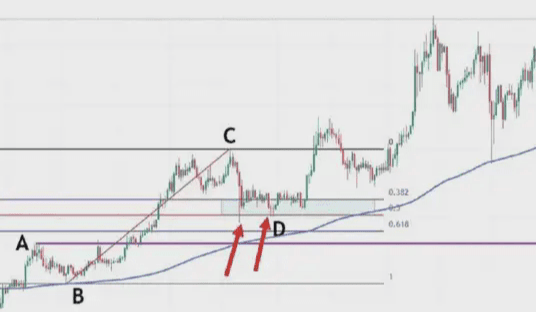
Figure 2.4-47
The blue line in the figure is EMA200. We see the high point A and the low point B. At this time, the price is above EMA200. We only go long and not short. We draw a purple horizontal resistance line with the high point A.
We see that the subsequent price directly breaks through A to reach the high point C. We draw the Fibonacci area with the low point B and the high point C, and then observe the performance of the price returning to the 0.382-0.618 area, which is the light green area in the figure.
We see that the price forms a double bottom in the area marked by the red arrow, and at the same time forms a small dense range at the bottom on the right. We can enter the market directly when it breaks through the top of the range. Of course, you can also choose other entry methods.
Let's look at another chart, as shown in Figure 2.4-48.
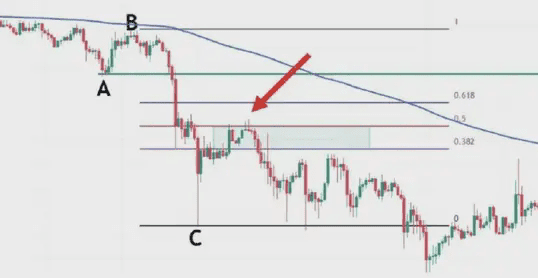
Figure 2.4-48
The blue line in the figure is EMA200. We see the low point A and the high point B. At this time, the price is below EMA200. We only go short and not long. We draw a green horizontal support line with the low point A.
We see that the subsequent price directly falls below A to reach the low point C. We draw the Fibonacci area with the high point B and the low point C, and then observe the performance of the price returning to the 0.382-0.618 area, which is the light green area in the figure.
We see that the price forms a double doji (DD) signal in the 0.5 area of Fibonacci, at the position marked by the red arrow. At the same time, it forms a miniature double top with a small high point on the left. This is an entry signal. Of course, you can also choose other entry methods. The above is about the drawing method of Fibonacci. I hope you can practice more and master it.
I am Lao Qi, and I am very happy to meet you all. Lao Qi focuses on ambush in the Ethereum contract spot market. There is still room in the team, so please get on board quickly and help you become a banker and a winner.