
To be honest. The attention span in the cryptocurrency world is shorter than that of a goldfish. We are constantly chasing shiny new things—the latest AI agents, the newest meme coins, the next "DePIN" craze. We spend so much time staring at price charts that we forget to look at the ground beneath our feet. And now, the ground has cracked.
We live in a data paradox. The information we create is more than any generation in human history, yet we feel completely powerless to control it. Our identities, browsing habits, financial histories—all scattered across the islands of tech giants, who then "rent" our data back to us.
We have accepted that "identity theft" or "data sold without consent" is just the cost of being online. This is the slow erosion of privacy, and we are all numb to it.
The current system is not just broken; it is predatory. In this model, you are the product, and the so-called "security" is just a facade.
Look at the traditional web. Your "identity" is just a patchwork of usernames and passwords, practically a honeypot for hackers. Now look at Web3—we swung the pendulum to the other extreme. We tell users: "Here’s your mnemonic phrase, don’t lose it, good luck." This is indeed pseudonymous, but also clunky and unforgiving. We solved the asset custody problem but created a user experience crisis.
We need a system that is by default secure, designed to protect privacy, and also user-friendly. We need that missing layer.
Fabric was built for this.
If you haven't heard of them yet, don't worry—most people haven't either. And that is precisely why they might become the most underrated narrative of 2026. Fabric is not just another L2 or Rollup competing for the lowest transaction fees. What they are building is a foundational layer for verifiable computation and private credentials.
Think of Fabric as the world's most secure notary, librarian, and data processor, all rolled into one decentralized protocol. They are not trying to make your money move faster; they want you to verify who you are and what you own without exposing everything to the world.
Alright, let's set aside the jargon for a moment. How does it actually work?
Fabric uses zero-knowledge proofs (ZK) not just for scalability, but for privacy. Imagine this: you need to prove you are over 21 at a bar. In the old world, you would hand your driver's license to the bouncer. Now they know your full name, address, exact date of birth, and height. They know everything.
In the world of Fabric, you just scan a QR code. The protocol generates a cryptographic proof stating: "Yes, this person is over 21." That's it. The bouncer gets a confirmation of "yes," while your home address remains protected.
They are creating a world where you can prove a statement is true (I have enough funds, I am a member, I am of age) without revealing the underlying data. This is the promise of "owning your identity" that we have heard about for a decade, now finally realized with workable mathematics.
Let me tell you what this means for ordinary people.
I have a friend who runs a small online community—a paid Discord group for artists. He spends hours manually vetting new members, chasing bots, and worrying about the privacy of those high-profile members. He tried using NFTs for access control, but the community culture is resistant to "gas wars" and complicated wallet setups.
With Fabric, he can create a system that allows members to prove they are unique humans (proof of personhood) and that they have paid, without exposing their crypto wallets or real email addresses in a public chat. This lowers the barrier to entry for users and enhances the security for hosts.
This is not science fiction. This is usable infrastructure.
So, why is it said to be underrated?
Currently, the market is highly focused on liquid tokens and AI memes. Funds are chasing 100x leverage games rather than infrastructure. But infrastructure is what underpins a bull market.
Fabric's token economic model is not designed to make a few insiders rich on day one. It is designed to align the interests of validators and users. As more applications require verification of private data (and they absolutely will in a world filled with AI deepfakes), the demand for the Fabric computation layer will increase.
By 2026, when the hype cycle ends and the real builders remain, the market will rotate back to fundamentals: revenue, usage, and real applications. Fabric is perfectly positioned for this rotation.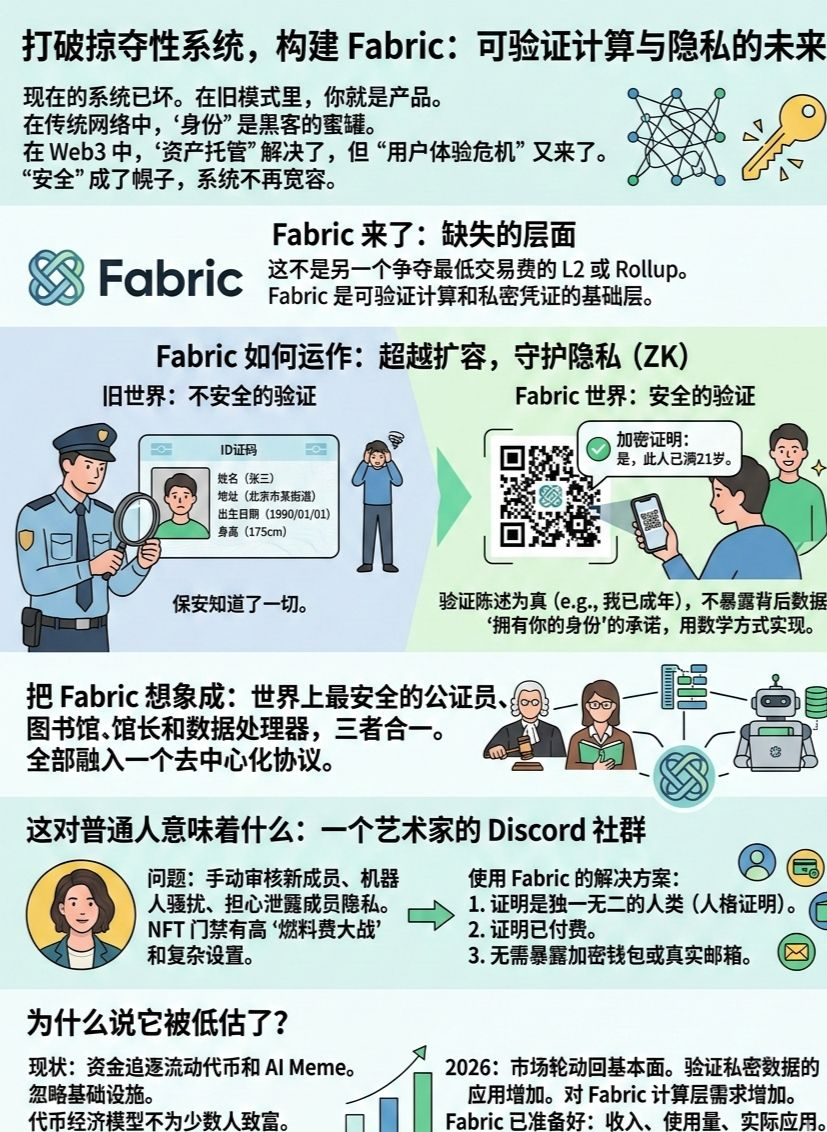
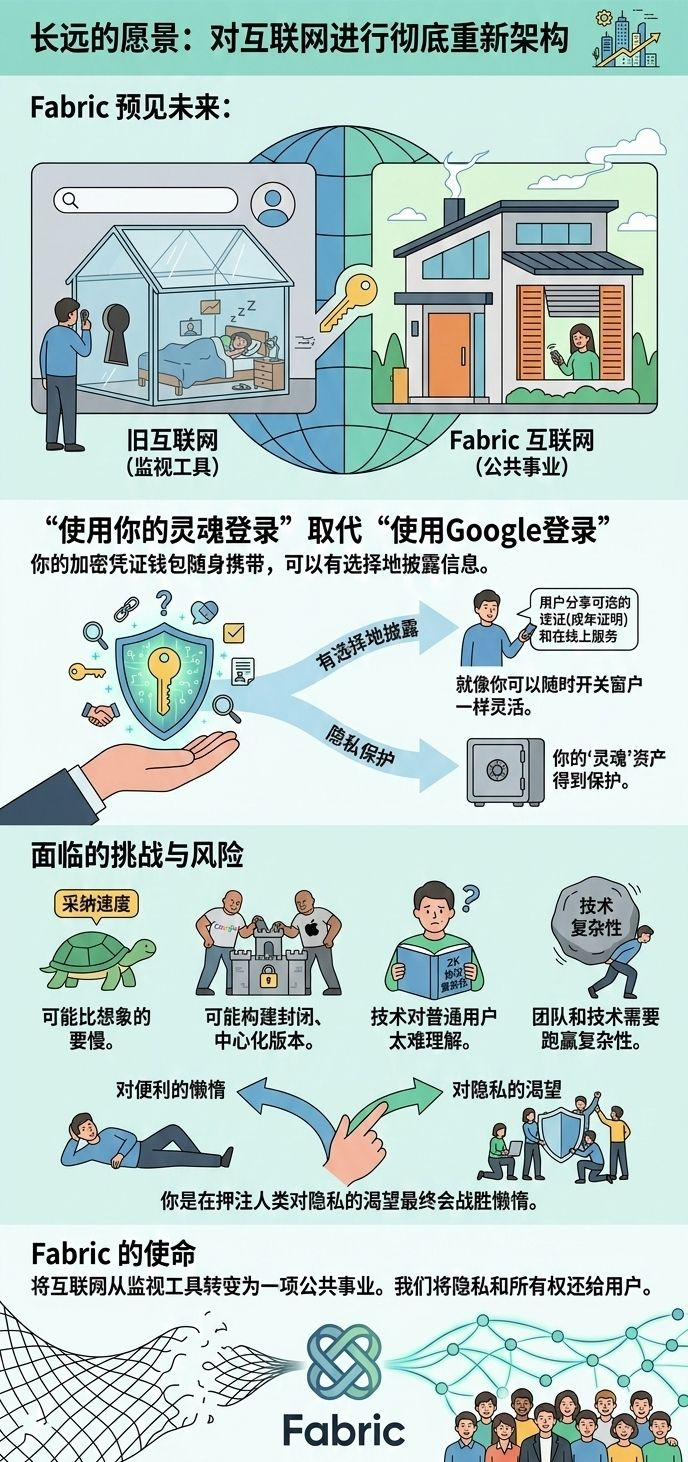
The long-term vision is a complete re-engineering of the internet.
Fabric envisions a future where "using Google login" will be replaced by "using your soul to log in." You carry a cryptographic credential wallet that can selectively disclose information. It's the difference between living in a glass house and living in a house where you can open and close windows at will.
This is about transforming the internet from a surveillance tool into a public utility.
Listen, I'm not saying this is a done deal. We're still in the early stages. The risk is that adoption may be slower than we think. The risk is that Google or Apple might build a closed centralized version (even though they will never give you true ownership). The risk is that this technology might be too hard for the average user to understand.
But this is the defensive posture you must take. You are betting that the team and technology can outpace the complexity. You are betting that humanity's desire for privacy will ultimately overcome the laziness for convenience.
So, while others are focused on the next Dogecoin that will skyrocket 1000 times, maybe it's time to look a little further.
Look at the foundational layer. Look at those tools that can truly protect your digital self—when the next major data breach occurs (and it will happen), these tools will come in handy. Fabric is building a way out of the walled garden.
Don't wait for the headlines to tell you it's important. By then, this narrative will no longer be underrated. It will become the only topic everyone is talking about.
Market Reference:
In a market cycle where "AI verification" and "anti-bot" mechanisms become the hottest trends, Fabric provides the cryptographic backbone to make them credible.
Core Value: Sovereignty.
Economic Incentive: Validators are rewarded for maintaining the integrity of the chain, aligning network security with token value.