
Why do many people get poorer the more they struggle, and the more they trade coins, the more they return to zero?
The answer is heart-wrenching: because you want to make money too much.
In the cryptocurrency circle, which is a 24-hour casino that never closes, this mindset is even more deadly. It seems we all suffer from severe FOMO, wishing to enter today, become a hundred times richer tomorrow, and achieve financial freedom the day after.
Where's the result? Not only did I not get rich, but even the principal has become the dealer's meal.
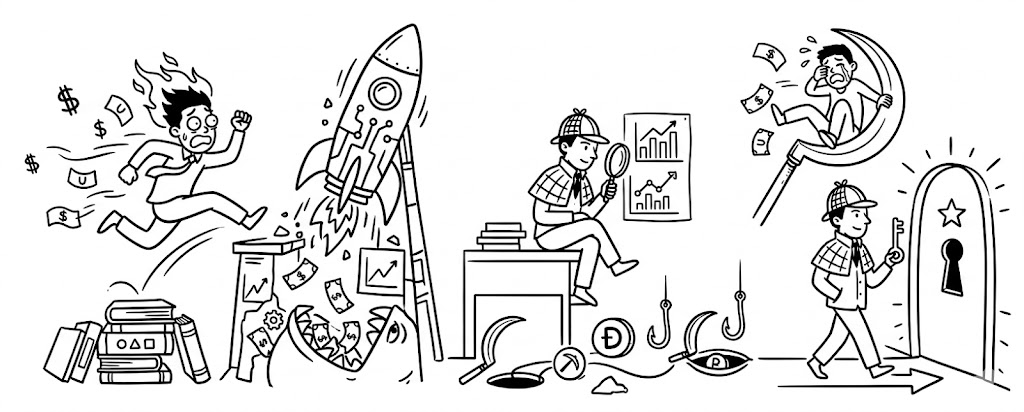
Don't be that player who gives away kills right at the beginning.
Have you ever played games?
If you are a newbie, what will you do when you first enter the game? You definitely won't go directly to attack the big BOSS with a wooden sword. You will honestly complete the novice tasks, fight small monsters, and familiarize yourself with the map.
This is the normal logic.
But once in the blockchain world, many people's IQ suddenly goes offline. They completely skip the beginner's village; some don't even understand what a public chain is or what a smart contract is, yet they fantasize about clearing the game directly.
I have a friend who heard that cryptocurrency is booming and saw others doubling their money in a day. In a rush, he immediately converted all his savings into U and jumped into the contract market with high leverage. What happened? He couldn't even understand the candlestick chart and only shouted trades in the group. After a month of turmoil, not only did he blow up his principal, but he also ended up in debt.
This is a typical case of wanting to run before learning to walk. In this circle, there are almost no opportunities to dive in and make money right away; if there are, you are the one being picked up.
When you are in a hurry for answers, scams come.
Why do shitcoin projects, Ponzi schemes, and signal callers always have buyers?
Because they have captured your urgent psychology. When a person is eager for quick success, the brain automatically shields risks, only wanting to hear one thing: What is the wealth code?
At this time, any answer that seems like a shortcut can make you obediently part with your money.
Look at those who rush into shitcoins; they see someone in the group shouting about a certain token, claiming it's the next SHIB, and immediately go all in. What happened? Buying at the peak, the pool was withdrawn, liquidity locked, and no matter how fast you run, you can't outrun the dealer's mouse.
You think you are investing in the future, but you are just a pawn in the project team's business model. The scythe cuts those who want to take shortcuts and find signal callers.
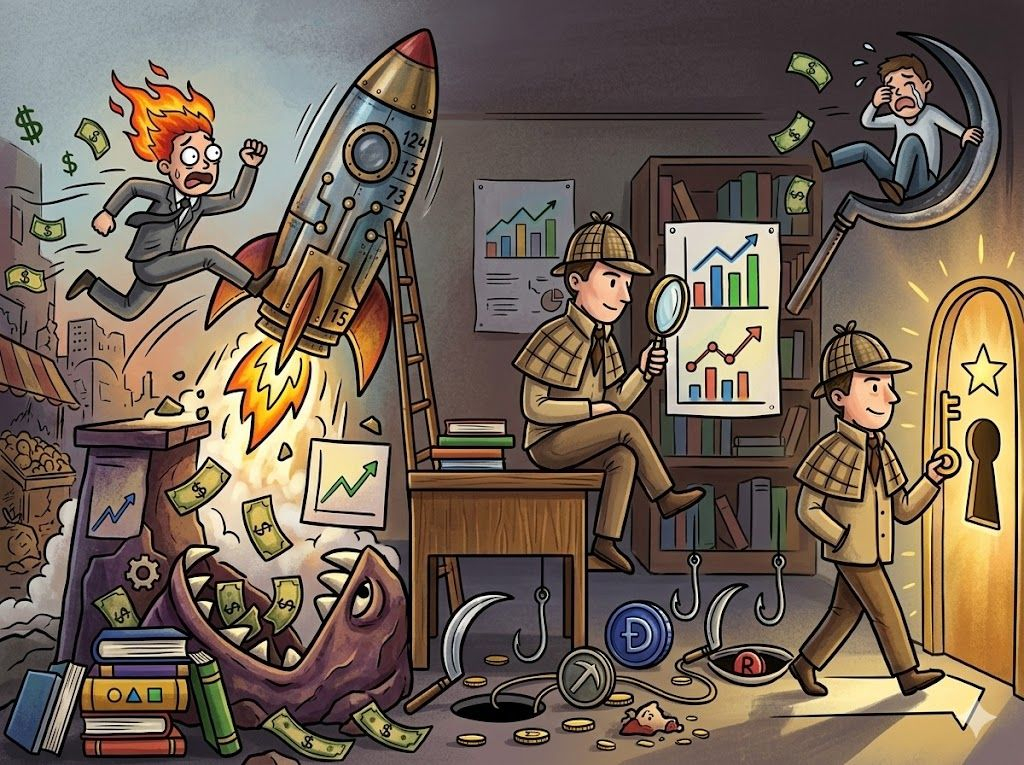
The way of the experts: first be a detective, then hit the confirmation button.
Real experts do things in reverse order. Ordinary people feel excited when they see a surge, while experts remain calm.
There is a big boss in the crypto circle who, before heavily investing in any project, did something that seemed like a waste of time.
For an entire month, he didn't invest a single cent. Every day he did one thing: watch project information, check on-chain data, analyze token economic models. He kept an eye on the project's wallet address to see if the tokens were unlocked or if there were any unusual movements; he lurked in Discord and Telegram groups to see if the community's activity was real or just bots.
Others laugh at him for missing the market, but he remains unaffected.
What happened? When others cried out because they blindly invested in shitcoins that went to zero, he precisely avoided countless scam projects. When he finally took action, it was a hit, with substantial profits. He avoided 99% of the traps and only made money from that 1% certainty.
That month of research helped him preserve hundreds of thousands of principal.
Three soul-searching questions before entering the market.
Therefore, if you want to enter the crypto world or any new industry, first hold back that restless heart and give yourself a period of calm.
During this period, clarify three core issues:
How does money flow? How does the project make a profit? Does the token have application scenarios? Or is it purely relying on later participants to take over?
What did the winners do right? Are those who make money relying on luck or understanding? How long have they held their positions?
Where do losers die? Is it from high leverage or from the fund's exit?
Making money cannot be rushed.
Many people desperately go all in, losing even their underwear in the end, while smart people quietly study the cycles.
Slow, sometimes, is fast. We make money to live, not to offer ourselves to the project team. Understand the rules before taking action to get the ticket to financial freedom.