
We have all seen scenes like this: a shiny, expensive humanoid robot stands in the laboratory, surrounded by engineers holding laptops. It successfully takes a step without falling. Everyone claps and cheers. Meanwhile, a worker in a warehouse in Missouri has just moved his ten thousandth box today, and his back is starting to hurt.
There is a huge gap between the laboratory demonstrations and the real world. This gap is not just about smarter artificial intelligence — it concerns the physicality of robots.
For decades, robotics has been a game for the wealthy. If you want to build a decent robot, you need a machine shop, six figures of funding, and a PhD in control theory. Most existing platforms are monolithic. They are welded steel frames with custom parts, and replacing a part is exorbitantly expensive. If you want to change a robot's functionality, you often have to completely rebuild it.
This creates a bottleneck. Innovation is stifled because hardware cannot keep pace with software development.
Traditional robotics platforms are like mainframe computers from the 1970s. They are large, expensive, and company-owned. They were born to do one task indefinitely. But the world we live in is not a 'one-and-done' world. We live in a world of rapid iteration.
If a startup wants to test a new gripper design or a new gait, they often have to wait six months to get custom mechanical parts. If the parts break, they wait another six months. This slow, centralized manufacturing model is precisely why robotics has not experienced explosive growth like smartphones.
This leads to 'Fabric'. The core idea is simple: stop treating robots like monuments and start treating them like textiles.
Think of fabric. You can cut it, sew it, stretch it, and patch it up with a simple needle and thread. It is adaptable. Fabric robotics applies this concept to hardware. It is a platform built on a modular basis, using materials and designs that are accessible, repairable, and scalable.
Imagine a robot not made of a welded steel monocoque, but of interlocking components. Think of those pillars, connectors, and smart actuators that snap together like high-tech Lego blocks but are industrial-grade.
The key lies in the 'Fabric' layer—a flexible, standardized way to route power and data through the chassis. If an arm breaks, you don't have to scrap the entire robot. You just unclip the broken module, snap in a new one, and keep going. This is not just for ease of assembly but for speed. It allows developers to prototype new robot designs in days instead of years.
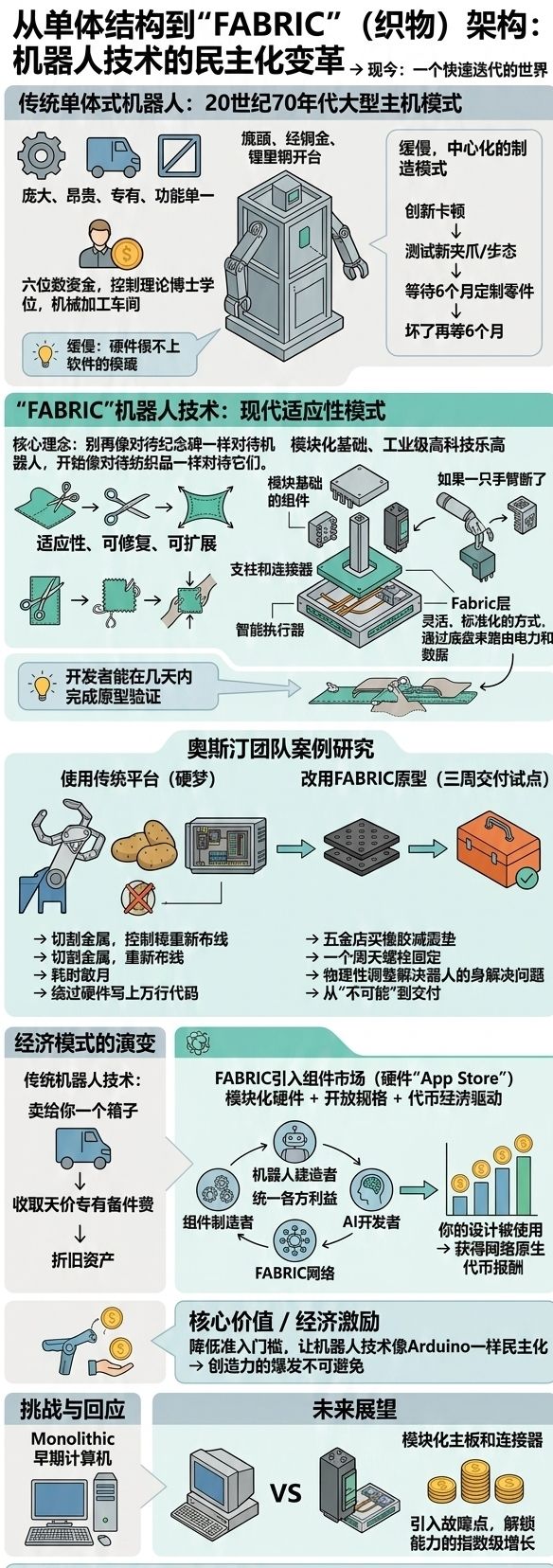
Last month, I spoke with a team in Austin. They were trying to create a robot to sort irregularly shaped produce—those oddly shaped potatoes always get stuck in their rigid traditional conveyor system.
With their original platform, solving the stalling problem required cutting metal and re-wiring the entire control box. It was a nightmare. They switched to a Fabric-based prototype. They literally ran to the hardware store to buy some rubber vibration pads and bolted them onto the modular frame over a weekend. They solved the stalling issue by physically adjusting the robot's body based on real problems instead of writing tens of thousands of lines of code to work around hardware limitations. They went from 'this is impossible' to delivering a pilot project in three weeks.
So how can this evolve into a movement, rather than just a product line? This is where the economic model becomes interesting. Traditional robotics sells you a box and then charges exorbitant fees for proprietary spare parts.
Fabric introduced a component marketplace. Because the hardware is modular and the specifications are open, a batch of manufacturers can produce compatible parts. You can think of it as the 'App Store' of hardware, but driven by a token economy.
If you design a better elbow joint, you can put it on the market. When others use your design, you will earn native tokens of the network. This aligns the interests of all parties: when more robots are produced, the platform benefits; when parts are used, the creator benefits; and builders benefit from having endless choices and competitive prices. It transforms robotics from capital expenditure into a dynamic, accessible ecosystem.
The insight here is that general artificial intelligence needs a general body. We are teaching the brain to think, but we are still putting them in iron lungs.
If we want robots that can clean our homes, build our houses, and grow our food, they cannot be these fragile, expensive 'divas'. They need to be robust, cheap, and repairable with tools you already have in your local garage. Fabric is the architecture prepared for that world.
Of course, criticism always exists: 'Modular things are weaker. They have more potential failure points. They can't withstand that much pressure.'
This is a significant engineering challenge. But look at the history of computers. The first computers were monolithic, hand-welded. They were more 'robust' in terms of vibration resistance but were of no use to innovation. Later, we moved to modular motherboards, plug-in cards, and standardized connectors. We introduced potential failure points, but we unlocked exponential growth in capabilities.
Fabric accepts a reality: robots will break. The goal is to ensure that when they do break, the repair cost is $5 and takes 5 minutes, rather than $5000 and 5 weeks.#ROBO
Next time you see a robot doing a backflip in a video, remember: that's a stunt. The real challenge is to create a robot that can pick up your trash can, drag it to the curb, and repeat the same task the next day when the trash can is in a different position and it's raining.
We are moving from the 'performance era' to the 'practical era'. And practical tools are not made of steel frameworks. They are woven into the 'fabric' of our daily lives.
Core Value / Economic Incentive
At its core, this shift changes the value proposition. You are no longer buying a depreciating asset (a robot). You are purchasing access to a network. The value lies in the community of parts creators and the AI that operates the body. By lowering the barriers to entry, Fabric aims to do for robotics what Arduino did for electronics—democratizing it until the explosion of creativity becomes inevitable.