STONfi: The completion of protection against impermanent losses is an important step for liquidity in TON (pair STON/USDT V2)
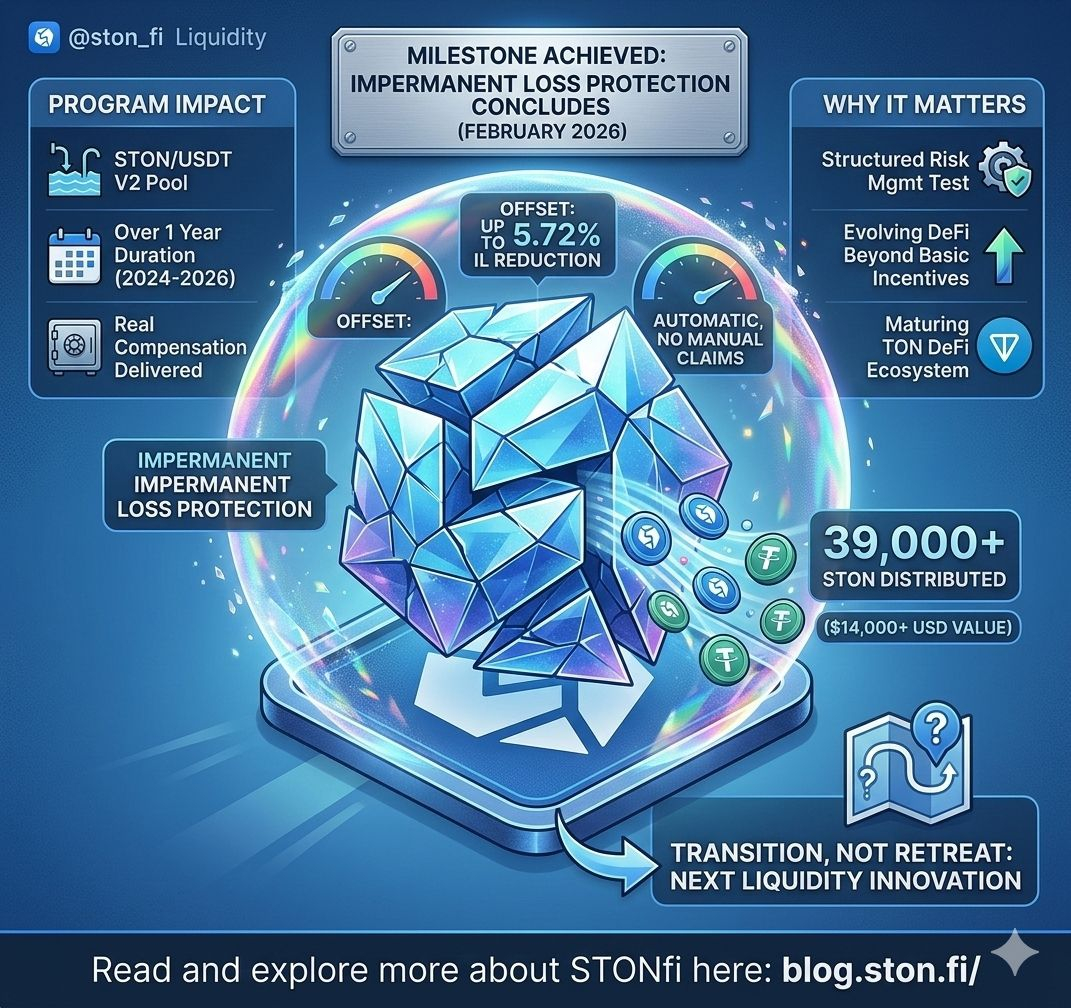
February 2026 marked the closure of the annual experiment on protecting liquidity providers from impermanent losses. The initiative was designed as a protocol mechanism to reduce systemic risk when working with automated market makers — not through manual claims or third-party insurance, but through built-in compensation within the pool itself.
The program's mechanics provided automatic coverage of impermanent losses up to 5.72%. The main idea is to lower the barrier to participation by eliminating bureaucracy and the need to file claims: compensations were calculated and distributed automatically during real market fluctuations.
The numbers confirm the practical value: since December 2024, participants in the pool have been paid more than 39,000 STON tokens worth over $14,000 in market conditions. This is not modeling — real payouts in the working network, providing developers and the community with empirical data on LP behavior and protection costs in different volatility modes.
Why this is important • Shift in incentives: protocol protection bets not only on rewards but also on capital sustainability, which reduces the required spread and can increase liquidity depth.
• Fewer frictions: automatic payouts are easier for a wider range of users to understand and accept compared to traditional insurance schemes.
• Live statistics: real results allow for a more accurate assessment of protection economics and the design of more effective mechanisms.
What to expect next The completion of the program is not a rollback, but a transition to new solutions. Likely directions for development: targeted or multi-level protection depending on time in the pool; use of capital-efficient hedges (reinsurance, synthetic); integration with concentrated or managed liquidity; inter-protocol primitives for risk diversification and reducing costs per LP.
Practical recommendations for participants • Verify payouts: if you participated in the pool, check the distributions and match them with the actual P&L.
• Review allocations: with the end of protection, it makes sense to assess whether to stay in the pool, move to other pools, or use managed strategies.
• Keep an eye on management: expect a post-mortem and suggestions for refining the mechanics — voting and roadmaps will provide insight into the next steps.
Conclusion The experiment showed that protocol solutions can practically mitigate key AMM liquidity risks while maintaining simplicity for the user. The closure of the program provides the community with valuable empirical data and a platform for developing more effective, finely-tuned, and capital-efficient LP protection methods. A detailed report and suggestions for the next stage will appear on the protocol's official blog.
Read and explore more about STONfi here: blog.ston.fi/