
Lately, I’ve been thinking a lot about the intersection of AI and crypto. Almost every week, a new project emerges claiming an “AI angle.” Some focus on smarter analytics, others on automated trading strategies, and many are developing AI agents that monitor blockchain activity in real time.
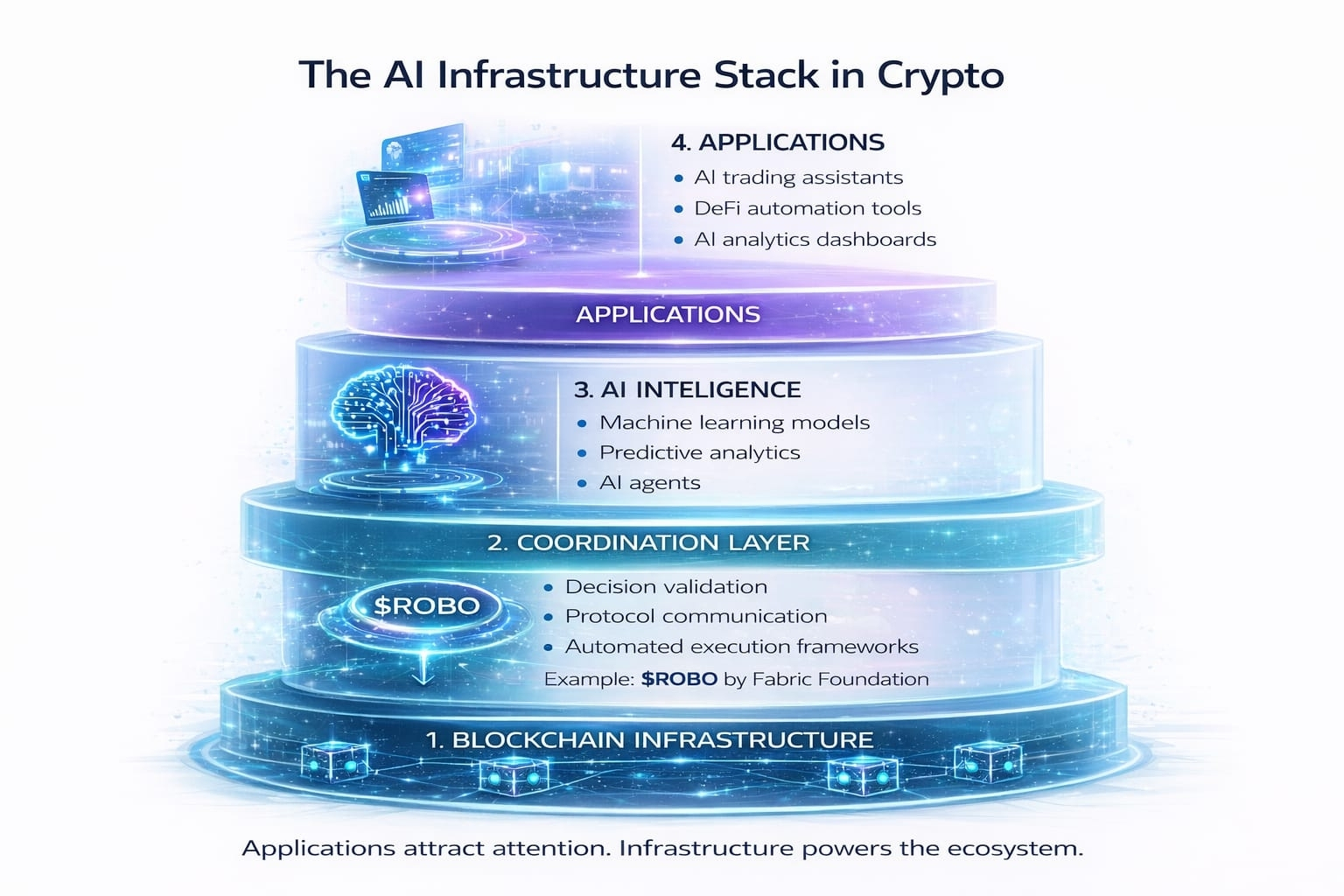
On the surface, it’s exciting. The idea that machines could analyze vast amounts of on-chain data and optimize decisions across DeFi feels like a natural evolution for the industry.
But the more I observe this space, the more I realize that something critical is often missing from the conversation.
Everyone talks about intelligence.
Very few focus on coordination.
In decentralized systems, analysis alone isn’t enough. Even the most accurate AI recommendation—whether reallocating liquidity, adjusting protocol parameters, or triggering rule changes—needs a structured, secure framework to execute effectively. Without that layer, automation could easily introduce chaos rather than efficiency.
This is what drew my attention to @Fabric Foundation and the concept behind $ROBO. Unlike most AI-related tokens that focus on visible, user-facing tools—dashboards, chat interfaces, trading assistants—their work seems centered on the often-overlooked backbone: coordination infrastructure.
From what I understand, #ROBO isn’t just another AI tool. It’s about creating frameworks that allow automated decisions to interact safely and effectively with blockchain networks. In other words, it’s about making sure AI-driven actions can actually work within decentralized systems, not just exist as recommendations.
This reminds me of patterns we’ve already seen in crypto. In the early days of DeFi, most attention was on yield farms and high-APY platforms. Applications captured the headlines, while the infrastructure layers—liquidity frameworks, layer-two scaling solutions, secure network architecture—quietly became indispensable.
AI in crypto might follow the same trajectory. Right now, the sector is experimental. Projects are testing AI agents, predictive analytics, and automation across protocols. The market rewards visible innovation. But infrastructure projects—coordination layers, security frameworks, integration tools—move more slowly. Their value emerges over time, through adoption, integration, and ecosystem growth.
If AI expands into areas like automated treasury management, dynamic liquidity allocation, or governance optimization, these coordination frameworks could become essential. Without them, decentralized ecosystems could quickly become too complex to manage safely.
Of course, adoption remains the biggest challenge. Even the most well-designed system can struggle if developers and protocols don’t integrate it. Competition is another factor—multiple teams will likely pursue similar coordination layers. The winners will need to demonstrate reliability, security, and practical utility. Tokenomics is also key; for $ROBO to sustain value, its role must be tied to actual network activity rather than theory.
Still, the broader idea is compelling. As AI systems grow more powerful, decentralized ecosystems will need ways to ensure automated decisions remain transparent, verifiable, and interoperable across protocols. Intelligence opens the door—but infrastructure ensures the door actually works.
That’s why Fabric Foundation’s approach is so interesting. It tackles a part of the AI conversation that doesn’t always make headlines but could become critical as blockchain ecosystems grow increasingly automated and interconnected.
Ultimately, the future of AI in crypto may not depend solely on how smart the algorithms become—it may depend even more on how effectively the infrastructure manages the interaction between AI and decentralized systems. And if that future unfolds as expected, coordination layers like $ROBO could prove far more important than most people realize today.